

Quick Summary
If your lights work but the engine won’t turn over, you likely have a “low-amperage” battery, a dead starter motor, or a security system glitch. Most people assume the battery is fine because the dash glows. They are wrong. It takes 100 times more power to start an engine than to turn on a lightbulb.
You turn the key. The dashboard glows. The radio plays your favorite station. But when you twist that key to “Start,” nothing happens. Maybe you hear a single click. Maybe a rapid-fire machine-gun sound. Or maybe just dead silence.
If your car won’t start but lights come on, the most common causes are a weak battery, a faulty starter motor, a bad ignition switch, or corroded connections. Start by checking battery voltage and terminals, then test the starter system. In many cases, the issue is insufficient power reaching the starter, not a completely dead battery.
I’ve been under enough hoods to know this is the most frustrating spot for a driver. It feels like the car is teasing you. It has enough juice to show you the time on the clock, but not enough to get you to work. I’m going to break down exactly why this happens and how to fix it without getting ripped off at the shop.
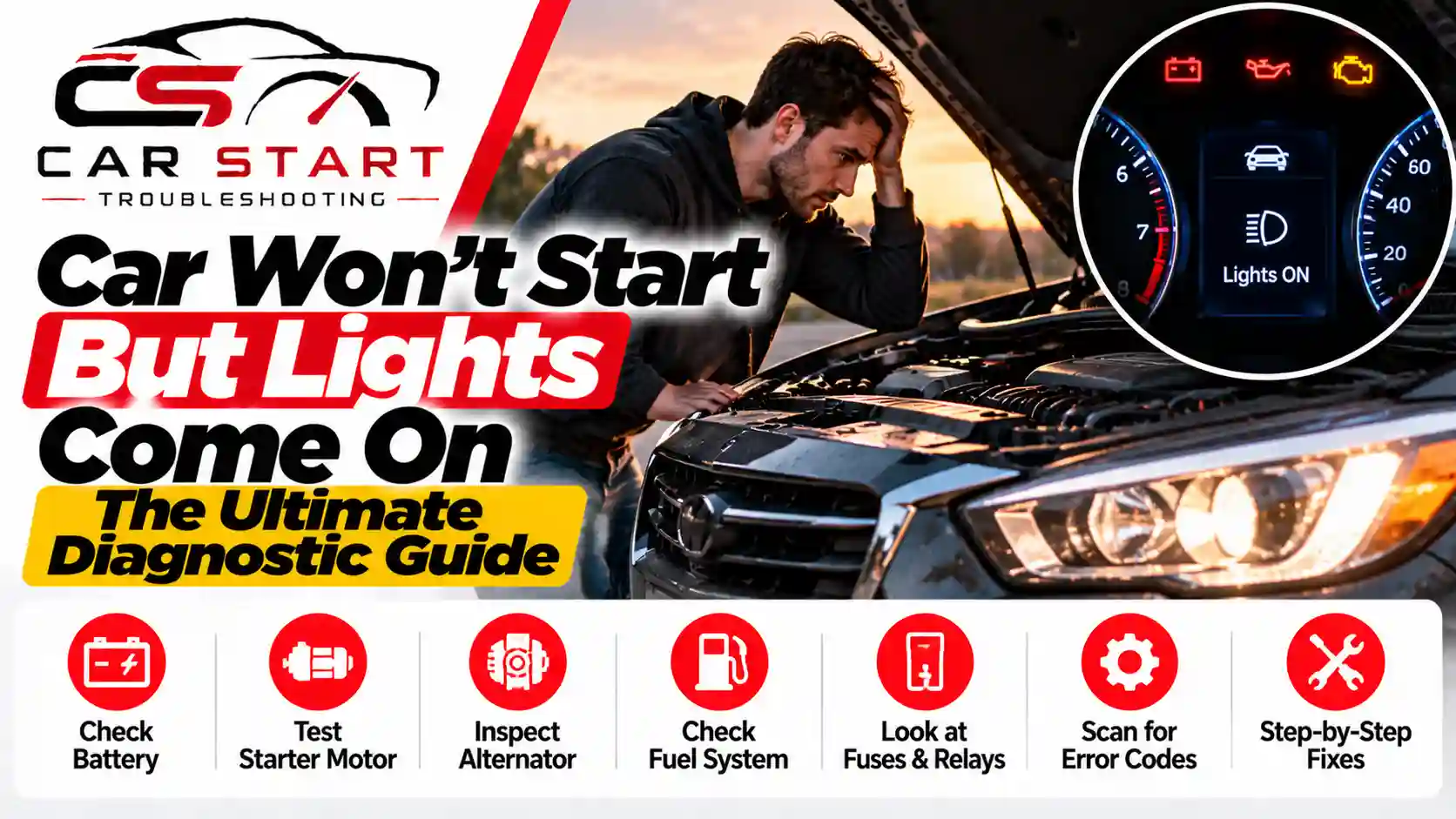
In this guide, you’ll learn exactly why your car won’t start but the lights come on, how to diagnose the real cause step-by-step, and what you can safely fix yourself. Whether you’re dealing with a clicking sound, complete silence, or intermittent starting issues, this article will walk you through practical solutions like an experienced mechanic would.
What the Problem Means
When your lights come on, but the engine doesn’t start, it tells us something important: your battery still has some power, but it may not be enough—or not reaching the right components.
Here’s how to interpret common symptoms:
- Lights work, no sound when turning key → Possible ignition switch or starter relay issue
- Lights work, clicking sound → Weak battery or bad starter motor
- Lights dim when trying to start → Battery cannot supply enough current
- No crank at all → Electrical interruption (starter circuit, neutral safety switch)
How the System Works (Simplified)
Your car’s starting system involves three main parts:
- Battery → Supplies electrical power
- Starter Motor → Turns the engine
- Ignition System → Sends the signal to start
Even if lights work, the starter motor needs far more power than lights or electronics. That’s why a weak battery can still power lights but fail to crank the engine.
Why This Happens (Root Causes Explained)
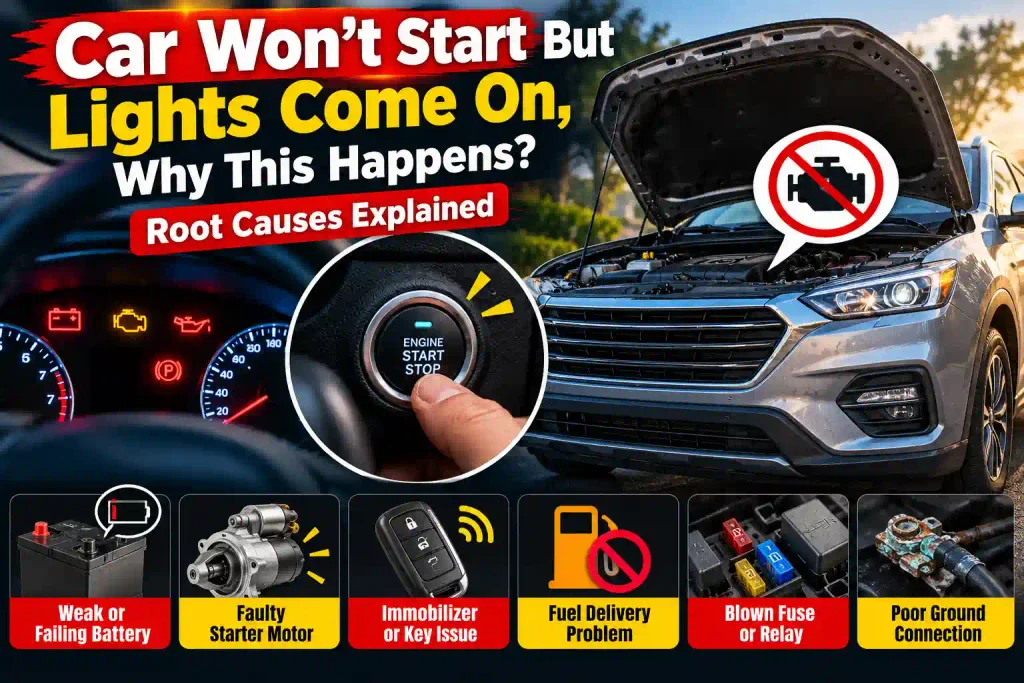
Let’s break down the real causes, not guesses, but actual mechanical and electrical failures.
1. Weak or Partially Dead Battery
A battery can still power lights at 10–11 volts but fail to start the engine, which requires closer to 12.6 volts and high current output.
Why it happens:
- Aging battery (3–5 years old)
- Cold weather reducing capacity
- Alternator not charging properly
Why Lights Don’t Mean Power? The Battery Myth
I see this every week. A driver tells me, “It can’t be the battery; the headlights are bright.”
Here is the cold truth: Your headlights need about 10 to 15 amps to run. Your starter motor needs between 150 and 350 amps to turn over a cold engine. A battery can be “surface charged” enough to run low-drain electronics while being totally useless for the heavy lifting of internal combustion.
Voltage vs. Amperage
Think of it like a garden hose. Voltage is the water pressure. Amperage is the volume of water. To run the lights, you only need a tiny trickle. To start the car, you need a fire hose. If your battery is old, the chemical plates inside can’t release enough volume (Amps) fast enough, even if the pressure (Volts) looks okay on a cheap tester.
| Battery Voltage | Charge State | Action Needed |
|---|---|---|
| 12.6V or higher | 100% | Battery is likely fine. |
| 12.4V | 75% | Needs a recharge soon. |
| 12.2V | 50% | Will struggle to start. |
| 12.0V or lower | 0% | Technically dead. |
Listening to the Starter Motor (The Click Test)
When you turn the key, listen closely. What you hear tells you exactly where the electricity is stopping.
The Rapid Machine-Gun Clicking
If you hear click-click-click-click, your battery is the culprit. The starter solenoid is trying to engage, but as soon as it draws power, the battery voltage drops too low to hold it. It snaps back, the voltage rises, it tries again, and the cycle repeats. Check your terminals for white, crusty stuff (corrosion).
The Single Loud Click
This usually means the battery is okay, and the power is reaching the starter, but the starter motor itself is jammed or burned out. I’ve seen the internal brushes wear down to nothing. Sometimes, the solenoid is stuck. Here is an old-school trick: have someone tap the starter motor with a hammer while you turn the key. If it starts, your starter is dying. Replace it immediately.
Total Silence
No click? No lights dimming? You might have a “handshake” problem. The car doesn’t know you’re trying to start it. This could be a neutral safety switch, a bad ignition switch, or a security system error.
The Silent Connection Killer (Corroded Terminals)
I’ve seen cars get towed to shops for $500 repairs that only needed a $2 wire brush. Look at your battery posts. Do you see blue, green, or white powder? That is lead sulfate or copper sulfate. It acts like an insulator.
It lets enough “trickle” through for your lights, but it blocks the massive surge needed for the starter. I always tell people to wiggle the cables. If they move, they aren’t tight enough. Take them off, clean them with baking soda and water, and tighten them until you can’t move them by hand.
The Alternator: The Root Cause
If you jump-start the car, it runs for five minutes, and then dies again, your battery isn’t the problem. Your alternator is. The alternator is a generator that recharges the battery while you drive. If the internal diodes or the voltage regulator fail, the car runs off the battery until it’s bone dry.
Look for these signs:
- Dimming headlights while idling.
- A battery warning light on the dash (it looks like a little red Lego brick).
- A burning rubber smell (the alternator belt might be slipping).
- Whining noises that change with engine speed.
Security Systems and Key Fob Glitches
Modern cars are rolling computers. If the “Immobilizer” doesn’t recognize your key, it will let you turn on the radio but won’t let the engine fire. This is common in brands like Honda, VW, and BMW.
Check your dashboard for a “Key” icon or a blinking red light. If your key fob battery is dead, the car might not see the transponder chip. Try holding the key fob directly against the Start button. Many cars have a hidden backup sensor right there for this exact reason. I saw a guy spend $200 on a tow just because his fob battery died. Don’t be that guy.
The Neutral Safety Switch
Automatic transmissions have a safety feature. The car won’t start unless it’s in Park or Neutral. If the sensor inside the shifter gets bumped or wears out, it thinks you’re in Drive.
The Fix: Try shifting into Neutral and then starting the car. If it fires up, your neutral safety switch is misaligned or failing. It’s a cheap part, but it can leave you stranded if you don’t know the trick.
Blown Fuses and Relays
Electricity travels through a path of least resistance. If a fuse pops, the path is broken. Look in your owner’s manual for the “Starter Relay” or “Ignition Fuse.”
I once spent three hours diagnosing a “dead” car only to find a 20-amp fuse had snapped. It cost ten cents to fix. Relays are like light switches controlled by the computer. You can often swap the “Starter Relay” with the “Horn Relay” (if they are the same part number) to test if the relay is dead. If the car starts but the horn doesn’t work, you found your problem.
Fuel Pump Failure
Sometimes the engine “cranks” (it goes *rur-rur-rur*) but won’t “catch.” This isn’t an electrical starting issue; it’s a delivery issue. You need air, fuel, and spark.
Turn your key to the “On” position without starting. Listen for a 2-second hum from the back of the car. That’s the fuel pump priming the lines. If you hear silence, your pump is likely dead. No fuel means no fire.
Ground Straps: The Hidden Culprit
Your car’s entire metal frame is used as the “negative” side of the electrical circuit. This is called the ground. A thick braided wire connects the engine to the chassis. If this wire rusts or snaps, the electricity has no way to get back to the battery.
I’ve seen cars where the lights work, but when the starter tries to pull power, it tries to find a ground through the throttle cable or shift linkage. This can actually melt parts of your car. If your battery and starter are good, check your ground straps.
Using a Multimeter Like a Pro
Don’t guess. Measure. A $20 multimeter from a hardware store is your best friend. Set it to DC Voltage (20V range).
- Static Test: Touch the probes to the battery terminals. You want 12.6V.
- Load Test: Have a friend try to start the car while you watch the meter. If the voltage drops below 10V, the battery is shot.
- Voltage Drop Test: Check the voltage between the battery positive and the starter motor terminal. If you see more than 0.5V while cranking, your wiring is bad.
Common Brand-Specific Issues
Not all cars fail the same way. Here is what I’ve noticed in the field:
Honda (Civic/Accord)
The “Main Relay” often fails. The solder joints crack. If the car won’t start on a hot day but starts fine when it’s cool, this is usually why.
Ford (F-150/Focus)
Check the “Fuel Pump Driver Module.” It’s located under the car near the spare tire. It’s made of aluminum and bolts to a steel frame. It corrodes and snaps in half, cutting off fuel.
Toyota (Camry/Corolla)
Starter solenoid contacts. Toyota starters are legendary, but the copper contacts inside the solenoid wear thin. You can actually buy a $10 rebuild kit instead of a $200 starter.
What to Do If You’re Stranded Right Now
If you’re reading this in a parking lot, follow this checklist:
- Step 1: Check your dash. Is the “P” for Park lit up? If not, jiggle the shifter.
- Step 2: Open the hood and wiggle the battery cables. If they move, tighten them.
- Step 3: Try to jump-start the car. If it starts, it’s the battery or alternator.
- Step 4: Tap the starter with a lug wrench or shoe. (Only if you can see it safely).
- Step 5: Try your spare key. The transponder in your main key might be dead.
Repair Cost Estimates
Don’t get fleeced. Here is what you should expect to pay for parts (not including labor):
| Component | Estimated Part Cost | Difficulty (1-10) |
|---|---|---|
| New Battery | $120 – $220 | 2 |
| Starter Motor | $150 – $350 | 6 |
| Alternator | $200 – $500 | 5 |
| Ignition Switch | $50 – $150 | 7 |
| Fuel Pump | $100 – $400 | 8 |
When to Call a Professional
If you’ve checked the battery, cleaned the terminals, and tried a jump-start with no luck, you might have a PCM (Powertrain Control Module) failure or a broken timing belt. These aren’t parking lot fixes. If the engine makes a fast, high-pitched whirring sound when you try to start it, your timing belt might have snapped. Stop trying to start it immediately, or you’ll destroy the valves.
Final Thoughts
A car that won’t start but has lights is usually a sign of a “bottleneck.” The power is there, but it can’t get through the narrow straw of a bad connection or a weak battery cell. Start with the simplest fix: clean your battery terminals. 90% of the time, that’s the culprit. Don’t let a mechanic talk you into a new engine when you just needed a $15 battery terminal cleaner.
Stay safe out there. Keep a set of jumper cables and a basic 10mm wrench in your trunk. It’ll save you a fortune.
Treat early warning signs seriously, and you’ll save yourself time, money, and frustration.

Leave a Reply