

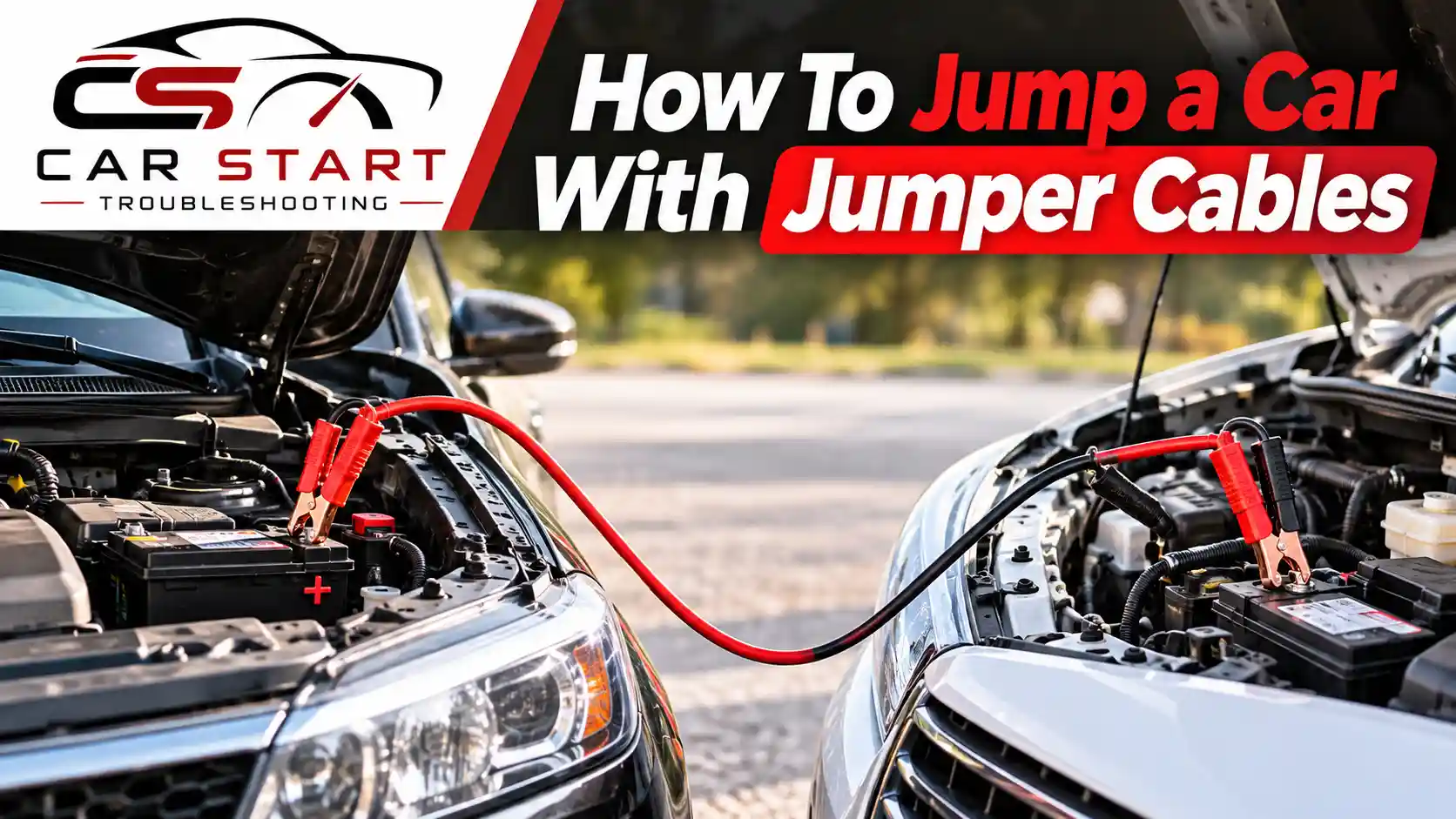
When you need to know how to jump a car with jumper cables? You turn the key. You hear a fast clicking sound. Or maybe you hear nothing at all. Your dash lights flicker and die. You have a dead battery. It happens to everyone. Usually, it happens when you are late for work or standing in a cold rainstorm.
To jump a car with jumper cables, connect red to positive terminals on both batteries, then black to the donor battery’s negative and a grounded metal surface on the dead car. Start the donor vehicle, wait a few minutes, then start the dead car. Remove cables in reverse order.
I have spent twenty years under hoods. I have seen people melt their wiring harnesses by doing this wrong. I have seen batteries pop like firecrackers because of a single spark. Jumping a car seems simple, but modern cars are packed with computers. One wrong move can cost you a $2,000 Engine Control Unit (ECU). This guide tells you how to do it right, why batteries die, and how to tell if your car is actually fixable on the spot.
Key Takeaways
- Safety First: Always connect the negative cable to a bare metal ground, not the dead battery’s negative terminal. This prevents sparks near hydrogen gas.
- Cable Quality Matters: Use 4-gauge or 2-gauge copper cables. Thin 10-gauge cables often fail to carry enough current for trucks or SUVs.
- The Order: Red to Dead, Red to Good, Black to Good, Black to Metal.
- Modern Risks: Jumping a car with sensitive ECUs (computers) requires care to avoid voltage spikes.
- Beyond the Jump: If a car won’t start after a jump, the issue is likely the starter motor or a bad alternator.
What the Problem Means
When your car won’t start and requires a jump, it typically points to a battery-related issue, not necessarily a major mechanical failure.
Common Symptoms Before a Jump Start
| Symptom | What It Means |
|---|---|
| Clicking sound when turning key | Battery too weak to power starter |
| Slow engine crank | Low battery voltage |
| No lights or dashboard activity | Fully discharged battery |
| Lights dim when starting | Insufficient current supply |
How the Starting System Works
Your car’s electrical system depends on the battery to deliver a high burst of current to the starter motor, which turns the engine over. Once the engine starts, the alternator takes over, generating electricity and recharging the battery.
When the battery voltage drops below about 12 volts, it can no longer supply enough current to the starter. That’s where jumper cables come in. They temporarily transfer power from a working battery to the dead one.
Why Your Cheap Cables Are Failing You (Step-By-Step Guide)
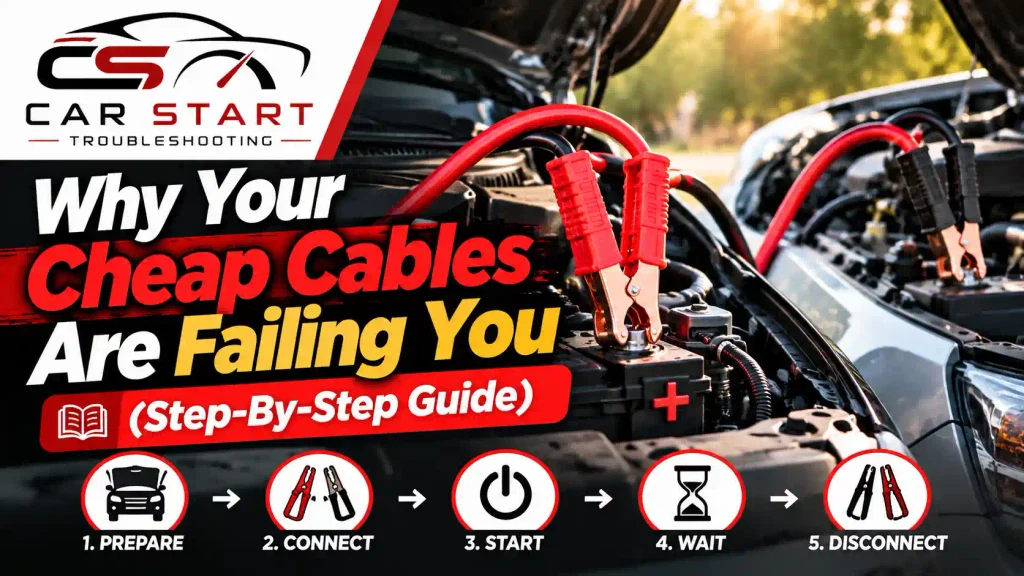
Most people buy the cheapest set of jumper cables at the gas station. That is a mistake. Those cables are usually 10-gauge or 12-gauge. The “gauge” refers to the thickness of the wire. In the world of wire, a higher number means a thinner wire. Thin wire has high resistance. High resistance creates heat and stops electricity from flowing.
If you try to jump a Ford F-150 with 12-gauge cables, the cables will get hot, but the truck won’t start. You need 4-gauge or 2-gauge cables. Look for “Pure Copper” instead of “Copper Clad Aluminum” (CCA). Pure copper carries juice better. Also, look for clamps with strong springs. If the teeth don’t bite into the battery terminal, you won’t get a good connection.
| Cable Gauge | Best Use Case | Reliability |
|---|---|---|
| 2-Gauge | Heavy Duty Trucks, Diesel Engines | Excellent |
| 4-Gauge | Standard SUVs, V6 Engines | Very Good |
| 6-Gauge | Small Sedans, 4-Cylinder Cars | Fair |
| 10-Gauge | Emergency Only (Often Fails) | Poor |
Step 1: The Setup and Safety Check
Before you even touch the cables, look at the dead battery. Is it leaking fluid? Is the plastic case bulging or cracked? If yes, stop. Do not jump it. A bulging battery is a sign of a frozen battery or an internal short. Trying to jump a frozen battery can cause it to explode.
Check the terminals. If they are covered in white or green crust, that is lead sulfate or copper sulfate corrosion. This crust acts like an insulator. It blocks the electricity. You might not even need a jump; you might just need to clean the terminals with a wire brush and some baking soda mixed with water.
I always keep a small wire brush in my glovebox. I have “fixed” dozens of dead cars just by scrubbing the battery posts until they shine. If the metal isn’t touching metal, the juice can’t flow.
Park the “good” car near the “dead” car. Make sure they do not touch. If the cars touch, it can create a ground loop that fries the electronics. Turn off both engines. Set the parking brakes. Turn off all lights, heaters, and radio. You want every bit of power to go to the starter motor.
Step 2: The Connection Sequence (The “Red to Dead” Rule)
The order you connect the cables matters. If you do it wrong, you risk a short circuit. Follow this exact order:
- Red to Dead: Connect the first red (positive) clamp to the positive terminal of the dead battery. The positive terminal is usually larger and has a “+” sign or a red cover.
- Red to Good: Connect the other end of the red cable to the positive terminal of the good battery.
- Black to Good: Connect the first black (negative) clamp to the negative terminal of the good battery.
- Black to Metal: Connect the last black clamp to a piece of unpainted metal on the engine block of the dead car. Look for a big bolt or a metal bracket. Do not connect it to the negative terminal of the dead battery.
Why Not Connect to the Negative Terminal?
Lead-acid batteries give off hydrogen gas when they discharge or charge. This gas is very flammable. When you connect the final clamp, a small spark usually happens. If that spark happens right at the battery post, it can ignite the gas. By grounding the cable to the engine block away from the battery, you keep the spark away from the gas.
Step 3: The Jump Start Process
Start the engine of the good car. Let it run for about five minutes. Do not try to start the dead car immediately. You want the good car’s alternator to pump some surface charge into the dead battery. If the dead battery is totally flat, it will act like a “sponge” and soak up all the initial power, leaving nothing for the starter.
After five minutes, try to start the dead car. If it cranks slowly and doesn’t start, wait another five minutes. You can slightly rev the engine of the good car to around 2,000 RPM. This makes the alternator spin faster and put out more amperage.
Once the dead car starts, do not turn it off! If you turn it off, you will likely need another jump. The alternator needs time to recharge the battery.
Step 4: Removing the Cables
Remove the cables in the exact reverse order. Do not let the clamps touch each other while they are still connected to one of the cars.
- Remove the black clamp from the engine block of the jumped car.
- Remove the black clamp from the good battery.
- Remove the red clamp from the good battery.
- Remove the red clamp from the jumped car.
Keep the jumped car running for at least 30 minutes. Drive it on the highway if you can. Idling in a driveway doesn’t always spin the alternator fast enough to give a deep charge. If the battery is more than three years old, drive straight to a parts store and get it tested.
What If It Won’t Start? Troubleshooting the “No-Go”
If you followed the steps and the car still won’t start, the battery might not be the only problem. Here is how to diagnose the cause:
1. The Rapid Clicking Sound
If you hear a fast “click-click-click,” it means the starter solenoid is engaging, but there isn’t enough amperage to turn the motor. This usually means your jumper cables are too thin or your connection is poor. Wiggle the clamps to bite deeper into the metal and try again.
2. One Single Loud Click
A single loud thud or click often means the starter motor itself is stuck or dead. Sometimes, you can hit the starter with a wrench or a hammer while someone turns the key. This can jar the internal brushes back into contact. It is a temporary fix to get you home.
3. No Sound at All
If the dash lights are bright but there is no sound when you turn the key, check your transmission. Is it in “Park”? Modern cars won’t start if the neutral safety switch thinks the car is in gear. Also, check for a blown “Starter” fuse in the engine bay fuse box.
4. The Car Dies When You Remove the Cables
This is a classic sign of a failed alternator. Once the car is running, the alternator should provide all the electricity for the spark plugs and computers. If the engine dies the moment you unhook the good car, your alternator isn’t doing its job. You will need a tow.
Modern Car Risks: ECUs and Hybrids
In the old days, cars were simple. Today, they are rolling computers. A voltage surge during a jump start can “fry” a module. Some high-end German cars (BMW, Mercedes) have specific “Jump Start Posts” under the hood because the battery is hidden in the trunk or under a seat. Always use these posts. They are designed to handle the surge.
Jumping a Hybrid or EV
Can you jump a Tesla or a Prius? Yes, but only the 12-volt battery. Hybrids have two systems: a big high-voltage battery for driving and a small 12-volt battery for the lights and computers. If the 12-volt battery dies, the car won’t “boot up.” You can jump the 12-volt battery just like a normal car. However, never try to jump another car using a hybrid as the donor. The 12-volt systems in hybrids are often weak and not designed to handle the massive amp draw of a starter motor. You could blow a very expensive DC-DC converter.
The Science of Battery Failure: Why Did It Die?
Batteries don’t just “run out” of electricity like a gas tank. They are chemical reactors. Inside are lead plates and sulfuric acid. When the battery discharges, lead sulfate builds up on the plates. When you charge it, that sulfate turns back into acid.
If a battery sits dead for too long, the sulfate hardens. This is called “sulfation.” Once it hardens, you can’t turn it back into acid. The battery loses its capacity. This is why a battery that has been dead for a week is often ruined, even if you jump it.
Cold Weather vs. Heat
Heat kills batteries; cold just shows you they are dead. Heat causes the liquid inside to evaporate and speeds up internal corrosion. When winter hits, the oil in your engine gets thick like molasses. The battery has to work twice as hard to turn the engine, but the cold slows down the chemical reaction inside the battery. That is why most batteries fail on the first freezing morning of the year.
Preventing the Next Jump Start
If you don’t want to be stranded again, do these three things:
Check the Age: Look at the sticker on the battery. If it is more than 4 years old, replace it. Don’t wait for it to fail.
Use a Multimeter: A $20 tool can save you hundreds. With the engine off, a healthy battery should read 12.6 volts. With the engine running, it should read between 13.7 and 14.7 volts. If it’s lower while running, your alternator is weak.
Clean the Terminals: Every time you change your oil, look at the battery. If you see white fuzz, clean it off. Apply a dab of dielectric grease to the posts to stop future corrosion.
Common Questions About Jumping Cars
Q: Can I jump a car in the rain?
A: Yes. While water conducts electricity, the 12 volts in a car battery isn’t enough to shock you through your skin. Just make sure you don’t let the red and black clamps touch each other, and try to keep the battery terminals as dry as possible to ensure a good connection.
Q: Can I jump a diesel truck with a small car?
A: It is difficult. Diesel engines have much higher compression and require two batteries or a very high Cold Cranking Amp (CCA) rating. A small Honda Civic might not be able to provide enough juice to turn over a Ford PowerStroke diesel. If you try, let the Civic run for at least 15 minutes while connected to the truck before trying to start it.
Q: Why does my battery keep dying overnight?
A: You likely have a “parasitic draw.” This means something is staying on when the car is off like a trunk light, a glovebox light, or a failing computer module. You can test this with a multimeter by checking the amp draw at the negative terminal while the car is asleep.
Q: Is a portable jump pack better than cables?
A: Yes. Modern Lithium-ion jump packs are safer because they have built-in spark protection and reverse polarity sensors. They also don’t require a second car. However, they must be kept charged. If you leave one in your trunk for a year without checking it, it might be dead when you need it.
Summary of Technical Terms Used
- CCA (Cold Cranking Amps): The measure of how much power a battery can put out for 30 seconds at 0 degrees Fahrenheit.
- Alternator: The belt-driven generator that charges the battery while you drive.
- Solenoid: An electromagnetic switch that engages the starter motor.
- Voltage Drop: The loss of electrical pressure caused by long or thin wires.
- Ground: The return path for electricity, usually the metal frame or engine of the car.
I have seen people get lucky using bad techniques, but luck runs out. Use the right cables. Follow the “Red to Dead” sequence. Ground to the engine block. If you do these things, you will get back on the road without blowing up your battery or your budget.

Leave a Reply