


Introduction
You walk out to your car after a week of not driving it, turn the key or press the start button… and nothing happens. Maybe you hear a weak click, maybe the engine struggles, or maybe it’s completely silent. This situation is incredibly common and frustrating, especially when you need the car urgently.
If your car won’t start after sitting for a week, the most likely cause is a weak or drained battery. Start by checking battery voltage, jump-starting the car, and inspecting terminals. If that doesn’t work, check fuel delivery, starter operation, and possible electrical drain.
The good news is that in most cases, this problem is not serious or expensive. Cars are designed to sit for short periods, but even a week can expose small weaknesses in the battery, electrical system, or fuel delivery. Understanding what’s happening behind the scenes can help you fix the issue quickly and prevent it from happening again.
In this guide, you’ll learn exactly why your car won’t start after sitting, how to diagnose the problem step-by-step, and what you can safely fix yourself versus when it’s time to call a mechanic.
Why Lights Don’t Mean Power
I see this every week. A driver tells me, “It can’t be the battery; the headlights are bright.”
Here is the cold truth: Your headlights need about 10 to 15 amps to run. Your starter motor needs between 150 and 350 amps to turn over a cold engine. A battery can be “surface charged” enough to run low-drain electronics while being totally useless for the heavy lifting of internal combustion.
Voltage vs. Amperage
Think of it like a garden hose. Voltage is the water pressure. Amperage is the volume of water. To run the lights, you only need a tiny trickle. To start the car, you need a fire hose. If your battery is old, the chemical plates inside can’t release enough volume (Amps) fast enough, even if the pressure (Volts) looks okay on a cheap tester.
| Battery Voltage | Charge State | Action Needed |
|---|---|---|
| 12.6V or higher | 100% | Battery is likely fine. |
| 12.4V | 75% | Needs a recharge soon. |
| 12.2V | 50% | Will struggle to start. |
| 12.0V or lower | 0% | Technically dead. |
What the Problem Means
When a car fails to start after sitting, the symptoms tell you a lot about what’s wrong. Pay close attention to what happens when you try to start it.
Common Symptoms and What They Indicate
| Symptom | Likely Issue |
|---|---|
| Clicking sound only | Weak battery or bad starter |
| Slow engine crank | Low battery charge |
| No sound at all | Dead battery or electrical failure |
| Engine cranks but won’t start | Fuel or ignition issue |
| Dashboard lights flicker | Poor battery connection |
How the Starting System Works (Simple Explanation)
Your car’s starting system relies on three main components:
- Battery: Provides electrical power.
- Starter motor: Turns the engine over.
- Fuel + ignition system: Allows combustion to begin.
If any one of these fails, the car won’t start. When a car sits unused, the battery is usually the first weak link.
Why This Happens
Let’s break down the real causes, not guesses.
1. Battery Self-Discharge
Even when unused, a car battery slowly loses charge. This is called self-discharge. Modern cars also have systems that continuously draw small amounts of power, such as:
- Clock
- Security system
- ECU (engine computer)
- Keyless entry modules
Over a week, a healthy battery should handle this. But if the battery is old or weak, it may drop below the required voltage (around 12.4V).
2. Parasitic Drain
Sometimes, something in the car continues drawing power abnormally. Common culprits:
- Interior lights left on
- Faulty relay
- Aftermarket electronics (dash cams, alarms)
This can drain a battery in just a few days.
3. Corroded Battery Terminals
Corrosion creates resistance, reducing the current flow needed to start the engine. Even a slightly dirty terminal can prevent proper starting.
4. Fuel System Pressure Loss
Fuel systems maintain pressure to ensure quick starts. After sitting, pressure can drop if:
- Fuel pump check valve is weak
- Fuel injectors leak slightly
This leads to longer cranking or no start.
5. Starter Motor Wear
A worn starter may struggle after sitting, especially in colder conditions or when battery voltage is slightly low.
How to Fix a Car Starting System (Step-by-Step Troubleshooting Guide)
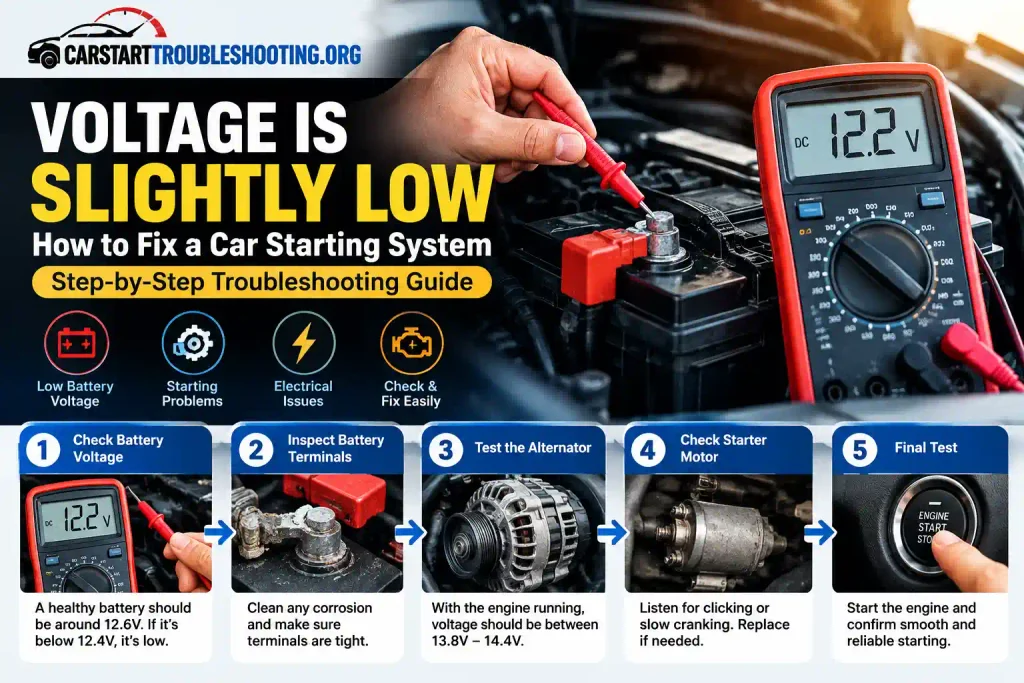
Follow this sequence from easiest to more advanced checks.
Tools You May Need
- Multimeter (for battery testing)
- Jumper cables or jump starter
- Wrench (for battery terminals)
- Safety gloves
Safety First
- Always turn off the ignition before working
- Avoid sparks near the battery
- Wear gloves and eye protection
Step 1: Check Battery Voltage
- Use a multimeter
- Healthy battery: 12.6V
- Weak battery: below 12.4V
If it’s below 12V, it’s likely discharged.
Step 2: Try a Jump Start
- Connect jumper cables properly:
- Red to positive (+)
- Black to negative (–)
- Start the donor car
- Wait 2–3 minutes
- Try starting your car
If it starts: the battery is weak or drained
If it doesn’t: move to the next step
Step 3: Inspect Battery Terminals
Look for:
- White or green corrosion
- Loose connections
Clean using:
- Baking soda + water solution
- Wire brush
Tighten connections securely.
Step 4: Listen for Starter Activity
Turn the key and observe:
- Click only → starter relay or battery issue
- No sound → electrical issue or dead battery
- Grinding → worn starter
Step 5: Check Fuel Delivery
If engine cranks but doesn’t start:
- Turn key to “ON” position
- Listen for fuel pump humming (2–3 seconds)
No sound may indicate:
- Faulty fuel pump
- Blown fuse
Step 6: Try a Second Start Cycle
Sometimes fuel pressure needs rebuilding:
- Turn key ON (don’t start)
- Wait 5 seconds
- Turn off
- Repeat 2–3 times
Then try starting.
Step 7: Scan for Warning Lights
If you have an OBD scanner, check for error codes related to:
- Crankshaft sensor
- Fuel system
- Ignition system
Real-World Diagnosis Scenarios
Scenario 1: The Weak Battery Case
A driver leaves their car parked for 6 days. When they return, the engine cranks slowly and clicks.
Diagnosis:
- Battery reads 11.8V
- Jump-start works immediately
Cause:
- Aging battery (over 3 years old)
Fix:
- Replace battery
Scenario 2: The Hidden Drain
Another driver experiences repeated dead battery after 5–7 days.
Diagnosis:
- Battery tests good
- Parasitic draw measured at 300mA (too high)
Cause:
- Faulty aftermarket alarm system
Fix:
- Remove or repair the system
DIY Fix vs Mechanic
When You Can Fix It Yourself
- Jump-starting
- Cleaning terminals
- Replacing battery
- Checking fuses
When to See a Mechanic
- Electrical drain diagnosis
- Starter motor replacement
- Fuel pump issues
- ECU-related problems
If the issue repeats, professional diagnosis is important.
Cost Estimate
Here’s what you can expect:
| Repair | Cost Range |
|---|---|
| Battery replacement | $80 – $200 |
| Terminal cleaning | $10 – $30 |
| Starter motor replacement | $200 – $600 |
| Fuel pump repair | $300 – $900 |
| Electrical diagnosis | $50 – $150 |
Costs vary depending on vehicle type and region.
Common Brand-Specific Issues
Not all cars fail the same way. Here is what I’ve noticed in the field:
Honda (Civic/Accord)
The “Main Relay” often fails. The solder joints crack. If the car won’t start on a hot day but starts fine when it’s cool, this is usually why.
Ford (F-150/Focus)
Check the “Fuel Pump Driver Module.” It’s located under the car near the spare tire. It’s made of aluminum and bolts to a steel frame. It corrodes and snaps in half, cutting off fuel.
Toyota (Camry/Corolla)
Starter solenoid contacts. Toyota starters are legendary, but the copper contacts inside the solenoid wear thin. You can actually buy a $10 rebuild kit instead of a $200 starter.
What to Do If You’re Stranded Right Now
If you’re reading this in a parking lot, follow this checklist:
- Step 1: Check your dash. Is the “P” for Park lit up? If not, jiggle the shifter.
- Step 2: Open the hood and wiggle the battery cables. If they move, tighten them.
- Step 3: Try to jump-start the car. If it starts, it’s the battery or alternator.
- Step 4: Tap the starter with a lug wrench or shoe. (Only if you can see it safely).
- Step 5: Try your spare key. The transponder in your main key might be dead.
Risks of Ignoring the Problem
Ignoring a car that struggles to start can lead to:
- Complete battery failure
- Being stranded unexpectedly
- Damage to starter motor
- Increased repair costs over time
It’s always cheaper to fix early signs.
Who Should Care / Common Situations
This issue is especially common if:
- You work from home and rarely drive
- You own a second vehicle
- You travel frequently
- Your car is older (3+ years battery age)
Even new cars can experience this due to electronic systems.
Prevention Tips (Very Important)
1. Drive the Car Regularly
At least once every 3–4 days for 15–20 minutes to recharge the battery.
2. Use a Battery Maintainer
A trickle charger keeps the battery at optimal charge when parked.
3. Turn Off All Electronics
Double-check:
- Interior lights
- Headlights
- Charging ports
4. Replace Old Batteries Early
Typical lifespan: 3–5 years
5. Keep Terminals Clean
Inspect every few months to prevent corrosion buildup.
FAQ
Why does my car battery die after just one week?
Most likely due to a weak battery or parasitic drain. A healthy battery should last several weeks without use.
Can cold weather cause this problem?
Yes. Cold temperatures reduce battery capacity and make it harder to start the engine.
How long should I run my car to recharge the battery?
At least 15–30 minutes of driving, not idling, to properly recharge.
Is jump-starting bad for the car?
No, when done correctly. Improper connections, however, can damage electronics.
Can a bad alternator cause this?
Yes, but usually you’ll notice issues while driving, not just after sitting.
Conclusion: Car Won’t Start After Sitting For a Week
A car that won’t start after sitting for a week is usually not a mystery once you understand the system. In most cases, the issue comes down to battery health, minor electrical drains, or simple maintenance problems like corrosion.
By following a structured car troubleshooting approach, you can identify the problem quickly and avoid unnecessary repairs. More importantly, adopting a few preventive habits can ensure your car starts reliably every time, even after sitting unused.

Leave a Reply