
Table of Contents (11 Sections)
If your car clicks rapidly and won’t start, the battery or its connections are failing under load. That fast clicking is the starter solenoid grabbing, losing voltage, letting go, and grabbing again, many times a second. The battery can work the solenoid. It cannot spin the starter. Do not buy a starter yet. Run the five checks below in order: headlights, clamp twist, resting voltage, cranking voltage, then a jump. Each takes about a minute, and the first one that fails names the fault.
What rapid clicking actually is
The click comes from the starter solenoid, a heavy switch. When you turn the key, a small signal current fires an electromagnet inside it. A plunger snaps forward, pushes the starter gear into the flywheel, and slams two thick copper contacts together, connecting the battery cable straight to the starter motor.
That snap is one click. A machine-gun rattle is not.
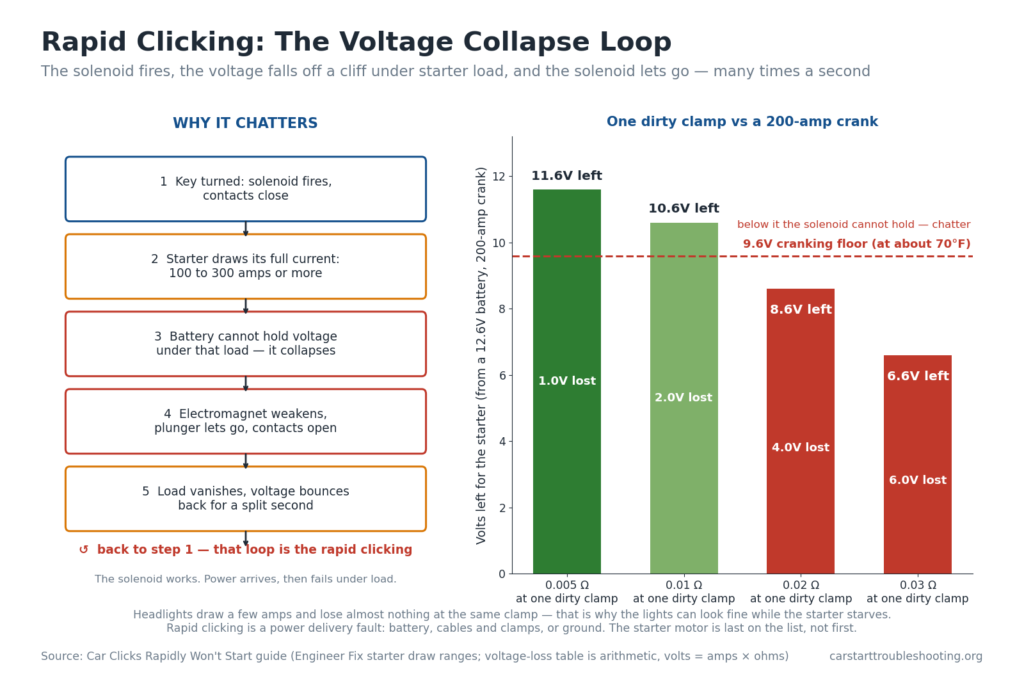
Here is the failure, step by step. The solenoid fires and the contacts close. The starter motor tries to draw its full current, 100 to 300 amps or more depending on the engine. The battery cannot hold its voltage up under that load, so the voltage falls off a cliff. The electromagnet holding the plunger in place weakens with it. The plunger lets go. The contacts open. The load vanishes, so the voltage bounces back up for a split second. The solenoid fires again. Contacts close. Voltage collapses. Let go. Fire. Collapse. That loop is the rapid clicking you hear.
That loop tells you where the fault lives. The solenoid works. The switch works. The key signal works. Power arrives at the starter and then fails under load. Rapid clicking is a power delivery fault, and power delivery has only three suspects: the battery itself, the cables and clamps between the battery and the starter, and the ground path back. The starter motor is last on the list, not first.
This is where most drivers go wrong: they shop for a starter. A starter runs $565 to $796 fitted at a shop. Cleaning two clamps runs nothing. Test the power side first.
The maths page 1 skips: how a dirty clamp eats your start
Every guide on this symptom says “check for corrosion.” Almost none of them show what corrosion costs you in volts. The numbers are brutal.
Engineer Fix puts starter draw at 100 to 200 amps for a warm four-cylinder engine, 150 to 250 amps for a six-cylinder, over 300 amps for a large V8, and 400 amps or more for a diesel. Cold oil thickens and raises the load again: a starter that pulls 150 amps on a warm day can pull 300 amps on a cold morning.
Voltage lost across a connection equals current multiplied by resistance. Run that against one dirty clamp at a 200-amp crank:
| Resistance at one dirty clamp | Volts lost at 200 amps | Volts left for the starter from a 12.6V battery |
|---|---|---|
| 0.005 ohms | 1.0V | 11.6V |
| 0.01 ohms | 2.0V | 10.6V |
| 0.02 ohms | 4.0V | 8.6V |
| 0.03 ohms | 6.0V | 6.6V |
Look at the third row. Two hundredths of an ohm. You cannot feel that with your fingers. At starter current it eats 4 volts and leaves the starter with 8.6V. A healthy battery should hold above 9.6V while cranking. So a clamp that looks “a bit crusty” can single-handedly push a good battery under the floor and set the solenoid chattering.
The same maths explains why the lights still work. Headlights draw a few amps, and a few amps across 0.02 ohms loses almost nothing. The starter asks for two hundred amps and gets robbed at the same clamp. Bright lights and rapid clicking come from the same fault, seen at two different loads.
So the rule for this symptom: a battery is only as good as its worst connection. Test the connection before the battery, and the battery before the starter.
The 5-minute test
You need a multimeter, a helper to turn the key, and five minutes of hands-on time. One honest note: check 3 reads resting voltage, and a true resting reading needs the surface charge from recent driving gone. That wait is the slow part. Run checks 1 and 2 while the battery settles.
Safety first. Park or neutral, parking brake on. Eye protection on. Rings and watches off. Keep sparks and flames away: batteries produce hydrogen gas. Never lay a tool across both terminals.
Check 1, minute one: watch the lights while you crank. Turn the headlights on. Your helper turns the key to start and holds it for two or three seconds. Watch the headlights and the dashboard. If the lights dim hard, flicker, or die in time with the clicking, voltage is collapsing under load: battery, clamps, cables or ground. If the lights stay bright while the clicking rattles on, the battery is holding up better than the sound suggests, and you should suspect resistance in the cables rather than the battery itself. Move on.
Check 2, minute two: the twist test. Open the hood. Try to rotate each battery clamp by hand. A clamp that moves is too loose, full stop. No meter needed. Then look at the posts. White, gray, blue or green powder is corrosion, and corrosion is resistance. A loose or crusty clamp is a failed check: clean the posts and the inside of the clamps back to bright metal, refit them tight, and try the key again. Our battery terminal corrosion guide covers the cleaning method in full. A clamp you can twist also explains the maddening version of this fault, where the car clicks on Tuesday and starts on Wednesday after you slammed the hood.
Check 3, minute three: resting voltage. Set the multimeter to DC volts, 20V range. Red probe on the positive post, black probe on the negative post. If the car was driven or charged in the last few hours, strip the surface charge first: headlights on for 2 minutes with the engine off, headlights off, wait 5 to 10 minutes, then read. Battery University is blunt about this: an accurate reading needs at least four hours of rest, and makers recommend 24 hours for lead acid. Treat a quick reading as a ceiling, not a verdict. Under 12.4V means charge first, because every later check assumes a charged battery.
Check 4, minute four: cranking voltage. Keep the meter on the posts. Your helper cranks the engine for 5 to 10 seconds while you watch the lowest number the meter shows. At about 70°F, a good battery holds above 9.6V during cranking. A reading of 9.0V to 9.6V signals a weak battery. Under 9.0V on a fully charged battery means the battery needs replacing. Two warnings. First, this check only means something on a charged battery: if check 3 came back under 12.4V, charge first or all you have proved is that the battery was flat. Second, cold weather drags the number down, so the same battery can pass in July and fail in January.
Check 5, minute five: the jump, used as a test. Connect a jump from a running car or a jump pack: red to positive on both, black to the good battery’s negative, last black clamp to bare metal on the dead car’s engine away from its battery. Then turn the key. This is a diagnostic, not just a rescue. If the engine cranks and starts, the starter and cables can do the job when fed properly, so the fault is the battery or its connections. If it still clicks rapidly with a good jump connected, the battery is off the hook and the fault sits in the cables, the ground path, or the starter. A portable jump starter does this job without a second car; our portable jump starter guide covers the picks.
Reading the numbers: the resting voltage ladder
Check 3 gives you one number. This table turns it into a decision. The figures are the Battery Council International standard for a 12V flooded starter battery, read at about 78°F after a 24-hour rest, as published by Battery University.
| Resting voltage (12V flooded) | Charge level | What to do |
|---|---|---|
| 12.65V | 100% | Battery is charged. Move to the cranking check. |
| 12.45V | 75% | Charge it before you judge it. |
| 12.24V | 50% | Recharge, then run the test again. |
| 12.06V | 25% | Recharge now. Expect clicking until you do. |
| 11.89V or lower | Discharged | Full recharge, then retest from check 3. |
Three things to know about this ladder. First, it is steep: the whole scale from full to empty spans about three quarters of a volt, so a tenth of a volt matters. A battery at 12.2V sounds “close to 12” and sits at half charge. Second, an AGM battery rests higher, around 12.8V to 13.0V when full, so use the chart for the battery type fitted to your car. Third, a reading taken minutes after driving reads high, which is what the headlights-on step in check 3 strips away.
Car batteries usually last 3 to 5 years, and heat shortens that life more than cold does. A five-year-old battery that reads 12.2V at rest and falls under 9.6V cranking is finished. Charge it, retest it once, and replace it if it still falls short. If you would rather have a pass-or-fail verdict than do the maths yourself, a dedicated tester runs the load test for you. Our car battery testers guide covers those tools.
If it starts on a jump
A start on a jump is good news with homework attached. The starter works. The cables can carry current. What failed was the supply: the battery, the connections, or the charging system that refills the battery between drives.
Work them in this order. First, the connections. If check 2 found a loose or crusty clamp, you already fixed the likely cause, so drive the car and watch it for a few days. Second, the battery. Charge it fully, let it rest, and rerun checks 3 and 4. A battery that holds 12.6V at rest and stays above 9.6V cranking after a charge was discharged, not dead. A battery that will not climb above 12.4V after a full charge and a 12-hour rest is failing, whatever its age. Third, the charging system. With the engine near 2,000 rpm and the lights and blower on, the meter should read 13.7V to 14.7V across the terminals. Below 13.5V suggests a weak alternator or a loose belt. Above 15.0V suggests a failing voltage regulator that can cook a battery. Either reading means a new battery will go flat the same way.
If the car starts on a jump, runs fine, then clicks again after sitting for a few days, something is draining the battery while parked. Normal parasitic draw is 25 to 50 milliamps. Anything over 50 milliamps deserves investigation, and a draw that size can flatten a healthy battery in a few weeks. Our car won’t start after sitting for a week guide walks through the parasitic draw test. Do not skip this branch. New batteries die here.
And drive the car after the jump. Twenty to thirty minutes of driving puts back a fraction of what the battery lost, not all of it. A proper charge finishes the job. A jump gets you moving. It fixes nothing.
If it still clicks on a jump
A good jump connected, clamps on clean metal, and the solenoid still chatters. The battery just got an alibi. The current is being lost between the battery and the starter, or on the way back through the ground.
The test that settles it is the voltage drop test, and Fluke’s guide lays out the procedure. You measure the voltage lost across each cable while real current flows. Set the meter to DC volts. Touch the red probe to the battery positive post itself, not the clamp, and the black probe to the starter motor’s main stud. Your helper cranks for 4 to 5 seconds while you watch the meter. Then repeat on the ground side: black probe on the starter housing or engine block, red probe on the battery negative post, crank again.
Fluke puts an acceptable total drop at 0.2V to 0.5V, about 0.3V on the positive side and 0.2V or less on the ground side. Anything higher points to corrosion, loose terminals or damaged cables. Two readings tell you where the fault sits. A big drop on the positive side means the positive clamp or cable. A big drop on the ground side sends you to the negative clamp and the ground strap where it bolts to the body or engine. That bolt lives low on the car, collects road salt, and gets forgotten because the battery end looks clean. Fluke also suggests feeling the cables after repeated cranks: a cable that runs warm under load is failing inside.
Engineer Fix makes the same point from the current side: low starter current with slow cranking usually traces back to corroded terminals, loose connections or damaged wiring, even when the starter motor itself is fine.
Only when both sides of the voltage drop test pass, the battery holds above 9.6V cranking, and the car still will not crank do you get to blame the starter. The solenoid is closing, full voltage is arriving, and the motor stays still. That is a starter fault, and it usually announces itself with a different sound, which is the next section.
Rapid clicking vs one loud click
These two sounds get lumped together in almost every guide. They are different faults with different shopping lists.
Rapid clicking, the machine-gun rattle, means the solenoid cannot hold its contacts closed. Voltage collapses under load. The fault is power delivery: battery, clamps, cables, ground. Everything in this guide applies.
One single loud click, then nothing, means the solenoid closed its contacts and stayed closed, and the motor still did not turn. The battery delivered. The motor refused. That points at the starter assembly itself: a seized motor, or worn solenoid contacts that close but cannot pass full current. A failed ground connection can mimic it, which is why the voltage drop test comes before the starter purchase in both branches.
If your car makes one solid click, stop here. The power-side checks above still come first, because they are cheap, but expect the answer to land on the starter. Our car won’t start but lights come on guide covers the full no-crank diagnosis, including the starter branch, in order.
What the fix costs
Test first. RepairPal’s national estimates, updated September 2026, put a shop-installed battery replacement at $456 to $493 before taxes and fees, with $394 to $403 in parts and $61 to $90 in labor. The battery alone costs far less at a parts store: AAA prices a standard battery at about $45 to $150 and an AGM at $150 to $250 for the part, and many parts stores test and install them free. Starter replacement runs $565 to $796 at a shop, with parts at $375 to $516 and labor at $191 to $280.
Cleaning two clamps costs a wire brush and twenty minutes. Every check above costs nothing but time, and each one can save you from buying the $565 part for a $0 fault.
When to stop and call a mechanic
Hand the job over when any of these show up:
- The battery case is cracked, leaking or swollen, or a post moves in the lid. That battery gets replaced, not charged, not jumped.
- Cables or clamps get hot, smoke, or spark heavily during cranking attempts.
- The voltage drop test still fails after both ends of both cables are clean and tight. The cable is damaged inside, and replacing main cables can mean routing work under the engine.
- The battery passes every check, both voltage drop readings are in spec, and the car still will not crank. The starter is the suspect now, and starter work often means lifting the car.
- You smell burning, see melted insulation, or the starter keeps running after the engine starts.
What to do next
Work in this order:
- Turn the headlights on and crank. Lights dimming or flickering with the clicks confirms a power delivery fault.
- Twist each clamp by hand. Anything that moves, or any post wearing white, blue or green powder, gets cleaned to bright metal and tightened today. Try the key again.
- Read resting voltage after the surface charge is stripped. Under 12.4V, charge first. 12.65V is full, 12.24V is half, 11.89V is empty.
- Watch the voltage while cranking. Above 9.6V at about 70°F passes. 9.0V to 9.6V is weak. Under 9.0V on a charged battery means replace it.
- Jump it and read the result. Starts means battery, connections or charging system: check running voltage next, 13.7V to 14.7V. Still clicks means cables or ground: run the voltage drop test, 0.2V to 0.5V total is the pass mark.
- Only when the battery and both cables pass do you shop for a starter.
Do those in order and the measurement names the part.
Sources & Further Reading
- Engineer Fix on what a clicking sound means: the solenoid as an electromagnetic switch, voltage collapsing under starter load, rapid clicking vs a single loud click.
- Engineer Fix starter current draw ranges: 100 to 200 amps for four-cylinder engines when warm, 150 to 250 for six-cylinder, over 300 for large V8 engines, 400 or more for diesels.
- Fluke starter circuit voltage drop guide: acceptable voltage drop of 0.2V to 0.5V total while cranking; crank for 4 to 5 seconds.
- Battery Tender multimeter testing guide: surface charge removal, resting voltage ladder, 9.6V cranking limit at about 70°F, 13.7V to 14.7V running voltage.
- Battery University BU-903 on measuring state of charge: BCI table at 78°F after a 24-hour rest (12.65V full to 11.89V discharged).
- Car battery replacement cost breakdown: RepairPal September 2026 estimate of $456 to $493 installed; AAA part prices of $45 to $150 standard and $150 to $250 AGM.
- Starter replacement cost breakdown: RepairPal September 2026 estimate of $565 to $796, parts $375 to $516, labor $191 to $280.
- Our car won’t start but lights come on guide: the full no-crank diagnosis.
- Our sitting-for-a-week guide: parasitic draw testing for a battery that keeps going flat.
- Our battery terminal corrosion guide: cleaning terminals back to bright metal.
- Our portable jump starter guide: jump starters that work without a second car.
- Our car battery testers guide: testers that run the load test for you.
Every figure in this guide comes from a page opened and read on 25 November 2026. The voltage-loss table is arithmetic from those figures: volts lost equals amps multiplied by ohms. Costs are national estimates, not quotes for your car.
Automotive Safety Notice
Lead-acid batteries produce flammable hydrogen gas and contain corrosive sulfuric acid. Always wear ANSI-rated eye protection, disconnect the negative terminal before electrical servicing, and consult an ASE-certified technician for fuel leaks or high-voltage hybrid systems.

Alexander Reed, MEng
Automotive engineer (MEng, 2021) specializing in no-start diagnostics, parasitic draw isolation, and starter-charging systems.
Verified Gravatar Profile ↗


Reader Discussion & Questions
0 Comments