

Table of Contents (10 Sections)
If your car cranks but won’t start, the starter is doing its job and combustion is not happening. The engine needs four things to fire: fuel delivered under pressure, a spark at the right moment, air, and compression to squeeze the mixture. One of those is missing, or the computer is withholding fuel and spark because it sees a bad signal. The sound and speed of the crank tell you which branch to test first. Work through the branches below in order, test before you buy parts, and stop at the first test that fails.
Cranking proves less than you think
Most drivers hear the engine turn over and cross the battery off the list. That is a mistake, and it is the reason this fault burns money. A battery can spin the starter and still be the problem.
A starter motor is the heaviest load on the car. Engineer Fix puts starter draw at 100 to 200 amps for a warm four-cylinder engine, 150 to 250 amps for a six-cylinder, over 300 amps for a large V8, and 400 amps or more for a diesel. Cold oil thickens and raises the load again: a starter that pulls 150 amps on a warm day can pull 300 amps on a cold morning. When the battery or its cables cannot feed that load, the crank slows down, and a slow crank can fail to start an engine that has fuel and spark. Low voltage during cranking also starves the fuel pump and the ignition coils, so a weak battery can fake a fuel fault and a spark fault at the same time.
So test the battery first anyway. It takes five minutes and it rules out the cheapest cause on the list.
Read the resting voltage. A resting reading only counts after the surface charge from recent driving is gone. Battery University puts the minimum rest at four hours, and battery makers recommend 24. Measure across the terminals with the engine off.
| Resting voltage (12V flooded) | Charge level | What to do |
|---|---|---|
| 12.6V or higher | 100% | Move on to the cranking test |
| 12.4V | About 75% | Charge it before you judge it |
| 12.2V | About 50% | Recharge, then test again |
| 12.0V | About 25% | Recharge now, then test again |
| 11.9V or lower | Discharged | Full recharge, then test again |
Those figures are for a standard flooded battery. An AGM battery rests higher, around 12.8V to 13.0V when full, so use the chart for the battery type fitted to your car.
Watch the voltage while cranking. Have a second person turn the key while you watch the meter. At about 70°F, a good battery holds above 9.6V during cranking. A reading of 9.0V to 9.6V signals a weak battery. Under 9.0V on a fully charged battery means the battery needs replacing. One warning: this test only means something on a charged battery. If the resting reading was below 12.4V, charge the battery first or the cranking test only proves it was flat.
Check what the cables steal. A corroded clamp or a loose ground can eat the voltage before it reaches the starter. Fluke’s starter-circuit voltage drop test measures the loss directly: red probe on the battery positive post, black probe on the starter motor’s main stud, crank for 4 to 5 seconds. An acceptable total drop is 0.2V to 0.5V, about 0.3V on the positive side and 0.2V or less on the ground side. Anything higher points to corrosion, loose terminals or damaged cables. Repeat on the ground side: black probe on the starter housing or engine block, red probe on the battery negative post.
If the battery passes all three tests and the crank sounds strong, the battery is cleared and you can trust the branches below. If you want a pass-or-fail verdict without doing the maths yourself, a dedicated tester does the load test for you. Our car battery testers guide covers those. And if the battery keeps going flat between drives, the cause sits upstream of this fault. Our sitting-for-a-week guide walks through the drain test.
Read the crank: sound and speed split the diagnosis
Before you open the hood, listen to one starting attempt and name what you hear. Crank speed and rhythm sort this fault faster than any parts swap. Each pattern rules out a group of causes and points at the next test.
| What the crank sounds like | What it means | First check |
|---|---|---|
| Fast, even crank, never fires | Battery and starter are working. Fuel, spark or a control signal is missing | Fuel pump prime sound, then the security light |
| Slow, labored crank | Voltage is collapsing under load, or the starter is dragging | Cranking voltage, then the voltage drop test |
| Uneven rhythm, one cylinder sounds flat | Compression loss on one or more cylinders, or a timing fault | Compression test at a shop |
| Cranks, fires for a second, dies | Combustion starts, then fuel or idle control fails | Fuel pressure, then scan codes |
| Fast whir, no pulsing engine sound | Starter spins without engaging the engine | Starter drive and ring gear at a shop |
Two more free checks before you touch a tool. First, watch the tachometer while cranking. Engineer Fix notes that if the needle does not move at all during cranking, the crankshaft position sensor signal is likely absent, and the computer will withhold fuel and spark on purpose. Second, watch the security light. A flashing lock or key symbol during the attempt means the immobilizer has not recognized the key, and the car is refusing to start by design. Both checks cost nothing and both can end the search in ten seconds.
One warning about repeated attempts. Every crank drains the battery further, heats the starter, and can flood the engine with fuel. Three or four short attempts give you all the evidence you need. After that you are only making the next test harder.
Branch 1: fuel delivery
Fuel is the most common missing piece in a crank-no-start, and the first test is free. Turn the key to the “on” position without cranking and listen at the rear of the car. A healthy electric fuel pump primes for about two seconds, a low hum or buzz from the tank. Engineer Fix describes the same check: silence at key-on points to the pump, its relay, its fuse or the wiring feeding it, in that order of suspicion.
Work the branch in this order:
Check the gauge, then doubt it. Fuel gauges lie. A sender stuck at a quarter tank can leave you cranking on an empty tank, and no test downstream fixes an empty tank. If the car ran low recently or the gauge has behaved oddly, add a gallon of fuel before you test anything else.
Listen for the prime. No prime sound means the pump is not getting power or has failed. Check the fuel pump fuse first. Then swap the fuel pump relay with an identical relay from a non-essential circuit, such as the horn, and listen again. A prime sound after the swap convicts the relay. RepairPal puts fuel pump relay replacement at $89 to $108, parts and labor, which makes it the cheapest fix on this page.
Measure the pressure. A prime sound proves the pump runs. It does not prove pressure. Modern fuel-injected engines need the pump to pressurize the line to roughly 30 to 60 psi, and the exact figure for your car sits in the service information. A fuel pressure gauge on the rail’s service port settles it. Low or absent pressure with a running pump points to a weak pump or a clogged filter. RepairPal puts fuel filter replacement at $258 to $322 nationally. A full fuel pump replacement runs $1,344 to $1,513 in RepairPal’s September 2026 national estimate, with parts at $1,104 to $1,160 and labor at $241 to $353. That gap between the relay price and the pump price is the whole case for testing in order. Approve the pump on symptoms alone and you can spend over a thousand dollars fixing a relay.
Clear a flooded engine. If you smell raw fuel after repeated attempts, the cylinders may be flooded with more fuel than the spark can light. Hold the accelerator pedal all the way down while cranking. On most modern cars that tells the computer to stop injecting fuel while the engine pumps the excess out. Crank in short bursts, and give the starter time to cool between them.
Try a jump as a test, not a cure. If the crank is slow and a jump makes it spin fast and start, voltage was the fault, and you are back in the battery branch above. Our guide to jumping a car with jumper cables covers the safe clamp order. If a strong jump changes nothing, fuel and spark move back to the front of the queue.

Branch 2: spark
Fuel in the rail means nothing without a spark to light it. The ignition system has to throw a high-voltage discharge across the plug gap at the exact moment the piston reaches the top of its stroke. That discharge runs to tens of thousands of volts, which is why spark testing carries rules the other branches do not.
Start with what fails together. Modern engines use one coil per plug, so a single dead coil gives you a rough-running engine or a misfire, not a total no-start. A crank-no-start with no spark on any cylinder points at something shared: the crankshaft position sensor signal, the immobilizer, a main power feed, or plugs so fouled across the board that none of them can fire. Fouled plugs are real. Carbon, oil or fuel deposits on the electrodes act as a short circuit that stops the spark jumping the gap, and worn electrodes raise the voltage the coil must produce past what an aging coil can deliver.
Test for spark with a proper inline spark tester, not a screwdriver held near the block. The tester clips in line with the plug lead or coil and shows the spark safely. Keep hands, leads and the tester clear of belts and fans, work away from any fuel smell, and never test spark near an open fuel line or a flooded engine bay. If the tester shows a strong, regular spark on every cylinder you check, the ignition side is doing its job and the fault sits in fuel or compression. If it shows nothing anywhere, stop buying ignition parts and move to the next branch, because a shared signal is missing.
One more check costs nothing. Pull one spark plug and read it. A plug soaked in fuel says fuel is arriving and spark or timing is failing. A bone-dry plug after several cranks says fuel never reached the cylinder, which sends you back to Branch 1 with better evidence than a guess.
Branch 3: sensors and security
Modern engines start on permission. The engine computer needs a valid crankshaft position signal to time fuel and spark, and it needs the immobilizer to accept the key before it allows either. When permission is missing, the car cranks perfectly and fires never, and the computer is doing exactly what it was built to do.
The crankshaft position sensor. This sensor reads a toothed wheel on the crankshaft and tells the computer where the pistons are and how fast they are moving. Engineer Fix is direct about the consequence: without a valid signal, the computer cannot time injection or spark, so it disables the fuel pump and the ignition coils as a protective measure. The tachometer test from the crank-reading section is your first clue. A needle that stays dead while the engine turns over points at a missing signal. A scan tool that shows zero engine RPM during cranking confirms the direction, though the fault can sit in the sensor, its wiring, its power or ground, or the toothed wheel itself. Test the circuit before you buy the sensor.
The immobilizer. The anti-theft system cuts fuel or spark when it does not recognize the key’s transponder chip. A damaged chip, a dead fob battery or a failed receiver all produce the same crank-no-start. Watch for a flashing security light during the attempt, and try the spare key. A car that starts on the spare key has told you the fault is in the first key, and that answer costs nothing. Do not try to bypass the immobilizer. On most cars that path ends with a locked module and a dealer bill.
Shared failures. No spark and no fuel together rarely means two parts failed on the same morning. It usually means one shared input is missing: crank signal, immobilizer permission, or a power or ground feed to the computer. Chase the shared input first and the two dead branches often come back together.
Branch 4: compression, air and timing
When fuel pressure is proven, spark is present on every cylinder, and the computer is granting permission, the remaining suspects are mechanical. The engine has to squeeze the mixture, breathe, and keep its valve timing.
The uneven crank is your warning sign here. A healthy engine cranks with a steady, pulsing rhythm as each piston comes up on compression. A cylinder with low compression lets the starter spin faster through that part of the cycle, and the rhythm goes lopsided. That sound points at worn rings, a burnt valve, a head gasket failure or a timing fault, and none of those yield to driveway testing beyond a compression gauge. A compression test screws a gauge into each plug hole in turn and compares the readings. It is a fair DIY job on engines with easy plug access, and a shop job on the rest.
Air is the quiet branch. A blocked air filter or a collapsed intake duct starves the engine, but total blockage severe enough to stop a start is rare and usually visible. Open the airbox and look. A filter soaked in oil or packed with debris is worth replacing on sight. A clean filter clears this branch in a minute.
Timing is the branch to hand over. A slipped or broken timing belt or chain puts the valves and pistons out of step, and on many engines a broken belt bends valves on the first crank. If the crank suddenly sounds faster and freer than usual, with the pulsing rhythm gone, stop cranking. That is the sound of an engine with no compression, and further attempts can turn a belt job into a cylinder head job. Tow it.
Scan before you clear
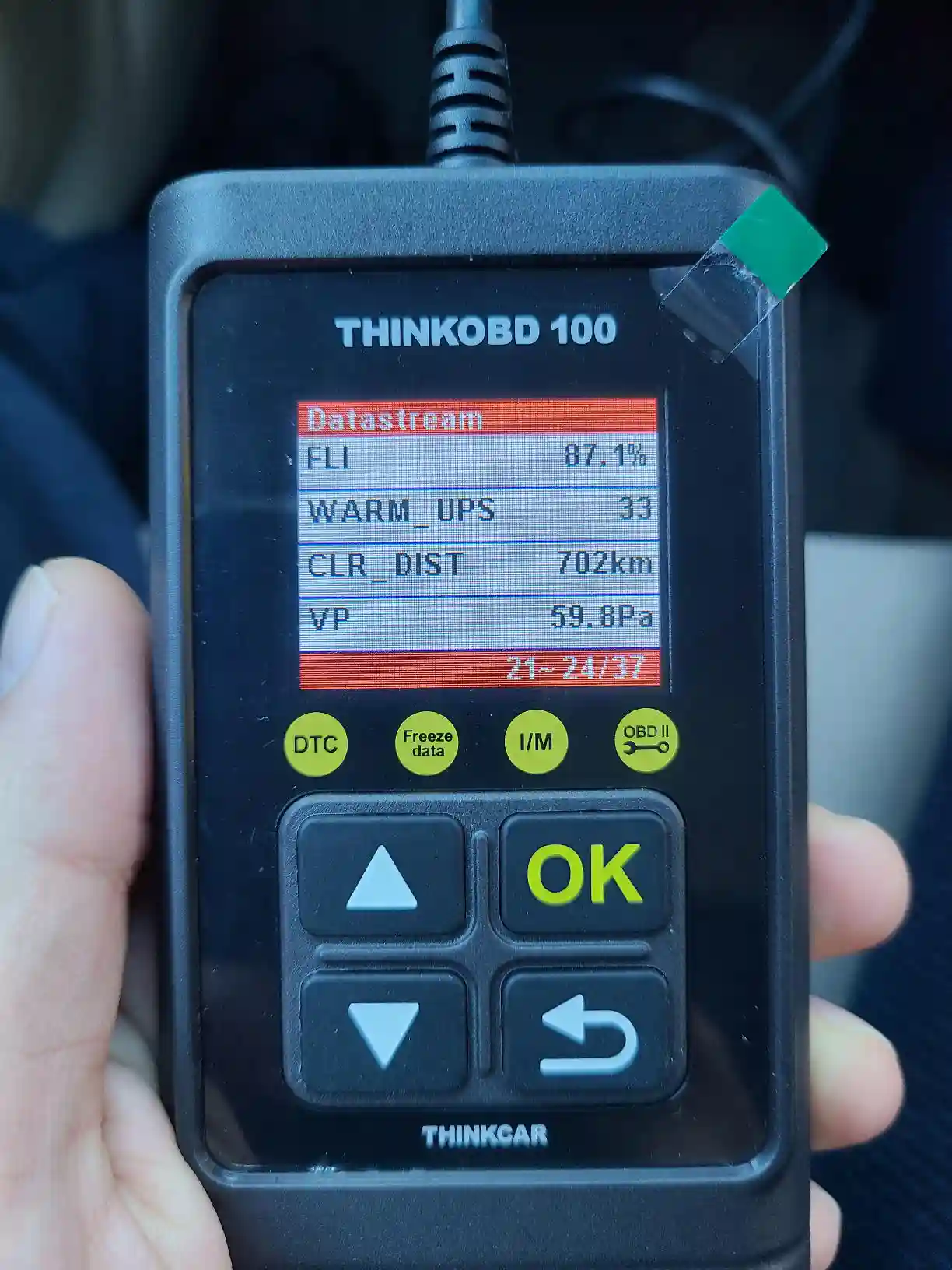
A basic OBD2 scanner reads the codes the computer stored during the failed starts, and those codes are evidence. Read them before you clear anything, and write down pending and history codes along with any freeze-frame data. A crankshaft sensor code, a fuel pressure code or a security fault each points at a different branch of this guide, and clearing them first deletes the map.
Treat codes as directions, not verdicts. A code names the circuit that reported a problem. It does not prove the named part failed, and the fault can sit in the wiring, the connector or the power feed to that part. Test the circuit the code names before you order the part the code mentions. If the scanner shows live data, watch engine RPM during one short crank: a live RPM reading means the crank signal is reaching the computer, and a flat zero sends you back to Branch 3. Our OBD2 scanner guide for beginners covers readers that explain codes in plain English and show live data.
When to stop and call a mechanic
Hand the job over when any of these show up:
- You smell raw fuel strongly, see a fuel leak, or see smoke. Stop cranking and keep ignition sources away.
- The crank rhythm has gone uneven or suddenly free-spinning. Compression and timing faults need shop equipment.
- Fuel pressure testing, spark testing and code reading all pass, and the car still will not fire. The missing piece needs live data and service information for your exact engine.
- The security light flashes with both keys. Immobilizer faults need the maker’s diagnostic path.
- A timing belt failure is suspected. Every extra crank risks bent valves.
- The battery voltage collapses even after a full charge and clean cables. The fault may sit in the starter or the charging system, and both need load testing.
Ask the shop for the test results, not just a verdict. Fuel pressure in psi, cranking voltage, compression per cylinder and the codes found are numbers you can check against this guide. A shop that tests in branch order will find the fault faster than one that swaps parts in sequence, and you will pay for the repair your car needs rather than the parts it did not.
What to do next
Work in this order:
- Name the crank. Fast and even, slow and labored, uneven, fires-and-dies, or free-spinning. One attempt, ears open, tachometer and security light watched.
- Test the battery anyway. Resting voltage against the ladder, cranking voltage above 9.6V, voltage drop under 0.5V total. Charge first if the resting reading is under 12.4V.
- Listen for the fuel pump prime at key-on. No hum: fuse, then relay swap. Hum: fuel pressure gauge against the spec for your car.
- If you smell fuel after repeated attempts, clear the flood: pedal to the floor, short cranks, starter cooling between them.
- Test spark with an inline tester. Read one plug while you are there. Wet plug means fuel arrives. Dry plug means it does not.
- Check permission. Tachometer movement during cranking, security light behavior, spare key test.
- Scan for codes before clearing anything. Follow the branch the codes name, and test the circuit before buying the part.
- Stop at the first failed test and fix that branch. If every test passes and the car still will not fire, hand it to a shop with your readings written down.
Do those in order and the car either starts or tells you which of the four requirements is missing. Either way, you stop buying parts on suspicion.
If the lights work but the engine will not crank at all, this guide is the wrong one. Our car won’t start but lights come on guide covers that fault in order, from the battery through the starter to the safety switches.
If the engine stalls hot and restarts cold, check for a P0336 crankshaft position sensor code before replacing parts.
Sources & Further Reading
- Engineer Fix on why a car cranks but will not start: fuel pressure range of 30 to 60 psi, the two-second fuel pump prime at key-on, crankshaft position sensor and immobilizer behavior, clear-flood procedure.
- Engineer Fix on starter current draw ranges: 100 to 200 amps for four-cylinder engines when warm, 150 to 250 for six-cylinder, over 300 for large V8 engines, 400 or more for diesels, cold oil can double the draw.
- Fluke starter circuit voltage drop guide: acceptable voltage drop of 0.2V to 0.5V total while cranking, about 0.3V positive side and 0.2V or less ground side; crank for 4 to 5 seconds.
- Battery University BU-903, how to measure state of charge: BCI resting voltage table for a 12V flooded starter battery, 12.65V at 100% down to 11.89V discharged, minimum four hours rest.
- RepairPal fuel pump replacement cost estimate: national average $1,344 to $1,513, parts $1,104 to $1,160, labor $241 to $353, updated September 2026; fuel pump relay $89 to $108; fuel filter $258 to $322.
- Our car won’t start but lights come on guide: the no-crank diagnosis when the starter never turns.
- Our sitting-for-a-week guide: parasitic draw testing for a battery that keeps going flat.
- Our jumper cables guide: safe clamp order and the jump-as-test method.
- Our OBD2 scanner guide: code readers that explain faults in plain English.
- Our car battery testers guide: testers that check the battery and charging system together.
Every figure in this guide comes from a page opened and read on 25 November 2026.
Automotive Safety Notice
Lead-acid batteries produce flammable hydrogen gas and contain corrosive sulfuric acid. Always wear ANSI-rated eye protection, disconnect the negative terminal before electrical servicing, and consult an ASE-certified technician for fuel leaks or high-voltage hybrid systems.

Alexander Reed, MEng
Automotive engineer (MEng, 2021) specializing in no-start diagnostics, parasitic draw isolation, and starter-charging systems.
Verified Gravatar Profile ↗


Reader Discussion & Questions
2 Comments