
Table of Contents (13 Sections)
Crankshaft position sensor replacement cost turns on where the sensor sits, because location decides how much labor you buy. The sensor itself is small and cheap on most engines. Reaching it can take half an hour at the crank pulley and several hours behind the starter, the timing cover or the bell housing. Budget by access first and by part brand second.
Most drivers pay a few hundred dollars at an independent shop. Super Car Digest puts the typical independent total at $120 to $350 in 2026. RepairPal lists one common sedan example at $229 to $333 before taxes and fees. MechanicRank puts most independent jobs at $90 to $440. Those bands overlap while differing at the edges, because access varies by engine. A buried sensor can reach $400 to $700 or more.
No bench test stands behind this guide. Every price, labor time and test value comes from a page opened for this post and listed in Sources with its read date. Where two sources disagree, this post prints both numbers. Repair costs are planning bands, and your quote depends on engine, part brand and local labor rate.
What the sensor does and why failure strands you
The crankshaft position sensor reads a toothed wheel on the crankshaft. Super Car Digest calls that wheel a reluctor or tone ring. MechanicRank notes that most rings carry a missing tooth or two that marks top dead center. Pulse timing then gives engine speed and crank angle, and the computer builds spark timing and injector timing from that stream. Identifix adds that the signal also drives the tachometer and supports misfire detection.
Lose the signal and the engine stops. Super Car Digest states that without the signal, most engines will not start or will shut off while running. The Motor Guy adds that most modules withhold spark and injector pulses when no crank signal arrives. The starter still turns the engine at normal speed. The engine never fires, which sends many drivers toward fuel or battery faults first.
Camshaft and crankshaft sensors do different jobs. The cam sensor tells the computer which stroke each cylinder is on. Super Car Digest notes that many newer engines can still start on the crank signal alone after a cam failure. Crank failure leaves no fallback. That gap explains why code P0335 strands cars while code P0340 often leaves them running rough.
Symptoms that point to the crank circuit
Heat failure is the classic pattern. The car starts cold, stalls once warm, and restarts after cooling as if nothing happened. Super Car Digest lists stalling after warmup with restart after cooling as a core sign. The Motor Guy gives the timing as a stall after twenty or thirty minutes followed by a restart once the engine has cooled for an hour. Identifix adds the mechanism. The winding opens as it expands with heat and reconnects when it cools, so the sensor passes checks on a cold engine.
Cranking without starting is the second pattern. The starter spins at normal speed and the engine never catches. Identifix describes that case directly. The computer never sees the crankshaft turning, so it withholds spark and fuel from the first crank. Long cranking before a catch fits a weakening signal that drops pulses before it fails outright.
Watch the tachometer while cranking. MechanicRank calls that needle the quickest check without tools. A needle that stays still means the computer sees no engine speed, which points at the crank sensor or its wiring. A needle that moves sends you toward fuel, spark or compression first. Identifix gives the scan tool version. Watch the RPM reading while an assistant cranks, and zero RPM confirms the missing signal in one step.
Other signs travel with those patterns. The tachometer drops to zero while driving. Misfires and hesitation appear when the signal degrades. The check engine light stores codes P0335 to P0339 for the crank circuit, beside cam codes P0340 to P0349. Correlation codes P0016 to P0019 mean crank and cam timing has moved apart. A new sensor will not fix moved timing.
Overlap is wide, because weak battery, tired fuel pump, worn plugs and failing coils can mimic crank complaints. Super Car Digest warns that no-start and misfire complaints overlap across starter, battery, fuel pump, coil and plug faults. Our car cranks but wont start guide orders those branches before parts get ordered. Rule out slow cranking first, since Identifix notes that a dragging starter or weak battery can set P0335 on a healthy circuit. Check cranking voltage with our battery or alternator test guide and our signs of a dying car battery guide first.
Cost at a glance by access
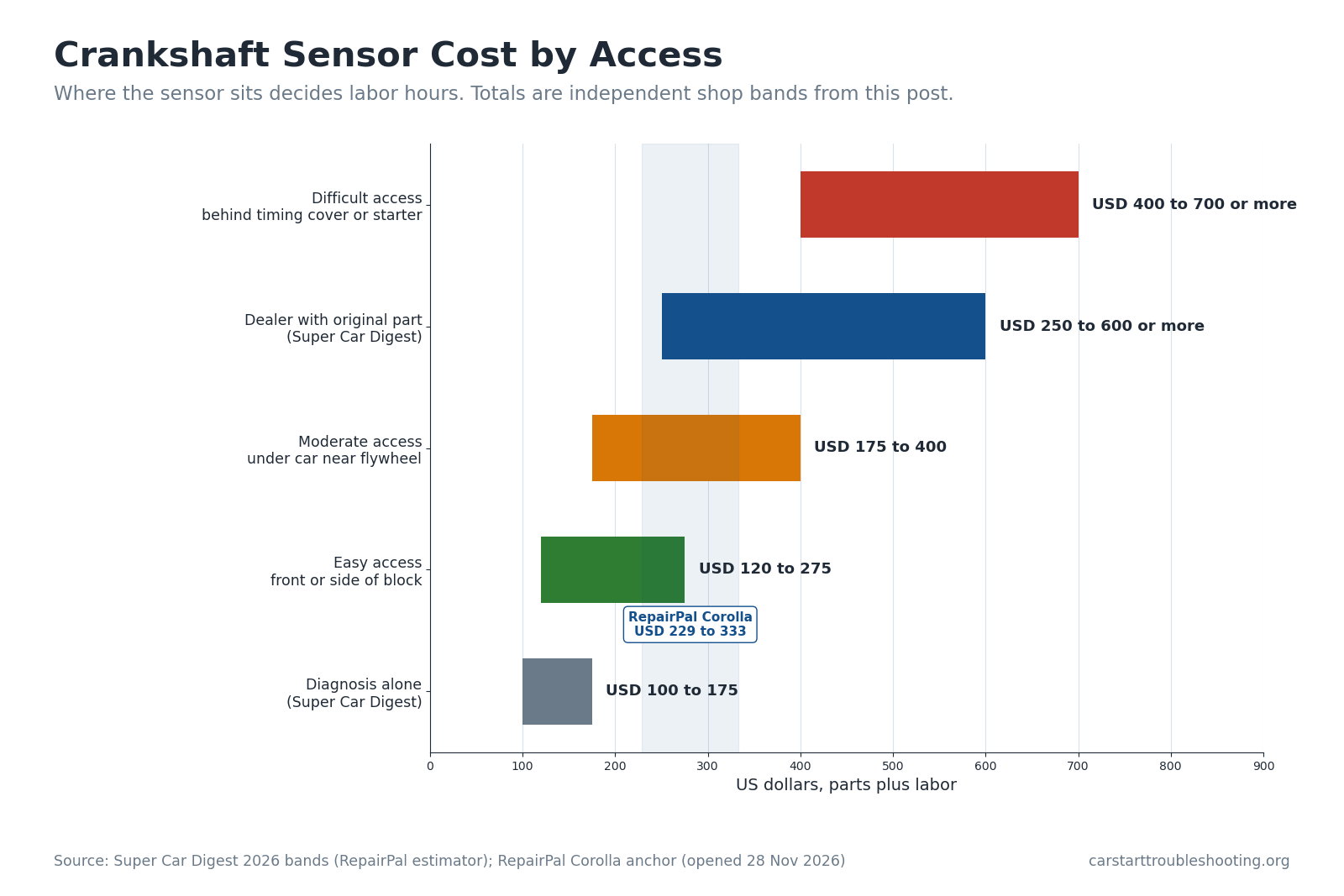
Access splits the bill into three tiers. Super Car Digest compiled 2026 bands from the RepairPal estimator, published labor times and parts store prices. Easy access at the front or side of the block runs $120 to $275, with parts at $20 to $100 and labor at 0.5 to 1 hour priced at $50 to $175. Moderate access under the car near the flywheel runs $175 to $400, with parts at $30 to $150 and labor at 1 to 1.5 hours priced at $100 to $265. Difficult access behind the timing cover or starter runs $400 to $700 or more, with parts at $40 to $150 and labor at 2 to 4 hours priced at $200 to $700.
| Access tier | Parts | Labor time | Typical total at an independent shop |
|---|---|---|---|
| Easy access, front or side of block | $20 to $100 | 0.5 to 1 hour | $120 to $275 |
| Moderate access, under car near flywheel | $30 to $150 | 1 to 1.5 hours | $175 to $400 |
| Difficult access, behind timing cover or starter | $40 to $150 | 2 to 4 hours | $400 to $700 or more |
| Dealer with original part | $60 to $250 | Dealer rate | $250 to $600 or more |
| Diagnosis alone | No part | 0.5 to 1 hour | $100 to $175 |
RepairPal gives a single model anchor inside those tiers. A 2018 Toyota Corolla iM in Miami lists $229 to $333 total, with parts at $86 to $124 and labor at $143 to $209 before taxes and fees. Use that anchor as a mid tier reference. Your engine can sit well below or above it once access and local rates enter the quote.
MechanicRank prices the same job from posted shop rates at $90 to $440 for most drivers, with front mount sensors near the bottom and sensors behind the starter or bell housing near the top. Vehicle bands run $80 to $415 for compact cars, $85 to $440 for midsize sedans and small sport utility vehicles, $100 to $510 for full size trucks, $120 to $620 for luxury and European cars, $95 to $485 for hybrids and $120 to $605 for diesel jobs. Identifix aggregates the typical swap at $150 to $350 with labor, The Motor Guy lists a fitted sensor at $120 to $400, and AutoZone lists professional work at $130 to $300 total. Budget with the wider band until a shop names your access tier in writing.
Parts cost by tier
The part looks cheap until brand enters the quote. Super Car Digest lists the sensor at $20 to $150 across tiers, with original dealer parts at $60 to $250. RepairPal lists $86 to $124 for the Corolla example. MechanicRank splits the shelf into cheap sensors at $15 to $35 and quality or factory sensors at $50 to $160. The Motor Guy lists parts at $20 to $120, and AutoZone lists do it yourself parts at $30 to $100.
Cheap sensors carry comeback risk. Super Car Digest warns that a signal slightly off can cause misfires or a returning code days later. MechanicRank notes that cheap sensors work fine on some cars while failing fast on others. Identifix records a pattern on Nissan 2.5 liter engines, where original sensors are favored because aftermarket units fail early. The Motor Guy adds fitment risk. Two sensors can share a connector and bolt yet differ in magnetic strength or tip length, so a tip that sits too far from the ring gives a weak signal.
Buy quality on this part, because the sensor can strand you without warning. Saving $30 on the part while paying $200 in labor twice costs more in the end. Ask which brand the quote includes and confirm the part number matches year, make, model and engine size. Compare old and new sensors side by side before install, as AutoZone directs.
Labor time and shop rates
Labor time follows location. MechanicRank states that front mount sensors near the crank pulley can finish in half an hour, while sensors on the back of the block, above the starter, or in the bell housing can take one and a half to two hours because other parts come off first. Super Car Digest gives a wider difficult band at 2 to 4 hours for sensors behind the timing cover or starter. AutoZone gives the common case at 30 to 60 minutes, with some vehicles requiring up to two hours. Budget with the longer band whenever a shop mentions timing cover, starter, axle or intake removal.
Rates widen the spread further. Super Car Digest lists independent rates at $100 to $175 per hour and dealer rates at $150 to $250 per hour, while noting AAA national averages around $140 per hour. MechanicRank counted 207 independent shops that post a rate and found a median of $129 per hour, with the middle half charging $100 to $165 per hour. California posts a $160 median and Ohio posts a $75 median. Your state moves the same job by hours multiplied by rate.
Dealer premium follows rate and part markup. Super Car Digest puts dealer totals at $250 to $600 or more. MechanicRank puts dealers $100 to $250 above an independent shop. Super Car Digest estimates the dealer gap at $50 to $100 for an easy sensor and $200 to $400 for a difficult sensor. Mobile work changes the math on a no-start car, since MechanicRank calls this job one of the best fits for a mobile mechanic when a tow alone costs $75 to $150. Give the technician year, make and engine before the visit and ask where the sensor sits on that engine.
| Option | Typical crank sensor total | Best fit |
|---|---|---|
| Independent shop | $120 to $400 | Fair rate with full diagnosis |
| Dealership | $250 to $600 or more | Original part and factory scan tools |
| Chain shop | $150 to $450 | Fast visit with code scan |
| Do it yourself | $20 to $150 in parts | Easy access with proof in hand |
Super Car Digest lists those option bands. Chain shops often scan codes free as a first step. A code scan alone falls short of full diagnosis on this circuit, because the code names the circuit that failed to report rather than the part that failed.
Diagnosis before parts
A code names a circuit, and The Motor Guy stresses that word because P0335 reports a missing or implausible signal while sensor, wiring and reluctor ring all sit inside that circuit. Only the sensor is a cheap part among those three, so paying for proof first beats paying for a second sensor later. Super Car Digest prices diagnosis at $100 to $175 for code scan plus circuit and signal checks, with scope work pushing that fee higher.
MechanicRank defines a fair price as including scanning for codes, checking sensor signal and wiring, swapping the sensor with a new O-ring, running a relearn when needed, and a road check. Dealers often add a full hour of diagnosis on a no-start, while independent and mobile shops usually charge less for the same checks. Ask whether diagnosis credits toward repair before you authorize parts.
Start with freeze frame data. The Motor Guy tells you to read it before touching anything, while engine speed and coolant temperature at code set still carry the clue. A cold cranking code points at a hard fault. A code at 2,500 RPM at full temperature points at heat failure or a connection that opens with expansion. Clearing codes first deletes that evidence, and Identifix warns that resetting the computer only erases evidence while the code returns when the signal drops again.
Identify sensor type before you probe. AutoZone notes that most vehicles use Hall Effect or magnetic sensors, and The Motor Guy separates the tests by type. Inductive two wire sensors generate alternating voltage and accept resistance and AC volt checks while cranking. Hall three wire sensors need reference voltage and ground and produce a square wave. Resistance checks tell you nothing useful on a Hall sensor, and a Hall sensor with no reference voltage points at supply or ground.
Inspect the loom next. The Motor Guy lists chafing, corrosion, water entry and fatigue at the plug among common faults on a sensor that lives low near exhaust heat. The signal wire usually runs screened with the screen grounded at one end, and a broken shield ground can corrupt the signal with every component sound. Wiggle the loom at idle while watching live engine speed for dropouts. Identifix gives the same order, directing you to trace the loom to its first junction while looking for melt near exhaust parts and oil filled connectors.
Scope the signal while cranking when doubt remains. The Motor Guy calls that step decisive for separating sensor faults from ring faults. A damaged ring shows the same distortion at the same point in every revolution, while a dead sensor shows no pattern at all. Heat checks matter when the fault hides cold. Warm the sensor with a heat gun while watching output, since a sensor that passes cold and drops out at temperature has been caught in the act.
Slow cranking can fake this code. Identifix lists dragging starter and weak battery as contributors. MechanicRank lists fuel delivery failure, anti theft blocking, coil failure, melted wiring, damaged tone ring and cam sensor faults as rivals. Our P0336 code guide covers the erratic signal variant where P0336 means signal present yet wrong, which shifts suspicion toward ring, air gap or debris. Our bad starter symptoms guide and starter replacement cost guide help split slow crank from missing signal.
When the sensor is sound and the bill changes
Wiring repair sits near sensor cost. The Motor Guy lists wiring or connector repair at $100 to $400 fitted, on parts at $10 to $60. Identifix prescribes soldered sealed splices over crimp connectors and secure routing away from exhaust heat. MechanicRank makes the same point about pigtail repair. Replacing the sensor into a cracked connector wastes the labor you just bought.
Debris and oil cost little to clean and more to cure. The Motor Guy lists cleaning plus oil leak correction at $120 to $600 fitted. Magnetic tips collect metal fuzz, and oil from a rear main seal, front crank seal or cover gasket can fill the gap between sensor and ring. Remove the sensor and inspect the tip, then ask what shed any metal you find. Fix the leak or the fault returns.
Wrong part comebacks cost less and teach more. The Motor Guy lists wrong or poor quality sensor correction at $60 to $250. The pattern is a code returning within days or weeks of a swap, which rarely means two failed sensors in a row. Check part number against the engine and check seating depth, since an O-ring left off or a sensor left short of its mounting face changes the air gap. AutoZone lists full seating for proper air gap as a core post check.
Reluctor damage breaks the budget. The Motor Guy lists reluctor ring or flexplate work at $500 to $1,500 fitted, on parts at $80 to $400. Identifix explains the access problem. The wheel can sit on the pulley, flexplate or crankshaft itself, so balancer rings swap easily while crank mounted wheels need major disassembly and flexplate rings can need transmission removal. Price that job against vehicle value before you approve it.
Timing faults share the code family. The Motor Guy lists timing chain and tensioners at $800 to $2,500 fitted. Correlation codes P0016 or P0017 alongside P0335 point at chain stretch, tensioner failure or a jumped belt tooth, and cold start rattle from the timing cover supports that branch. Sensors cannot fix moved timing.
Reference voltage and ground faults mimic sensor death. The Motor Guy lists that repair at $100 to $400. Shared reference circuits can drop several sensors at once, so several unrelated sensor codes at the same moment hint at shared supply. Engine ground straps deserve a voltage drop check while cranking, and that strap repair lists $60 to $180 fitted. Computer failure sits last at $600 to $1,500 with programming, justified only by elimination after a known good sensor, a scoped signal at the module connector, and verified reference voltage and grounds still leave the code setting.
| Finding under the same code | Typical fitted total |
|---|---|
| Crankshaft position sensor | $120 to $400 |
| Wiring or connector repair | $100 to $400 |
| Cleaning sensor plus oil leak correction | $120 to $600 |
| Wrong or poor quality sensor correction | $60 to $250 |
| Reluctor ring or flexplate | $500 to $1,500 |
| Timing chain and tensioners | $800 to $2,500 |
| Engine control module with programming | $600 to $1,500 |
The Motor Guy lists those fitted bands. Cheap repair and four figure repair share one code, which is why proof comes before parts on every quote.

Relearn after the swap
Many cars need a relearn after sensor work. MechanicRank names GM, Ford and some hybrid models, while others need none. The relearn teaches the computer exact tooth spacing for misfire detection, and skipping it can set a misfire or crank code later. Identifix gives the same warning, noting that a skipped GM variation relearn after a Chevy repair commonly returns with misfire codes.
Engineer Fix names the procedure as Crankshaft Position Variation Learn, which maps microscopic differences in ring spacing and sensor position. Codes P0315 and P1336 flag missing or invalid variation data, and ignoring those codes can bring rough idle or reduced power. Timing chain, belt or harmonic balancer work can trigger the same need.
Tool access decides who can finish the job. Engineer Fix requires an advanced scan tool with special functions or bi-directional controls, while a basic code reader cannot command learn mode. Preparation needs stable voltage with a battery maintainer preventing drops that abort learning. Coolant temperature must reach at least 158 degrees Fahrenheit, or 70 degrees Celsius, because the computer blocks learning on a cold engine. Confirm relearn need for your exact engine and confirm the quote includes it, as Super Car Digest lists among its savings steps.
The sequence runs under scan tool guidance with the transmission in Park or Neutral, the parking brake set and drive wheels blocked. Start the engine at required temperature, then accelerate rapidly to the specified speed, often 4,000 RPM or 5,150 RPM by maker, until the computer cuts fuel. Release the pedal at fuel cut, and the computer records the deceleration signature before confirming learned status.
Do it yourself limits
Easy sensors suit careful home work. Super Car Digest describes the common job as unplugging the connector, removing one bolt, installing the new sensor with light oil on the O-ring, and clearing codes. Some engines then need relearn with a scan tool, so check relearn need before you start. AutoZone gives the driveway sequence in full. Park on level ground with the parking brake set, disconnect the negative battery cable, and let the engine cool fully.
Use jack stands when access comes from below and never rely on a jack alone. Sensor positions include front near the crank pulley, lower block near the transmission, and behind the starter motor. Mounting bolts typically run 8 to 10mm. Press the connector release tab and pull gently, apply penetrating oil on corroded bolts, remove the mounting bolt while keeping washers, pull the sensor straight out, and clean the mounting area.
Compare new and old sensors side by side, seat the new sensor fully, and tighten to maker specification. AutoZone lists 7 to 10 lb-ft as typical, while your service manual figure governs your engine. Route wiring away from exhaust heat and reconnect until the tab clicks. Post checks close the loop, with AutoZone directing a scan for codes P0335 to P0339 followed by clearing and a road check for 5 to 10 minutes across speeds. A healthy engine starts within 1 to 3 seconds and idles smooth at 600 to 900 RPM without misfires. Check air gap on adjustable designs and center the tip over reluctor teeth.
Stop and hand the job over in three cases. Access needs starter, timing cover, axle or transmission work beyond your tools. Diagnosis needs a scope to separate sensor from ring. Relearn needs a bi-directional tool you lack. AutoZone states the same boundary, noting that hard to reach sensors and complex designs may require professional help. Our car stalls when braking guide helps when stalling persists after sensor work, because idle and vacuum branches can wear the same disguise.
Can you drive on a failing sensor
Park the car after one stall. Super Car Digest warns that a failing crank sensor can shut off the engine without warning, while steering assist drops and brake assist lasts only a few presses. MechanicRank gives the same verdict, advising repair before traffic use once the car has stalled even once. The Motor Guy ranks P0335 among stop driving codes, since signal loss stops the engine in the same instant with no gradual power loss to warn you.
Power steering turns heavy when the engine quits, and brake servo reserve covers few pedal applications before effort climbs sharply. Recovery beats a drive to the shop on an intermittent heat fault, because cold behavior can look perfect while heat behavior strands you. Engine damage from the fault itself stays rare, since Identifix notes that the computer cuts fuel and spark cleanly. MechanicRank adds that prolonged misfires from a weak signal can overheat the catalytic converter. A tow or mobile diagnosis costs less than a stall across an intersection.
How to pay less without cutting corners
Get diagnosis in writing before you approve parts. Ask whether tach or scan RPM stayed at zero while cranking. Ask whether wiring and plug received checks beyond the code. Ask where the sensor sits and what comes off to reach it. Ask whether relearn sits inside the price and which brand goes in. Ask whether tow or diagnosis fees credit toward repair and what happens if the car still fails to start after the swap. MechanicRank lists those questions as the ones that reveal guessing fast.
Buy quality once, since a $25 sensor that fails in a month doubles labor and Super Car Digest gives that warning directly. Get two quotes on difficult access jobs where labor estimates vary most. Check powertrain or extended coverage, because Super Car Digest notes that engine sensors often sit under those plans. Skip needless add-ons, since MechanicRank warns against fuel cleaning, tune up work or a new cam sensor as routine extras. Crank and cam sensors need replacement together only when both report faults or a known pattern links them, as Super Car Digest states in its pairing rule. Replace the O-ring every time and inspect the old tip for metal debris.
Cam sensor money differs enough to keep quotes separate. Super Car Digest puts one cam sensor at $90 to $300 installed and both banks on a V6 or V8 at $150 to $450. Dealer cam work runs $200 to $500, and most cam sensors mount on the head or timing cover with one bolt so twenty minutes to an hour covers many jobs. Codes tell you which circuit failed, so insist on separate line items when a shop quotes both sensors together.
Questions drivers ask next
How much does it cost to replace a crankshaft position sensor at a shop? Access sets the band, with easy sensors at $120 to $275 at an independent shop, moderate sensors at $175 to $400, and difficult sensors at $400 to $700 or more. Dealers run $250 to $600 or more, and diagnosis alone runs $100 to $175. Ask the shop to name your access tier before you compare quotes.
Why do two shops quote $150 and $600 for the same sensor? Location and rate explain most of that gap, because one engine exposes the sensor at the front in half an hour while another hides it behind the starter or timing cover for several hours. Independent rates post $100 to $165 for the middle half of shops, dealer rates run higher with original parts, and part tier adds the rest.
Does every car need a crank relearn after sensor replacement? Many GM, Ford and some hybrid models need one while others need none, and the procedure needs a bi-directional scan tool with warm coolant and stable voltage. Codes P0315 and P1336 flag missing variation data, so confirm relearn need for your exact engine. Confirm the quote includes relearn when your car needs one.
Can a bad battery or starter set a crank sensor code? Slow cranking can set P0335 with a sound sensor circuit, because a dragging starter or weak battery drops cranking speed below clean signal range. Check cranking voltage and starter draw first on slow crank complaints. A tach needle that moves while cranking also argues against a dead crank signal.
Is a cheap sensor worth the savings on this job? Labor dominates the bill, so a cheap part that returns a code in days costs a second labor charge. Quality and factory sensors run $50 to $160 by MechanicRank bands while cheap sensors run $15 to $35. Fitment and tip length matter on this circuit, so spend on the part and save on repeat labor.
Sources
- Super Car Digest crankshaft sensor replacement cost guide (opened 28 November 2026)
- RepairPal crankshaft position sensor replacement estimator for a 2018 Corolla iM (opened 28 November 2026)
- MechanicRank crankshaft position sensor replacement cost guide (opened 28 November 2026)
- Engineer Fix crankshaft position sensor relearn guide (opened 28 November 2026)
- AutoZone crankshaft position sensor replacement guide (opened 28 November 2026)
- The Motor Guy P0335 code guide (opened 28 November 2026)
- Identifix P0335 crankshaft position sensor circuit guide (opened 28 November 2026)
Automotive Safety Notice
Lead-acid batteries produce flammable hydrogen gas and contain corrosive sulfuric acid. Always wear ANSI-rated eye protection, disconnect the negative terminal before electrical servicing, and consult an ASE-certified technician for fuel leaks or high-voltage hybrid systems.

Alexander Reed, MEng
Automotive engineer (MEng, 2021) specializing in no-start diagnostics, parasitic draw isolation, and starter-charging systems.
Verified Gravatar Profile ↗

Reader Discussion & Questions
0 Comments