
Table of Contents (11 Sections)
Can you drive with a bad alternator? Yes, but only for a short emergency hop. The battery holds a small reserve of power. The alternator is no longer refilling it. Most cars cover 5 to 30 miles before voltage falls low enough to stall the engine. Once it stalls, it usually will not restart. Drive only on a short, daytime, low traffic route to a shop or home. Otherwise call a tow.
Your battery label already holds a rough answer. The reserve capacity number tells you how long the battery can carry the car alone. Read that number first. Then cut every load you can live without. Then decide with cold eyes whether the trip fits inside the reserve.
The short answer
The alternator does two jobs. It powers every electrical system while the engine runs. It also keeps the battery topped up. When it fails, the battery alone carries the whole load. That load includes the ignition and fuel system that keep the engine alive. A car battery was built to start the engine. It was not built to run the car for long.
AmpAuto gives the plain range. Most cars cover 5 to 30 miles on battery alone. A healthy, fully charged battery may run the car 20 to 60 minutes. Night driving cuts that hard. A weak or older battery can quit in under 10 minutes. There is no safe fixed number. Plan for the shortest case.
No bench test stands behind this guide. Every voltage value, amp value and price comes from a page opened for this post and listed in Sources with its read date. Where two sources disagree, this post prints both numbers. Runtime figures below come from arithmetic on published ratings. They are estimates, not promises.
Your battery label already tells you the answer
Most drivers have never read the reserve capacity rating. It sits on the battery label next to the cold cranking amps. Batteries Plus defines it in one line. Reserve capacity measures how long a battery can power your electronics if the charging system fails.
The test behind the number is simple. Impact Battery describes the standard method. A fully charged battery at 80 degrees Fahrenheit delivers a steady 25 amps. The clock runs until voltage drops to 10.5 volts. The minutes on that clock become the rating. A battery marked 120 RC supplied 25 amps for 120 minutes in that test.
AAA gives the normal band for a car battery. A good reserve capacity rating runs 90 to 120 minutes. That is 1.5 to 2 hours at the 25 amp test load. Your battery may sit inside that band or below it. Age and past deep discharges pull the real figure down.
One more step turns the rating into energy. Multiply the minutes by 25 and divide by 60. A 120 RC battery gives 50 amp hours at the 25 amp rate. A 90 RC battery gives 37.5 amp hours. That energy figure is the fuel tank for the drive home. Everything in the next section spends from it.
Two warnings belong here. First, the rating assumes a new, fully charged battery. A battery that has already run the car for two days with the warning light on starts the trip half empty. Second, lead acid batteries deliver less total energy at higher currents. Double the load and the runtime drops to slightly less than half. The math below already bends that way.
What the car actually draws while it drives
Published load tables give the spending side. AA1Car lists engine idling with no lights or accessories at 35 to 50 amps. That baseline covers the computer, injectors, coils and fuel pump. Engineer Fix gives the same 35 to 50 amp band for a modern vehicle idling with nothing switched on.
The parts inside that band matter. AA1Car puts the electric fuel pump at 4 to 12 amps. The ignition primary circuit draws 6 to 20 amps. Fuel injectors draw 4 to 6 amps at peak. The computer and sensors take the rest. None of these can be switched off. The engine stops without them.
Accessories stack on top of the baseline. AA1Car lists halogen low beam headlights at 8 to 9 amps per pair. High beams draw 9 to 10 amps. The heater blower on high draws about 15 amps. The rear defroster adds 10 to 20 amps. An electric cooling fan draws 6 to 30 amps when it runs. Engineer Fix puts the blower on high at 15 to 20 amps and the rear defroster at 10 to 20 amps. The two tables agree on the shape of the problem.
| Load | Amps from published tables | Can you switch it off? |
|---|---|---|
| Engine baseline (computer, coils, injectors, pump) | 35 to 50 | No |
| Halogen low beam headlights, per pair | 8 to 9 | Only in daylight |
| Heater blower on high | 15 to 20 | Yes |
| Rear window defroster | 10 to 20 | Yes |
| Electric cooling fan when running | 6 to 30 | No, the car controls it |
| Radio and infotainment | About 5 | Yes |
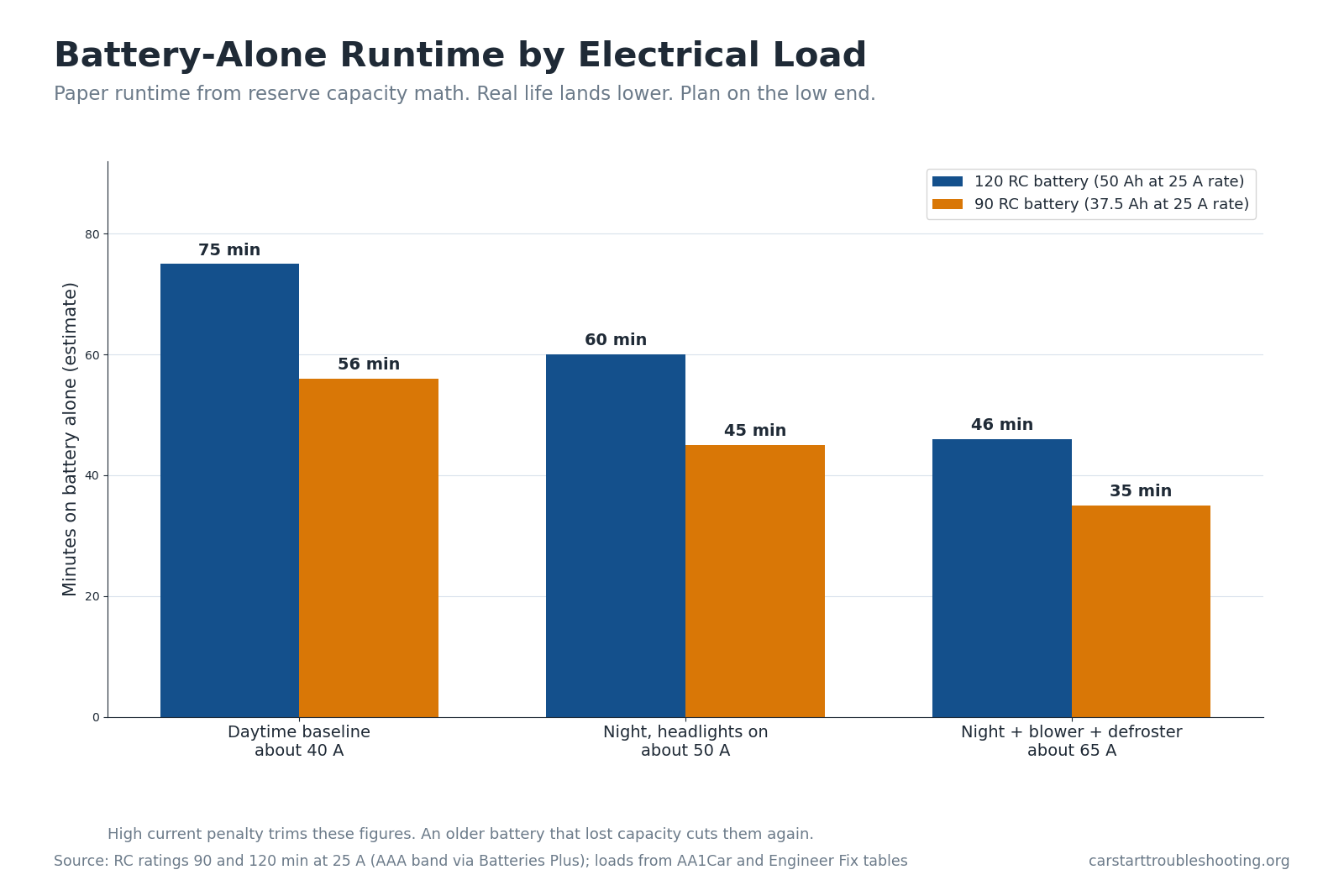
Now the runtime math writes itself. Take the 120 RC battery with 50 amp hours at the test rate. At a 40 amp baseline draw, simple division gives 75 minutes. The high current penalty trims that. Plan on roughly an hour in daylight with nothing extra on. Add headlights and the blower and the draw climbs toward 65 amps. The same division gives about 46 minutes before the penalty. Real life lands lower.
The 90 RC battery holds less. Its 37.5 amp hours at a 40 amp draw give about 56 minutes on paper. At 65 amps the paper figure falls to about 35 minutes. An older battery that has lost a third of its capacity cuts both numbers again. That is how one driver gets 30 miles and another gets stranded in 8 minutes. The battery size and the load list explain the gap.
The range table, in miles and minutes
AmpAuto turns the same physics into road numbers. A fresh battery in daytime with nothing extra on gives 20 to 60 minutes, or 20 to 40 miles. An older battery in normal driving gives 10 to 25 minutes, or 5 to 15 miles. Night driving with headlights gives 10 to 20 minutes. Heater fan, defroster, wipers and radio together give 5 to 15 minutes. A battery light that has been on for days means minutes, and nobody can say how many.
Treat every number in that table as a ceiling. Your car may stall sooner. The battery may already be partly drained. The cooling fan may run the whole trip in traffic. Cold weather shrinks battery output further. If the shop sits beyond the low end of your row, the trip does not fit.
Speed changes miles, not minutes. The battery spends amp hours by the clock. Highway speed covers more ground inside the same minutes. It also raises the stakes of a stall. A stall at 65 miles per hour in a fast lane is a different event from a stall on a quiet side street. Miles per charge is the wrong prize. Safe minutes to a safe stop is the right one.
What you will feel as voltage falls
The battery warning light is the first signal. Nashville Mobile Mechanics notes the light monitors the whole charging system, not just the battery. A light that flickers under load often means a worn alternator or a slipping belt. Either one can fail completely without much more warning.
Electrical items then weaken in a rough order. Power windows slow down. Headlights dim. The blower loses force. Wipers drag. The instrument cluster may flicker or throw odd warnings. The radio may cut out. Each symptom says voltage is sliding toward the point where the computer can no longer run the engine cleanly.
The end comes fast. AmpAuto describes the stall as sudden, with little warning. Once the engine stops, power steering assist is gone. The brake booster keeps a pump or two of reserve, then the pedal turns hard. The car still steers and stops. It takes real effort, and that surprises drivers. Hazard lights may also fail once the battery is flat. You can end up parked on a shoulder with no way to warn other drivers.
A jump start does not reset the clock. AmpAuto warns that a jump adds only a little surface charge. With a dead alternator the car runs off the battery again and quits within minutes. Jumping treats a starting problem. This is a charging problem. Our battery or alternator test guide separates the two faults with three readings.
Drive it or tow it: the decision rule
AmpAuto gives a five question gut check. Answer each one straight before you turn the key.
- Is the shop or home within a few miles? Short trips are survivable. Long ones are a gamble.
- Is it daytime and dry? No headlights and no wipers mean far less drain and far less risk.
- Was the battery healthy until now? A strong battery gives a real cushion. An old one does not.
- Can you avoid highways and heavy traffic? A stall on surface streets is recoverable. A stall in a fast lane is not.
- Has the battery light been on for days? If yes, assume the battery is nearly empty and tow it.
If you answer no to any of the first four, lean toward a tow. AmpAuto puts a local tow at roughly 75 to 150 dollars. That is far less than a collision, a ruined battery, or a dead stop in traffic. When in doubt, the tow is almost always the cheaper choice.
If you do drive, drive the load down first. Switch off the radio. Switch off the air conditioning and heated seats. Run the blower on low or off. Keep headlights off in daylight where the law allows it. Take the most direct low speed route. Keep a safe place to pull over in mind the whole way. Do not stop for fuel or errands. Every minute counts against the reserve.
Mistakes that make it worse
One old test needs a clear warning. Drivers once pulled the negative battery cable with the engine running to test the alternator. AmpAuto says plainly: do not do it. On modern vehicles this can spike voltage and damage sensitive electronics. The multimeter test below gives the same answer safely.
Driving until the car dies is the second mistake. A full deep discharge can ruin the battery. You then buy a battery on top of the alternator. Stop while charge remains. The reserve capacity test ends at 10.5 volts for a reason. Below that point the battery is effectively discharged, and deep discharge shortens its life every time.
Ignoring an intermittent light is the third mistake. A flickering battery light under load often means the alternator or belt is close to full failure. The cheap day to fix it is the day it flickers. The expensive day is the day it strands you at night in the rain. Our bad alternator symptoms guide lists the eight signs in test order.
Confirm the fault before you spend
A five minute multimeter test confirms a charging fault. Rebuild Masters gives the standard numbers. Engine off, a fully charged battery reads about 12.6 volts. Engine running, expect roughly 13.5 to 14.5 volts at the battery. Engineer Fix gives the same window and the same logic. The charging system must exceed about 13.5 volts to push current back into the battery.
| Reading at the battery | What it usually means |
|---|---|
| About 12.6 volts, engine off | Battery near full charge |
| 13.5 to 14.5 volts, engine running | Charging system working |
| Below 13.0 volts, engine running | Not charging: belt, connections, regulator, diodes or alternator |
| Above 15 volts, engine running | Overcharging: regulator fault likely |
Test with a charged battery. A weak battery distorts every reading. Charge it first if the resting figure sits under about 12.2 volts. Check the belt and terminals before you condemn the alternator. A slipping belt or corroded cable can make a good alternator look weak. If the battery keeps dying overnight instead, work the drain branch in our car battery keeps dying guide.
One honest limit belongs here. Some vehicles run smart charging. The computer changes the target voltage with load and temperature. A single low reading on such a car does not prove failure. Check service information for your model before you buy parts. Two readings, rest and running, still beat guessing.
What waiting costs
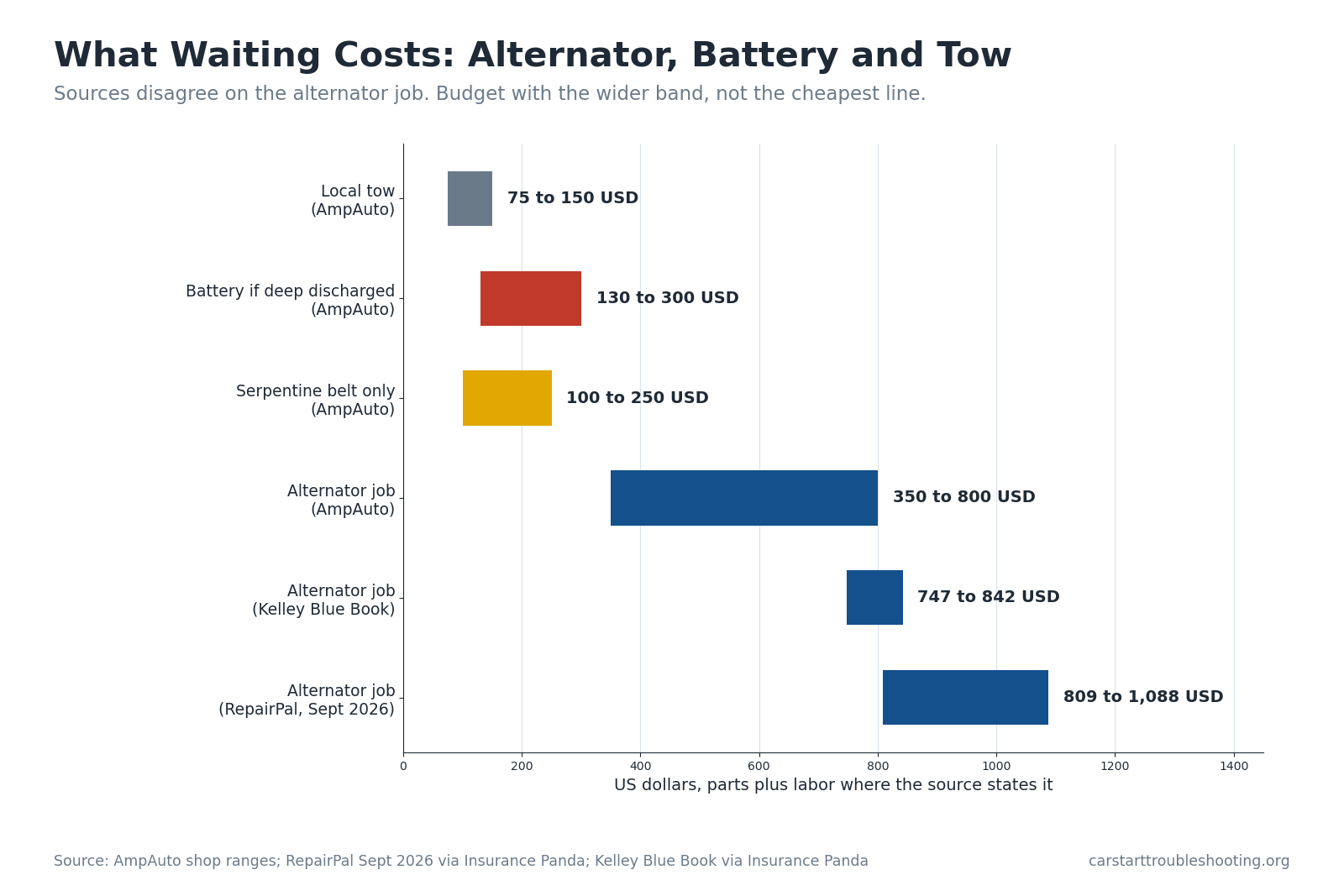
Sources disagree on alternator cost, so this post prints both. AmpAuto gives typical independent shop ranges of 350 to 800 dollars for alternator replacement, parts plus 1 to 2.5 hours of labor. RepairPal, in its September 2026 estimator, puts the national average higher at 809 to 1,088 dollars, with parts at 613 to 800 dollars and labor at 196 to 288 dollars. Kelley Blue Book sits between them at 747 to 842 dollars. Your car, your city and your part choice decide where you land. Budget with the wider band, not the cheapest line.
The cost of driving too far is easier to pin down. AmpAuto puts a replacement battery at 130 to 300 dollars if the old one is deep discharged. That bill is avoidable if you stop before the battery fully drains. A serpentine belt alone runs 100 to 250 dollars when the belt, not the alternator, caused the fault. Our car battery replacement cost guide breaks down battery types and prices.
Add the tow math and the decision sharpens. A 75 to 150 dollar tow protects a battery worth 130 to 300 dollars. It also keeps a stalled car out of fast traffic. Driving to save the tow fee risks paying both bills plus the alternator. The short hop only makes sense when the distance is short and the battery is strong.
Questions drivers ask next
Can you drive with a bad alternator to the shop?
Yes, if the shop is a few miles away, it is daytime and dry, the battery was healthy until now, and you can avoid highways. Kill every accessory you can. If any answer flips, tow it.
How long will a car run with a bad alternator?
A healthy, fully charged battery may run the car 20 to 60 minutes. Night loads and heater loads cut that to 5 to 20 minutes. A weak battery can quit in under 10 minutes. The reserve capacity rating on your battery label gives the starting figure for your car.
Will a jump start fix it?
It will not. A jump adds surface charge only. The car runs off the battery again and stalls within minutes. A jump solves a starting problem. A bad alternator is a charging problem.
Can a bad alternator ruin a good battery?
It can, quickly. Running the battery to full discharge damages it. Deep discharge causes sulfation and shortens battery life. Stopping early, while charge remains, is the cheapest protection you own.
How do you know it is the alternator and not the battery?
Test voltage at rest and running. About 12.6 volts at rest with under 13.0 volts running points at charging. A battery that dies overnight and will not crank points at the battery or a drain. Our signs of a dying car battery guide covers the battery side.
Sources
- AmpAuto guide to driving with a bad alternator (opened 26 November 2026)
- Batteries Plus battery ratings guide (opened 26 November 2026)
- Impact Battery reserve capacity guide (opened 26 November 2026)
- AA1Car electrical amp loads table (opened 26 November 2026)
- Engineer Fix amps while running guide (opened 26 November 2026)
- Rebuild Masters alternator voltage guide (opened 26 November 2026)
- Engineer Fix alternator charging test (opened 26 November 2026)
- Nashville Mobile Mechanics bad alternator guide (opened 26 November 2026)
- Insurance Panda alternator cost guide with RepairPal figures (opened 26 November 2026)
- Preferred Mechanic alternator cost guide (opened 26 November 2026)
Automotive Safety Notice
Lead-acid batteries produce flammable hydrogen gas and contain corrosive sulfuric acid. Always wear ANSI-rated eye protection, disconnect the negative terminal before electrical servicing, and consult an ASE-certified technician for fuel leaks or high-voltage hybrid systems.

Alexander Reed, MEng
Automotive engineer (MEng, 2021) specializing in no-start diagnostics, parasitic draw isolation, and starter-charging systems.
Verified Gravatar Profile ↗


Reader Discussion & Questions
0 Comments