

Table of Contents (12 Sections)
Run this battery or alternator test with a multimeter and three readings: resting voltage with the engine off, voltage while cranking, and voltage with the engine running. A healthy battery rests at 12.6V or higher and holds above 9.6V while cranking. A healthy alternator holds 13.7V to 14.7V with the engine running and the loads on. Charge the battery first, then judge. A flat battery makes a good alternator look weak, and a weak alternator kills a good battery. Test in order and stop at the first reading that fails.
Why this question is harder than it looks
The battery stores power. The alternator makes it. Those two jobs sound separate, and the symptoms of failure are not.
A dead battery leaves you stranded in a parking lot. A dying alternator leaves you stranded too, but later, because it drains the battery while you drive until the battery can no longer run the car. By the time the car stops, the battery reads flat. The battery looks guilty. The alternator did it.
The trap runs both ways. A flat or failing battery drags running voltage down and makes a healthy alternator look weak on the meter. Replace the alternator on that evidence and you have bought the expensive part for the cheap fault. RepairPal puts alternator replacement at $809 to $1,088, parts and labor. That is a costly guess.
The warning light helps, but it does not settle the argument. The battery-shaped light on the dash signals a problem in the charging circuit, which includes the alternator, its belt, its wiring and the battery connections. It does not name the failed part.
Three readings name it. Each one tests a different job, and together they cover the whole system: what the battery holds at rest, what it delivers under the heaviest load on the car, and what the alternator produces while the engine runs. One warning before you start. Clean the battery terminals first. Corrosion adds resistance, blocks charging current, and creates false low readings that convict good parts. Our battery terminal corrosion guide covers the cleaning method.
Reading 1: resting voltage, engine off
Resting voltage tells you how much charge the battery holds before you ask it to do anything. It only counts after the surface charge from recent driving is gone. Surface charge is a temporary voltage bump that hides a weak battery, and it fools more home tests than any other single cause.

Strip it first. Engine off, accessories off. Switch the headlights on for 2 minutes, switch them off, wait 5 to 10 minutes, then measure. Better still, measure after the car has sat overnight. Battery University puts the minimum rest at four hours for an accurate reading, and battery makers recommend 24 hours for lead acid. A reading taken minutes after a drive is a ceiling, not a verdict.
| Resting voltage (12V flooded) | Charge level | What to do |
|---|---|---|
| 12.65V | 100% | Move on to the cranking test |
| 12.45V | 75% | Charge it before you judge it |
| 12.24V | 50% | Recharge, then test again |
| 12.06V | 25% | Recharge now, then test again |
| 11.89V | 0% | Full recharge, then test again |
Those figures come from the BCI table in Battery University BU-903, read at 78°F after a 24-hour rest. An AGM battery rests higher, around 12.8V to 13.0V when full, so use the chart for the battery type fitted to your car.
Read the table with suspicion. The whole scale from full to empty spans about three quarters of a volt. A battery at 12.2V sounds close to 12. It sits at half charge. And a battery that cannot climb above 12.4V after a full charge and a 12-hour rest is failing, whatever its age. That single sentence ends a lot of arguments at the parts counter.
A low resting reading does not convict the battery yet. It proves the battery is discharged. Discharge has two causes: the battery cannot hold charge, or nothing charged it. The next two readings separate those causes. If the battery keeps going flat after the car sits, a parasitic drain is a third suspect, and our car won’t start after sitting for a week guide walks through the drain test.
Reading 2: cranking voltage, the load test
A battery can show 12.6V at rest and still collapse under load. Resting voltage measures charge. Cranking voltage measures delivery. The starter is the heaviest load on the car, so cranking is the honest test of the battery itself.

Have a second person crank the engine for 5 to 10 seconds while you watch the lowest number the meter shows. At about 70°F, a good battery holds above 9.6V during cranking. A reading of 9.0V to 9.6V signals a weak battery. Under 9.0V on a fully charged battery means the battery needs replacing. Engineer Fix states the same floor: a healthy battery should not drop below 9.6V during cranking, regardless of engine size.
One condition decides whether this test means anything. The battery must be charged first. If the resting reading came back under 12.4V, charge the battery before you crank-test it, or the test only proves the battery was flat. Charge time follows a simple formula: amp-hours times depth of discharge, divided by charger amps, with real-world times running 10% to 25% longer from charging losses. Our car battery charger guide covers charger sizing and the worked examples.
Cold weather drags the cranking number down, so the same battery can pass in July and fail in January. Test in a garage rather than on a freezing driveway when you can. If you want a pass-or-fail verdict without a helper, a dedicated tester applies a controlled load for you. Our car battery testers guide covers those tools.
Reading 3: running voltage, the alternator at work
Now start the engine. The alternator takes over as the car’s power source, runs every accessory, and puts back the charge the starter took. This reading judges the alternator, and it is the reading most home tests get wrong by taking it once, at idle, with everything switched off.
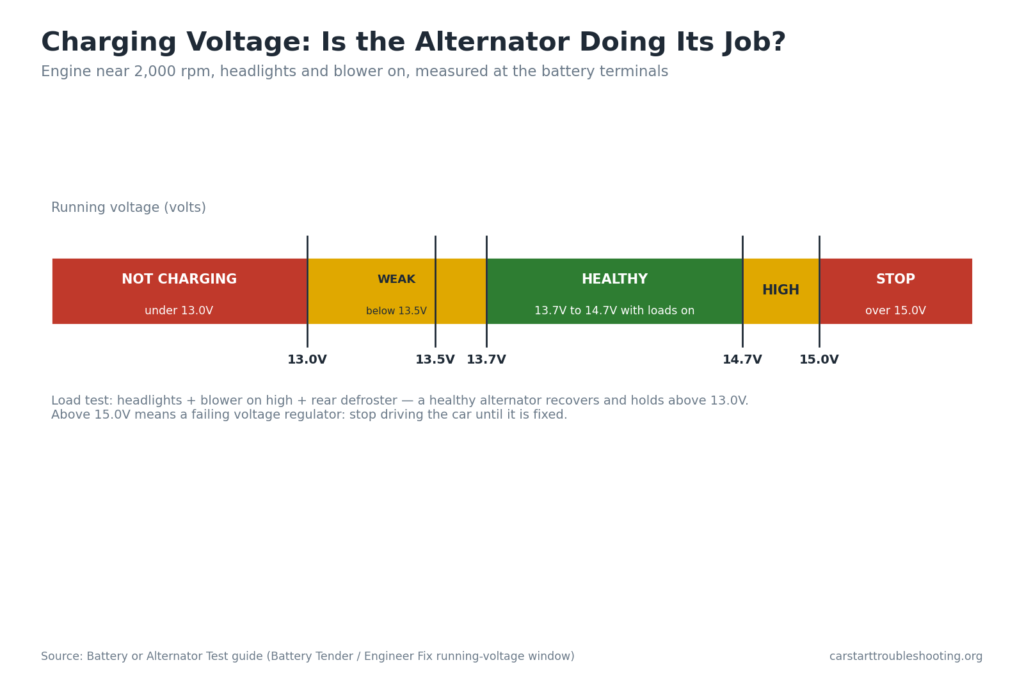
Hold the engine near 2,000 rpm. Switch the headlights and the blower on. Measure across the battery terminals. A healthy charging system reads 13.7V to 14.7V. Engineer Fix gives the same window, 13.5V to 14.7V at idle, and puts the failure line below 13.0V: a reading under 13.0V means the alternator is not producing enough power to charge the system.
Below 13.5V suggests a weak alternator or a loose belt. Check the belt before you condemn the alternator. A slipping or glazed belt makes a good alternator look weak, and a squealing belt under load is the sound of that mistake. Above 15.0V points the other way: a failing voltage regulator. Engineer Fix warns that sustained voltage above 15.0V can damage the car’s electronic control units and boil the battery electrolyte. An overcharging alternator cooks batteries. If your reading sits above 15.0V, stop driving the car until it is fixed.
Watch the headlights while you are here. Dim headlights that brighten as rpm rises mean the alternator produces some charge but not enough. Headlights that stay dim or flicker irregularly with the engine running point at the charging side. And if the battery warning light stays lit with the engine running, the charging circuit has a fault whether the meter agrees or not.
One caution on modern cars. Some charging systems vary their output on purpose, so a single low reading at idle on a newer car deserves a second reading at 2,000 rpm with loads on before you judge. The loaded reading is the one that counts.
The load test: make the alternator work
An alternator can hold 14V with nothing switched on and fall apart under load. The load test closes that gap.
With the engine running, switch on the headlights, the heater blower on high, and the rear defroster. The voltage may dip for a moment when the load lands. A healthy alternator recovers and holds above 13.0V with all of it running. If the voltage drops hard and keeps falling as the engine runs, the alternator cannot keep up with the car’s demands. That is a failing alternator even if the unloaded reading looked fine.
Run the same test at the battery posts and then at the alternator’s output terminal if you can reach it safely. A healthy reading at the alternator and a low reading at the battery means the current is being lost in the cables between them. Clean and tighten the connections before you price a replacement.
The ripple check: catching a dying diode early
An alternator makes AC power. Its diodes convert that AC to DC. When a diode fails, AC leaks into the system as ripple, and the car can show flickering lights, battery-drain complaints and erratic behavior long before the alternator stops charging outright. The DC readings above can look normal while a diode is dying. The ripple check catches it.
Switch the meter to AC volts on its lowest range. Engine running, loads on. Red probe on the battery positive post, black probe on the negative post. Fluke puts the numbers plainly: ripple at or under 0.05V AC at idle with load is desirable. Between 0.05V and 0.10V AC is a caution zone worth monitoring. At 0.30V to 0.50V AC or more, the alternator usually has at least one bad diode or a stator fault.
Raise the engine speed to 2,000 to 2,500 rpm and watch the reading. A healthy alternator holds ripple steady or lets it drop slightly. Ripple that climbs fast with rpm or added load confirms an internal fault.
Two warnings. Many basic meters measure AC riding on DC poorly, so treat a borderline reading as a reason to measure again, not as a verdict. And poor grounds can raise ripple on a healthy alternator. Fluke’s advice stands: verify clean, tight ground straps before you replace the alternator.
The trap: charge first, then judge
Every reading above assumes one thing: the battery started the test charged. Break that assumption and the test lies to you in both directions.
A bad alternator kills a good battery. Drive on a weak alternator for a week and the battery runs deeper and deeper, sulfates, and loses capacity. By test day the battery fails the cranking test, and the battery gets replaced. The new battery dies the same death, slower. The alternator was the fault the whole time.
A bad battery makes a good alternator look weak. A discharged battery soaks up current and drags running voltage down, so the alternator reading comes back low on a healthy alternator. Replace the alternator on that reading and the new one reads low too, because the battery is still flat.
The fix is sequence. Charge the battery fully. Rest it. Run the three readings in order. Only then spend money. If the battery fails after a full charge and a proper rest, the battery is the fault. If the battery passes and the running voltage fails, the alternator, its belt or its wiring is the fault. If both pass and the car still dies overnight, the fault is a drain, not a part.
The decision table: three readings, one verdict
Single readings mislead. Combinations convict. Find your row.
| Resting | Cranking | Running (loaded) | Verdict | Next step |
|---|---|---|---|---|
| 12.6V or higher | Above 9.6V | 13.7V to 14.7V | Both healthy | If the car still dies parked, test for a parasitic drain |
| Low, rises after charging | Above 9.6V after charge | 13.7V to 14.7V | Battery was discharged, alternator healthy | Find why it discharged: drain test, short trips |
| 12.6V or higher | Under 9.6V | 13.7V to 14.7V | Battery failing under load | Replace the battery |
| Low, will not pass 12.4V after full charge and rest | Under 9.6V | Any | Battery finished | Replace the battery, then recheck running voltage |
| 12.6V or higher | Above 9.6V | Under 13.5V, or falls under load | Alternator weak, belt slipping, or cable loss | Check belt and connections, then the alternator |
| Any | Any | Above 15.0V | Voltage regulator failed, alternator overcharging | Stop driving it. Replace the alternator |
| Any | Any | Normal DC, ripple 0.30V AC or more | Diode or stator fault in the alternator | Verify grounds, then alternator service |
| Low every morning, charges fine | Above 9.6V after charge | 13.7V to 14.7V | Parasitic drain while parked | Draw test: normal is 25 to 50 mA |
The parasitic draw figure comes from Battery Tender’s guide: normal draw is 25 to 50 milliamps after the car sleeps, and anything over 50 milliamps deserves investigation. A draw in that range flattens a healthy battery in a few weeks, and bigger draws do it in days.
Age settles borderline rows. Car batteries usually last 3 to 5 years, and heat shortens that life more than cold does. A five-year-old battery that fails the cranking test after a full charge is finished. Charge it, test it once more, and replace it if it still falls short.
What the fix costs
Test first, because the two parts live in different price brackets. RepairPal puts alternator replacement at $809 to $1,088 nationally, with parts at $613 to $800 and labor at $196 to $288, in estimates updated September 2026. On some cars the alternator hides behind suspension parts, cooling fans or bumpers, and access drives the labor up. RepairPal also notes that shops test the whole starting and charging system with professional equipment, which identifies the failed part directly.
That price is the whole case for the three readings. A multimeter test costs twenty minutes. Guessing wrong costs $809 or more, plus the battery the weak alternator already killed. If the car will not crank at all, this guide is the wrong one. Our car won’t start but lights come on guide covers the no-crank diagnosis in order, from the battery through the starter to the safety switches.
When to stop and call a mechanic
Hand the job over when any of these show up:
- Running voltage sits above 15.0V. Overcharging damages electronics and boils batteries. Stop driving the car.
- You smell burning, see smoke, or a cable gets hot during testing.
- The belt is frayed, cracked or soaked in oil, or the alternator pulley wobbles or grinds.
- Ripple reads 0.30V AC or more after grounds are verified clean and tight. The alternator needs a bench test.
- The battery case is cracked, leaking or swollen. That battery gets replaced, not charged.
- All three readings pass and the car still will not start or still dies overnight. The fault needs professional test equipment and service information for your exact car.
Ask the shop for the three readings, not just a verdict. Resting voltage, cranking voltage and loaded running voltage are numbers you can check against this guide. A shop that tests the system before selling parts will find the fault faster than one that swaps them in sequence.
What to do next
Work in this order:
- Clean both battery terminals to bright metal and tighten the clamps. Corrosion fakes every fault in this guide.
- Strip the surface charge: headlights on for 2 minutes, off, wait 5 to 10 minutes. Read resting voltage. Under 12.4V means charge first.
- Charge the battery fully, rest it, and read again. A battery that will not pass 12.4V after a full charge and a 12-hour rest is failing.
- Crank-test it with a helper. Above 9.6V at about 70°F passes. Under 9.0V on a charged battery means replace it.
- Start the engine, hold near 2,000 rpm, loads on. 13.7V to 14.7V passes. Under 13.5V means check the belt and connections, then the alternator. Above 15.0V means stop driving it.
- Load-test the alternator: headlights, blower on high, rear defroster. Voltage should recover and hold above 13.0V.
- Run the ripple check on AC volts. At or under 0.05V AC is healthy. 0.30V AC or more, after grounds are verified, means alternator service.
- Match your three readings to the decision table and fix the row you land on. If the car passes everything and still dies parked, run the parasitic draw test.
Do those in order and the meter names the part.
Sources & Further Reading
- Battery University BU-903, how to measure state of charge: BCI resting voltage table for a 12V flooded starter battery, 12.65V at 100% down to 11.89V discharged, readings at 78°F after a 24-hour rest; minimum four hours rest before measuring; AGM rests slightly higher; surface charge fools readings.
- Battery Tender multimeter testing guide: surface charge removal, resting voltage ladder, 9.6V cranking limit at about 70°F, 13.7V to 14.7V running voltage, below 13.5V weak alternator or loose belt, above 15.0V failing regulator, parasitic draw 25 to 50 mA normal.
- Engineer Fix on battery or alternator failure: static voltage 12.6V to 12.8V healthy, cranking floor of 9.6V, running voltage 13.5V to 14.7V, below 13.0V not charging, load test holding above 13.0V, sustained voltage above 15.0V damaging ECUs, battery warning light meaning a charging circuit fault.
- Fluke guide to alternator ripple voltage: ripple at or under 0.05V AC desirable at idle with load, 0.05V to 0.10V AC caution, 0.30V to 0.50V AC fault range for a bad diode or stator, ripple climbing with rpm confirms an internal fault, verify grounds before replacing the alternator.
- RepairPal alternator replacement cost estimate: national average $809 to $1,088, parts $613 to $800, labor $196 to $288, updated September 3, 2026; shops test the whole starting and charging system; access drives labor cost on some cars.
- Our car won’t start but lights come on guide: the full no-crank diagnosis when the starter never turns.
- Our sitting-for-a-week guide: parasitic draw testing for a battery that keeps going flat.
- Our battery terminal corrosion guide: cleaning terminals back to bright metal.
- Our car battery testers guide: testers that run the load test for you.
- Our car battery charger guide: charger sizing and charge-time maths.
Every figure in this guide comes from a page opened and read on 25 November 2026.
Automotive Safety Notice
Lead-acid batteries produce flammable hydrogen gas and contain corrosive sulfuric acid. Always wear ANSI-rated eye protection, disconnect the negative terminal before electrical servicing, and consult an ASE-certified technician for fuel leaks or high-voltage hybrid systems.

Alexander Reed, MEng
Automotive engineer (MEng, 2021) specializing in no-start diagnostics, parasitic draw isolation, and starter-charging systems.
Verified Gravatar Profile ↗


Reader Discussion & Questions
6 Comments