

Table of Contents (10 Sections)
The signs of a dying car battery are a slow or dragging crank, clicking when you turn the key, headlights that dim during the start, electrical glitches, repeated jump starts, and a battery more than four or five years old. Winter rarely causes these failures. It exposes them. Cold cuts the power a battery can deliver at the same moment thick oil makes the starter demand more, so a battery that coped all summer can fail on the first hard frost. Test in fall, while a weak result still lets you pick the replacement day yourself.
Why winter is the deadline
A car battery lives two lives. Summer damages it. Winter finds out.
Heat is the destructive season. AAA puts it plainly: high heat can be more damaging than extreme cold, and three to five years is the normal life span. Battery University calls heat the worst enemy of batteries, lead acid included. Trojan says the same from the maker’s side: heat raises capacity for a while, at the cost of battery life. The battery that dies in January usually spent the previous summer losing capacity. January just sends the bill.
Cold then attacks from both sides at once. Supply falls first. Trojan’s rule of thumb: for every 15°F below 80°F, capacity drops by 10%. Run that rule as arithmetic. At 32°F, 48°F below 80, the battery holds roughly 30% less capacity. At 0°F, 80°F below, the loss runs to roughly half. A cold battery is a smaller battery.
Demand rises at the same time. Cold oil thickens, and the starter has to push through it. Engineer Fix puts warm starter draw at 100 to 200 amps for a four-cylinder, 150 to 250 for a six-cylinder, over 300 for a large V8, and 400 or more for a diesel. Then the winter multiplier: a starter pulling 150 amps on a warm day might draw 300 amps on a cold start. Demand doubles. Supply halves. A battery with no margin left has nowhere to hide.
Then there is the failure nobody expects. A discharged battery can freeze, and a frozen battery is finished. As a battery discharges, acid leaves the electrolyte and binds to the plates, so the liquid turns more water-like and freezes earlier:
| Source | Charge level | Electrolyte freezing point |
|---|---|---|
| Trojan Battery | Fully charged | -92°F |
| Battery University, citing BCI | Fully charged starter battery, specific gravity 1.265 | -67°F |
| Trojan Battery | 40% state of charge | About 16°F |
| Battery University, citing BCI | Specific gravity 1.15, near 25% charge on the BCI table | 5°F |
The two sources sit 25 degrees apart at full charge and 11 degrees apart when partly discharged. They test different electrolyte strengths, so treat the figure as a range. The shared point matters more. A fully charged battery will not freeze in any weather you will drive in. A battery left sitting at low charge can freeze on an ordinary cold night, and Battery University is blunt about the result: freezing leads to permanent damage, and flooded batteries tend to crack the case and leak.
That is the case for testing in October. A battery that barely passes now is a January no-start with the date left blank.
The signs, in the order drivers notice them
Slow, dragging cranks. The earliest and most common warning. The engine turns over in a sluggish, labored motion, or it needs a longer crank before it fires. Engineer Fix traces it to diminished internal capacity: the battery can no longer hold its voltage up under the starter’s heavy load. Cold mornings show it first. A crank that sounds fine in July and heavy in November is a battery spending its last margin.
Clicking instead of cranking. When capacity drops further, the starting attempt turns into rapid clicking. Engineer Fix explains the mechanism: the solenoid engages, the starter’s current draw drags battery voltage below the solenoid’s holding threshold, the solenoid lets go, voltage recovers, and the cycle repeats. The clicks prove the battery can run a relay but cannot turn the engine. One solid click with bright lights points more at the starter. Rapid machine-gun clicking points at power delivery, and the battery leads that list.
Dim lights during the start. Headlights that dip hard while you crank show voltage collapsing under load. AAA describes the running version: at a stop, engine speed drops, alternator output falls, and a weak battery cannot make up the difference, so the headlights dim and the power windows slow down. Engineer Fix adds the tell: lights that brighten when you press the accelerator mean the charging system is stronger than what the battery can hold. Bright lights with the engine off prove almost nothing. The starter asks for hundreds of amps. The lights ask for a handful.
Electrical glitches. Slow power windows, a radio or screen that cuts out and restarts during cranking, dashboard lights that flicker at start-up. Modern cars run on stable voltage, and a battery that sags under load makes electronics misbehave. One glitch means little. Glitches arriving together with slow cranks mean the battery.
Repeated jump starts. One jump after you left the lights on means little. A pattern means a lot. AAA draws the line: if the car sits for a day or two and then needs a jump, check the battery and the electrical system. A jump after two weeks to a month parked is not unusual, because modern cars draw power while parked. Frequent jumps are a sign, and each successful jump hides the evidence for one more day.
The battery warning light. This one misleads more drivers than any other. The battery-shaped light usually signals a problem with the charging system, which includes the battery, the alternator and the wiring between them. Engineer Fix states it directly: the light frequently signals a charging system problem, not the battery itself. If the alternator stops charging, the battery runs the whole car until it dies, and then the battery takes the blame. Treat the light as an order to test the whole system together.
Age. Most car batteries last three to five years, and heat shortens that span. Battery Tender notes that batteries more than four to five years old commonly end at replacement after a full charge and a retest. Age alone does not convict a battery. Age plus any sign above moves it to the front of the queue. Check the date code, and when you shop, ask for the manufacture date and avoid a battery that has sat on the shelf (AAA).
What the battery itself shows you
Open the hood and look. The case and terminals carry evidence the dashboard cannot.
A swollen or bulging case means the battery has been overcharged or overheated, and AAA calls for immediate replacement plus a check of the charging system. Swelling can look subtle: bowed sides, a raised top, a case that no longer looks square. Engineer Fix ties it to excessive internal pressure, with the plates gassing hard. Our swollen car battery guide covers the causes and safety steps in full.
White, blue or green powder around the terminals is corrosion. It comes from acid vapor reacting with the metal, adds resistance to every start, and can fake a dying battery on a healthy one. Clean the terminals to bright metal before you test anything, or the test measures the corrosion. Our battery terminal corrosion guide covers the cleaning method.
A rotten egg smell means acid is venting, a sign of overcharging or internal damage. AAA treats it as a clear problem sign. Wet patches on the case or liquid pooling on the tray mean a leak. Battery liquid is acidic enough to burn skin and damage paint and wiring. A leaking, cracked or swollen battery gets replaced, not charged. Stop there.
The test sequence that settles it
Signs raise suspicion. Four readings deliver the verdict. Run them in order. Stop at the first failure.
Step one: charge it fully, then let it rest. Every reading after this one assumes a charged battery. A flat battery fails tests it would pass charged, so a plug-in charger comes first. Charge time follows a simple formula: amp-hours times depth of discharge, divided by charger amps, with real-world times running 10% to 25% longer from charging losses. Our car battery charger guide covers sizing and worked examples. After charging, let the battery rest. Battery University puts the minimum rest at four hours, and battery makers recommend 24 hours for lead acid. In a hurry, switch the headlights on for 2 minutes with the engine off, switch them off, wait 5 to 10 minutes, then measure. That strips the surface charge that makes a weak battery read high.
Step two: read the resting voltage. This is the BCI table from Battery University BU-903, read at 78°F after a 24-hour rest:
| Resting voltage (12V flooded) | Charge level | What to do |
|---|---|---|
| 12.65V | 100% | Move on to the cranking test |
| 12.45V | 75% | Charge it before you judge it |
| 12.24V | 50% | Recharge, then test again |
| 12.06V | 25% | Recharge now, then test again |
| 11.89V | 0% | Full recharge, then test again |
An AGM battery rests higher, around 12.8V to 13.0V when full, so use the chart for the battery type fitted to your car. Battery Tender adds the verdict line: a battery that cannot climb above 12.4V after a full charge and a 12-hour rest is failing, whatever its age. Below 12.4V, sulfation eats capacity, so a battery that lives at low charge gets weaker every week. Cold batteries read a little lower, so run this test in a garage rather than on a freezing driveway when you can.
Step three: watch the voltage while cranking. Have a second person turn the key while you watch the lowest number the meter shows. At about 70°F, a good battery holds above 9.6V during cranking. A reading of 9.0V to 9.6V signals a weak battery. Under 9.0V on a fully charged battery means replacement. Battery Tender states the winter consequence plainly: the same battery can pass in July and fail in January.
Step four: clear the alternator. Start the engine, hold it near 2,000 rpm, switch the headlights and blower on, and measure across the terminals. A healthy charging system reads 13.7V to 14.7V. Below 13.5V suggests a weak alternator or a loose belt. Above 15.0V suggests a failing voltage regulator, which can cook a battery. This reading matters because a weak alternator kills good batteries, and a new battery in the same car dies the same death. If the battery keeps going flat while parked, suspect a parasitic drain. Normal parked draw is 25 to 50 milliamps, and our car won’t start after sitting for a week guide walks through the draw test.
Pass all four steps and the battery has earned its winter. Fail any step after a full charge and a proper rest, and the battery has told you its answer while the weather is still mild enough to act on it.
CCA: the number winter cares about
Cold Cranking Amps is the rating printed on the battery label, and it is the only rating measured in winter conditions. Engineer Fix gives the definition: the maximum current a new, fully charged 12-volt battery can deliver for 30 seconds at 0°F while holding at least 7.2 volts. AAA adds the shopping warning: make sure the CCA rating is based on testing at 0°F, not at warmer reference temperatures, because a warmer test flatters the number. The related CA rating is measured at 32°F and always reads higher for the same battery, so compare CCA to CCA.
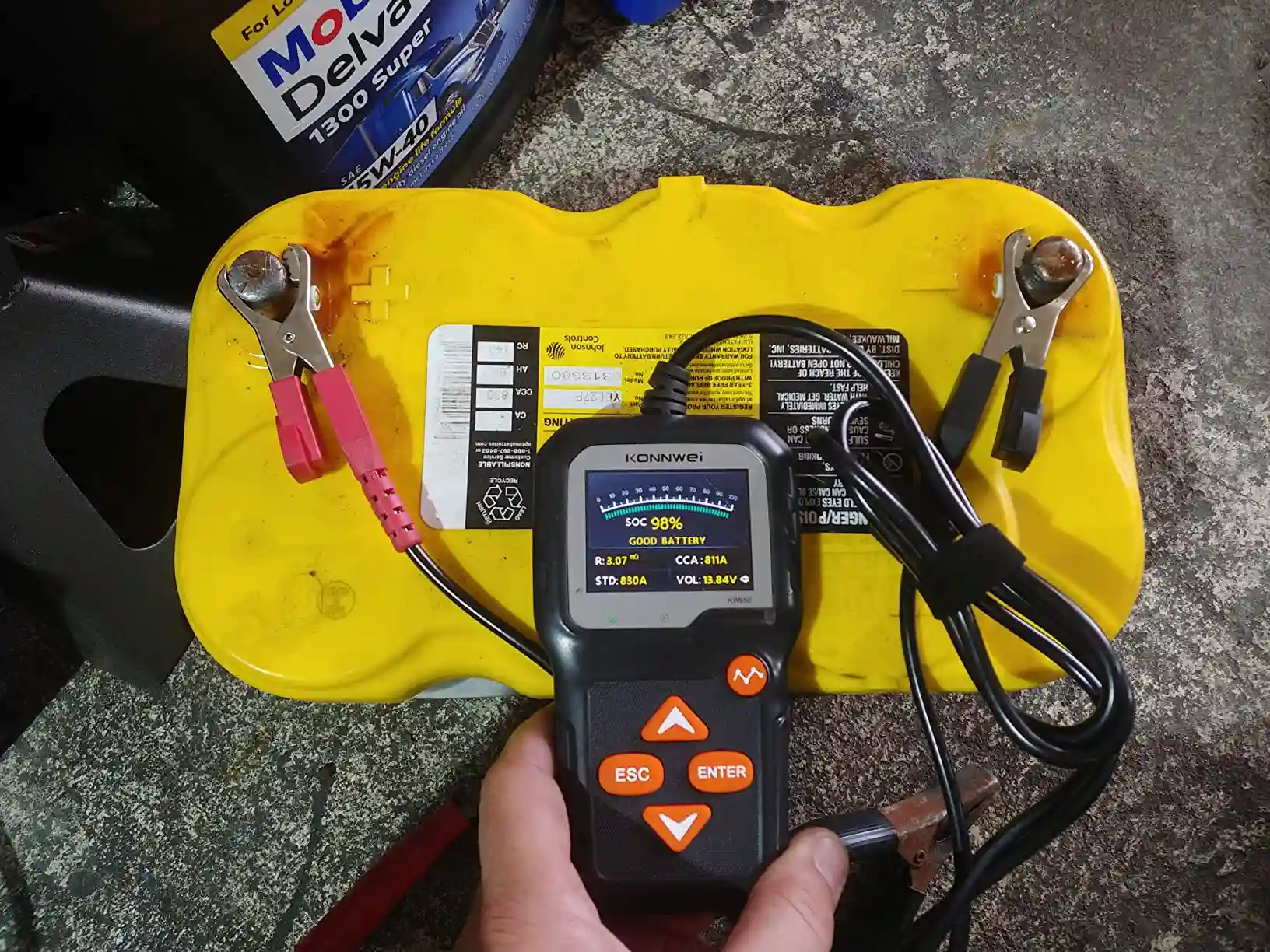
A dedicated battery tester estimates the CCA your battery can still deliver. Compare that estimate with the number on the label. The arithmetic turns a tester reading into a decision. Take a battery rated at 600 CCA:
| Tester estimate | Share of label rating | Verdict |
|---|---|---|
| 510 CCA | 85% | Keep it. Retest before next winter |
| 420 CCA | 70% | Plan replacement before the cold arrives |
| 300 CCA | 50% | Replace it now |
Those percentages are arithmetic on the label rating, not a maker’s pass mark, and tester estimates vary between tools. The logic holds regardless: the label number was the battery’s strength when new, at 0°F, and winter asks for close to that strength while the battery can offer less of it every year. A battery at half its rated CCA in October has no reserve for a 0°F morning with thick oil. Our car battery testers guide covers the tools; most parts stores will run the check in a few minutes.
When you buy, meet or beat the original specification. AAA’s rule: choose a battery that meets or exceeds the original ratings, and if the car came with an AGM battery, replace it with another AGM. Engineer Fix adds that exceeding the original CCA specification is generally acceptable and buys margin for severe winters.
Every sign, matched to its test
Most sign lists stop at the symptom. This table pairs each sign with the check that confirms or clears the battery, and the number that separates a pass from a fail.
| Sign | The check that decides it | Verdict |
|---|---|---|
| Slow, dragging crank | Cranking voltage on a charged battery | Above 9.6V at about 70°F passes. Under 9.6V means failing under load |
| Rapid clicking | Resting voltage after a full charge and rest | Will not pass 12.4V means replace the battery |
| Dim lights during the start | Resting voltage, then cranking voltage | Both low means battery. Resting fine, cranking low means failing under load |
| Electrical glitches at start-up | Resting voltage against the BCI ladder | Under 12.4V after charging means the battery cannot hold charge |
| Repeated jump starts | Resting voltage the morning after a full charge | Flat again means battery, alternator or drain. Test all three |
| Battery warning light lit | Running voltage at 2,000 rpm with loads on | 13.7V to 14.7V clears the alternator. Under 13.5V means charging fault |
| Swollen case, leak or rotten egg smell | Eyes and nose. No meter needed | Replace the battery and check the charging system |
| Corrosion on terminals | Clean to bright metal, then retest | Readings recover means connections. Still low means battery |
| Age over four to five years | Tester CCA estimate against the label rating | Near half the label CCA means replace before winter |
If the car will not crank at all, this guide is the wrong one. Our car won’t start but lights come on guide covers the full no-crank diagnosis in order, from the battery through the starter to the safety switches.
What the fix costs
Test first, because the two ways to buy a battery live in different price brackets. Car Repair Atlas, citing RepairPal’s September 2026 national estimate, puts a shop replacement at $456 to $493, with parts at $394 to $403 and labor at $61 to $90, before taxes and fees. The battery alone costs far less: AAA prices a standard battery at about $45 to $150 and an AGM at $150 to $250. Many parts stores test and install free or for a small fee, which closes most of the gap.
Return the old battery to avoid the core charge. And if your car has a start-stop system, it likely uses an AGM battery that needs registering with the car’s computer after replacement, which is a job for a shop with the right tool. That October test is the difference between parts-store money on a Saturday you chose and shop money on a morning the weather chose.
When to stop and call a mechanic
Hand the job over when any of these show up:
- The battery case is cracked, leaking or swollen, or a post moves in the lid. That battery gets replaced, not charged.
- You smell rotten eggs strongly, see smoke, or a cable gets hot during testing.
- Running voltage sits above 15.0V. Overcharging damages electronics and boils batteries. Stop driving the car.
- The battery may be frozen after sitting discharged in hard frost. Ice can rupture the case. Do not jump or charge it until it has thawed and been inspected.
- The battery passes every test and the car still cranks slowly or clicks. The fault sits in the cables, the starter or the control circuit.
- The car has a start-stop system and the new AGM battery needs registering with the computer.
Ask the shop for the readings, not just a verdict. The numbers in this guide let you check their work.
What to do next
Work in this order, in October rather than January:
- Look at the battery. Swollen case, leak or rotten egg smell means replace it now and check the charging system.
- Clean both terminals to bright metal and tighten the clamps. Corrosion fakes every sign in this guide.
- Check the date code. Past four to five years, test with suspicion.
- Charge the battery fully. Budget the hours: amp-hours times depth of discharge, divided by charger amps, plus 10% to 25% for losses.
- Rest the battery, then read resting voltage. Under 12.4V after a full charge and 12-hour rest means the battery is failing. Replace it.
- Crank-test with a helper. Above 9.6V at about 70°F passes. Under 9.0V on a charged battery means replace it.
- Get a CCA estimate and compare it with the label rating. Near half means replace before the cold arrives.
- Start the engine, hold near 2,000 rpm, loads on. 13.7V to 14.7V clears the alternator. Under 13.5V means fix the charging system first.
- Match your sign to its test in the table above and act on the row you land on.
Do those in order and winter stops being a gamble. The battery either proves it has the margin for a cold morning, or it tells you in fall, while the fix is cheap and scheduled.
Sources & Further Reading
- AAA Club Alliance, 8 signs your car battery is dying: the sign list, three to five year life, heat more damaging than cold, CCA rated at 0°F, manufacture date advice.
- Engineer Fix on the signs of a dying car battery: slow crank and clicking mechanisms, dim lights that brighten with revs, warning light meaning a charging fault.
- Engineer Fix starter current draw ranges: draw by engine size; a starter pulling 150 amps warm might draw 300 amps on a cold winter start.
- Engineer Fix on what CCA means: CCA as current for 30 seconds at 0°F holding 7.2V; CA at 32°F; meet or exceed the original CCA.
- Battery University BU-903, how to measure state of charge: BCI resting table, 12.65V at 100% to 11.89V discharged, at 78°F after 24 hours rest.
- Battery University BU-410, charging at high and low temperatures: BCI freezing points by specific gravity; freezing means permanent damage.
- Battery Tender multimeter testing guide: resting ladder, 9.6V cranking floor, 13.7V to 14.7V running voltage, the 12.4V retest verdict, charge-time formula.
- Trojan Battery lead acid FAQs: freezing at -92°F fully charged and about 16°F at 40% charge; capacity down 10% per 15°F below 80°F.
- Car battery replacement cost breakdown: RepairPal September 2026 estimate of $456 to $493 installed; AAA part prices; free testing at many parts stores.
- Our car won’t start but lights come on guide: the full no-crank diagnosis.
- Our sitting-for-a-week guide: parasitic draw testing.
- Our swollen car battery guide: causes and safety steps for a bulging case.
- Our battery terminal corrosion guide: cleaning terminals to bright metal.
- Our car battery testers guide: testers that estimate CCA.
- Our car battery charger guide: charger sizing and charge-time maths.
Every figure in this guide comes from a page opened and read on 25 November 2026. The CCA percentages and cold-weather capacity figures are arithmetic from those sources on stated ratings and rules of thumb, not measured results.
Automotive Safety Notice
Lead-acid batteries produce flammable hydrogen gas and contain corrosive sulfuric acid. Always wear ANSI-rated eye protection, disconnect the negative terminal before electrical servicing, and consult an ASE-certified technician for fuel leaks or high-voltage hybrid systems.

Alexander Reed, MEng
Automotive engineer (MEng, 2021) specializing in no-start diagnostics, parasitic draw isolation, and starter-charging systems.
Verified Gravatar Profile ↗

Reader Discussion & Questions
2 Comments