

Table of Contents (11 Sections)
Starter replacement cost runs $565 to $796 at a shop, with parts at $375 to $516 and labor at $191 to $280, per RepairPal’s national estimates updated September 2026. Do the job yourself and the same repair drops to the price of the part, which CarParts.com puts at roughly $150 to $400 for most everyday cars. One condition decides whether either bill makes sense: prove the starter is guilty first, because a corroded cable copies a dead starter and costs almost nothing to fix.
Why the same job costs $565 on one car and double on another
A starter is a starter. Two bolts, two cables, one motor. The repair bills disagree because the part is the small half of the story and access is the big half.
CarParts.com lays out the spread plainly. Some starters sit in plain sight under the car and swap in about an hour or less. Others hide under intake manifolds, engine mounts or subframes and book 3 to 6 hours or more of labor. Their example is the 2007 Toyota Tundra, where the starter comes out through the wheel well with a large part of the exhaust system removed on one side, for a five-hour labor charge. The part on that truck is ordinary. The path to it is not.
Engineer Fix reaches the same conclusion from the rebuild side: access difficulty is the main factor influencing labor time, with some vehicles requiring intake manifold removal to reach the unit. Vehicle type moves the parts bill too: CarParts.com notes compact commuter cars are often cheapest, while many European luxury cars use pricier components and need extra disassembly.
So “what does it cost” starts with a different question: where did the factory put yours?
What a shop charges: the split
RepairPal’s estimator, read directly for this post, puts starter replacement at $565 to $796 on average, with parts at $375 to $516 and labor at $191 to $280, in estimates last updated September 3, 2026. That range excludes taxes and fees, and RepairPal warns that related repairs may also be needed.
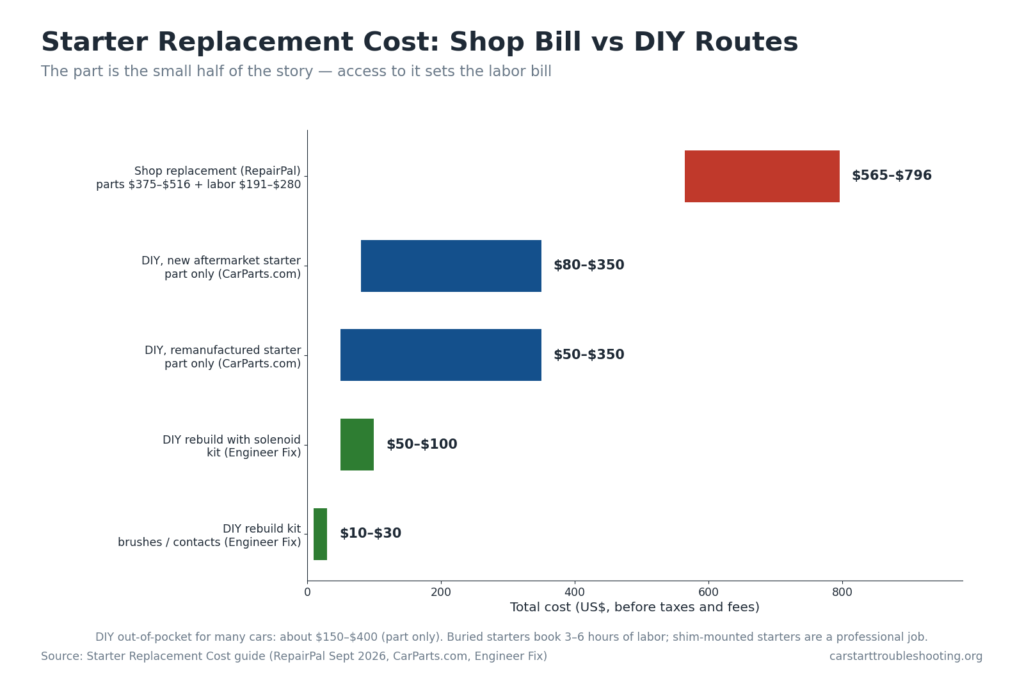
CarParts.com, working from repair-database data, lands in the same neighborhood: professional replacement typically runs $500 to $900 total, with many national averages clustering near $700 to $800, and the full spread runs $250 to $1,200 from simple, accessible engines to tightly packaged vehicles and metro dealerships.
Labor is where quotes drift apart. Engineer Fix puts mechanic labor rates at $70 to $150 per hour, with a full replacement taking one to three hours. CarParts.com puts shop rates higher, around $100 to $250 per hour, booking 1 to 4 hours. The lesson: the hourly rate matters less than the hours booked, and the hours booked are set by access.
A fair shop quote also includes diagnosis. RepairPal describes the standard path: the mechanic connects the car to a starting and charging system test machine, inspects while testing, and if the starter is found at fault it comes out, gets a bench test, and gets replaced. A quote that skips the test machine and the bench test is a guess with a price tag. RepairPal also recommends a high-quality replacement starter and solenoid, noting that an OEM starter can reduce the risk of another replacement later.
What DIY really costs
The DIY case is simple on paper: you buy the part and keep the labor money. CarParts.com puts the DIY out-of-pocket cost near the $150 to $400 mark for many vehicles, against the $500 to $900 shop range. Their parts-only breakdown: a new aftermarket starter runs about $80 to $350, a remanufactured starter roughly $50 to $350, and premium or luxury applications stretch above $500.
There is a cheaper route still, for the right failure. Engineer Fix prices a standard starter repair kit, covering the common wear items, at about $10 to $30 for many common applications, and even a comprehensive kit with a new solenoid rarely exceeds $50 to $100 in parts. A rebuild suits a failure limited to brushes, solenoid contacts or bushings, especially on an older, high-quality OEM starter whose core is still sound. The primary cost is your time: removal, disassembly, cleaning, reassembly and reinstallation, which Engineer Fix notes can be significant depending on accessibility.
Tools are the hidden line item. CarParts.com lists the essentials: a floor jack and stands rated for the vehicle, a socket set with extensions and a breaker bar, a torque wrench for reinstall, and safety glasses and gloves. If those already live in your garage, the DIY saving is real. If you buy them for one job, count them against the labor saved.
Time is the other honest cost. Shops book 1 to 4 hours for this work per CarParts.com, and Engineer Fix puts a professional job at one to three hours. A first-time DIY job runs longer than book time. On a buried starter, the book time is the warning: if a shop needs five hours on a Tundra, the driveway version eats a weekend.
One caution from CarParts.com belongs in every DIY plan: many parts and extended warranties require proof of professional installation for future claims, so a DIY install can void the very warranty that made the part attractive.
Before you pay anyone: prove the starter is guilty
Here is the part the price guides skip. The starter is the most expensive suspect in a no-crank, and the cheapest suspects wear the same symptoms. Engineer Fix states the split directly: low current draw with slow cranking usually traces back to corroded terminals, loose connections or damaged wiring, even when the starter motor itself is fine. RepairPal adds that a starter that will not turn the engine could be caused by a faulty ignition switch, a blown fuse or a bad solenoid. Four checks, in order, settle it before money moves.
Check one: read the resting voltage. Surface charge fools this reading, so rest matters. Battery University puts the minimum rest at four hours for an accurate reading, with battery makers recommending 24 hours for lead acid. In a hurry, switch the headlights on for 2 minutes with the engine off, switch them off, wait 5 to 10 minutes, then measure across the battery posts.
| Resting voltage (12V flooded) | Charge level | What to do |
|---|---|---|
| 12.65V | 100% | Move on to the cranking test |
| 12.45V | 75% | Charge it before you judge it |
| 12.24V | 50% | Recharge, then test again |
| 12.06V | 25% | Recharge now, then test again |
| 11.89V | 0% | Full recharge, then test again |
Those figures come from the BCI table in Battery University BU-903, read at 78°F after a 24-hour rest. An AGM battery rests higher, around 12.8V to 13.0V when full.
Check two: watch the voltage while cranking. Have a second person turn the key while you watch the meter across the terminals. At about 70°F, a good battery holds above 9.6V during cranking. A reading of 9.0V to 9.6V signals a weak battery. Under 9.0V on a fully charged battery means the battery needs replacing, and every starter quote waits until the battery question closes. This test only means something on a charged battery, so charge first if the resting reading came back under 12.4V.
Check three: run the voltage drop test. A cable can look fine and fail under starter load, because corrosion hides inside clamp rings and under insulation. Fluke’s procedure measures the loss directly: red probe on the battery positive post, black probe on the starter motor’s main stud, crank for 4 to 5 seconds. Then repeat on the ground side: black probe on the starter housing or engine block, red probe on the battery negative post. Fluke puts an acceptable total drop at 0.2V to 0.5V, about 0.3V on the positive side and 0.2V or less on the ground side. Anything higher points to corrosion, loose terminals or damaged cables. Our battery terminal corrosion guide covers the cleaning method and this test in full.
Check four: prove the control side at the S terminal. The starter has two electrical connections: the thick cable on the main stud and a thin wire on the small terminal, usually marked S. Red probe on the S terminal, black probe on a good ground, helper turns the key to Start. Battery voltage at the S terminal during the attempt means the ignition switch, relay, safety switch and wiring all did their jobs. The fault then sits in the solenoid, the motor, or the main cables you already checked. No voltage there sends you back up the control circuit: fuses, relay, safety switch. Our single click guide walks this proof in full.
A clamp-on ammeter adds a fifth piece of evidence where one is available. Engineer Fix puts normal draw at 100 to 200 amps for a warm four-cylinder, 150 to 250 amps for a six-cylinder, over 300 amps for a large V8 and 400 amps or more for a diesel, with cold oil able to double the draw. Draw far above the range, with battery and cables proven good, points inside the starter or at a stiff engine. Keep attempts short: no more than 10 to 15 seconds of cranking.
Pass the first four checks and the battery, cables and control side are cleared. Whatever symptom remains belongs to the starter or the engine it turns. Our bad starter symptoms guide pairs each warning sign with the measurement that confirms it.
The decision table: your situation, the right route, the bill
Price guides give you a range. This table gives you a route. Find your row after the four checks above.
| Your situation | Right route | What it costs |
|---|---|---|
| Battery fails resting or cranking test | Charge or replace the battery. No starter work | Battery price only. The starter was never guilty |
| Voltage drop over 0.5V total | Clean terminals, repair or replace the cable. No starter work | Cleaning supplies or a cable. Far under any starter bill |
| No voltage at the S terminal | Fuses, relay, safety switch, ignition switch. No starter work | Small parts, found by the control-side checks |
| Starter convicted, easy access, tools on hand | DIY replacement | Part only: about $80 to $350 aftermarket or $50 to $350 remanufactured per CarParts.com |
| Starter convicted, failure limited to brushes or solenoid contacts, core sound | DIY rebuild | Kit about $10 to $30, or $50 to $100 with a solenoid, per Engineer Fix. Plus your time |
| Starter convicted, buried under intake or subframe | Shop replacement | RepairPal range $565 to $796, higher where access books 3 to 6 hours |
| Starter convicted, older vehicle with shim-mounted starter | Shop replacement, per RepairPal | RepairPal range. Shim mistakes can damage the flywheel |
| Grinding on cranking attempts | Stop cranking. Shop, now | Starter bill plus possible flywheel damage if you kept trying |
| Car under warranty or recall | Dealer | Covered repairs cost the owner nothing where the warranty or recall applies |
Read the table from the top. The first three rows end the job for the price of a battery, a cable or a relay. The starter rows only start after the checks clear everything cheaper.
When DIY saves money, and when it costs more
DIY wins on a specific car: the starter convicted by tests, visible from underneath, two bolts and two cables, no intake manifold in the way, and the tools already in the garage. On that car you keep the $191 to $280 of labor in RepairPal’s range and pay only the part. CarParts.com calls that out-of-pocket cost roughly $150 to $400 for many vehicles. That is real money saved for an afternoon of work.
DIY loses in four situations, and each one is named in the sources above.
Buried access. If the starter lives under the intake manifold, the job stops being a starter swap and becomes a teardown with a starter swap inside it. CarParts.com adds the risk side: collateral damage or air leaks from disturbing intake and steering components can outweigh the labor saved.
Shim-mounted starters on older vehicles. RepairPal is blunt about this one. On many older vehicles the starter is installed using shims to align it correctly, and RepairPal recommends a professional mechanic for those cars because mistakes could damage the engine’s flywheel or other parts. Alignment is not a guess you get to make twice.
Warranty conditions. CarParts.com warns that many parts and extended warranties require proof of professional installation for future claims. Fit the part yourself and the warranty you paid for may be worth nothing when the part fails early.
Live-cable safety. The starter’s main cable is live at all times, connected straight to the battery. RepairPal’s replacement procedure starts with disconnecting the battery to prevent electrical shock or damage to electronic components, and their DIY answer repeats the warning. Disconnect the negative terminal before a wrench touches anything.
Rusted mounting bolts belong on the same list. CarParts.com counts corrosion, oil leaks and damaged wiring among the extras that move a shop bill, and they move a DIY afternoon the same way: a snapped bolt turns a one-hour job into a drilling job under a car on stands.
Rebuild or replace: the middle option
Between the $565 shop bill and the full DIY swap sits the rebuild. Engineer Fix frames the choice cleanly: rebuilding suits a failure limited to solenoid contacts, brushes or bushings, especially on an older, high-quality OEM starter with a sound core. Replacement wins when core components carry permanent damage, such as a burnt-out armature or damaged field coils.
CarParts.com adds the cost-per-mile view: replacement is usually smarter when the starter is old and high-mileage, when there is internal damage, burning or heavy corrosion, or when access labor is high, because paying that labor twice to chase intermittent issues is expensive. A remanufactured unit, rebuilt with new wear parts and a warranty, sits between the two on price and risk.
The practical rule: if access is easy and the failure is brushes or contacts, a $10 to $30 kit is the cheapest correct answer. If access is painful, fit the best complete unit you can afford once, and never pay the access labor twice.
How to read a quote before you sign it
CarParts.com gives a four-step sanity check. Look up a ballpark range for your vehicle first. Compare the parts pricing: ask which brand and type of starter is being fitted, OEM, aftermarket or remanufactured, and cross-check that bracket against major parts retailers. Evaluate labor hours rather than the hourly rate alone, and if one quote lists double the labor of the others, ask what extra disassembly it includes. Factor in warranty, because a long parts and labor warranty can beat a bargain install with a parts-only guarantee.
Add two questions of your own. Ask what the starting and charging system test showed, and ask for the bench test result on the old starter. RepairPal describes both as standard practice. A shop that ran the tests before quoting can show you numbers. A shop that quoted from the symptom is selling you the most expensive guess in the no-crank chain.
If the car makes no sound at all, our car won’t start but lights come on guide covers the silent version in order.
When to stop and call a mechanic
Hand the job over when any of these show up:
- The starter is shim-mounted. RepairPal flags shim alignment as a professional job because mistakes can damage the flywheel.
- The starter sits under the intake manifold, engine mounts or a subframe, and you have never done that teardown before.
- Grinding on any cranking attempt. Every try chews the flywheel ring gear further.
- The starter stays engaged after you release the key, or keeps running with the key off. Switch off, disconnect the negative battery cable if you can do it safely, and tow it.
- You smell burning, see smoke, or a cable gets hot during attempts.
- Current draw reads far above the range for your engine. The engine itself may be resisting, and that needs shop equipment.
- Battery, cables and control side all test good and the car still will not crank. The starter needs a bench test before anyone sells you a replacement.
Ask the shop for the readings: resting voltage, voltage during the attempt, voltage drop on both sides, voltage at the S terminal, and the bench test result on the old starter. Numbers tell you whether the repair fixed the fault or just the symptom.
What to do next
Work in this order:
- Name the symptom, then run the four checks: resting voltage against the ladder, cranking voltage above 9.6V on a charged battery, voltage drop under 0.5V total, voltage at the S terminal during the attempt.
- Stop at the first failed check and fix that branch. Battery, cable and control-side faults all end the job for small money.
- If the starter is convicted, find out where it lives on your car. Visible from underneath means DIY stays on the table. Buried or shim-mounted means a shop.
- Price the part before you price the job: aftermarket, remanufactured and OEM brackets differ by hundreds of dollars on the same car.
- Compare any shop quote against the RepairPal split, parts $375 to $516 and labor $191 to $280, and ask what the system test and bench test showed.
- Pick your route from the decision table, book it or do it, and retest after the fix: smooth, strong cranking with no grinding or abnormal noise.
Do those in order and the starter bill, whichever route you take, pays for a proven fault. Either way, you stop buying starters for wiring faults.
Sources & Further Reading
- RepairPal starter replacement cost estimate: national average $565 to $796, parts $375 to $516, labor $191 to $280, updated September 3, 2026; starting and charging system test and bench test before replacement; battery disconnected first; shim-mounted starters on older vehicles flagged as a professional job; DIY risk warning on live cables.
- Engineer Fix on starter rebuild cost: DIY repair kit about $10 to $30, comprehensive kit with solenoid rarely over $50 to $100; mechanic labor $70 to $150 per hour; professional job one to three hours, $150 to over $1,100 total; access as the main labor factor; rebuild versus replacement guidance.
- CarParts.com starter replacement cost guide: professional replacement $500 to $900 typical, $250 to $1,200 across vehicles; new aftermarket parts $80 to $350, remanufactured $50 to $350, premium above $500; labor $100 to $250 per hour booking 1 to 4 hours, buried starters 3 to 6 hours or more; 2007 Toyota Tundra five-hour labor example; DIY out-of-pocket near $150 to $400; tool list and warranty cautions.
- Engineer Fix starter current draw ranges: 100 to 200 amps for four-cylinder engines when warm, 150 to 250 for six-cylinder, over 300 for large V8 engines, 400 or more for diesels; cold oil can double the draw; crank no more than 10 to 15 seconds; high draw points to mechanical resistance or internal starter faults, low draw to high resistance in cables and connections.
- Fluke starter circuit voltage drop guide: acceptable voltage drop of 0.2V to 0.5V total while cranking, about 0.3V positive side and 0.2V or less ground side; crank for 4 to 5 seconds; disable ignition or fuel before the test; warm cables signal internal failure.
- Battery University BU-903, how to measure state of charge: BCI resting voltage table for a 12V flooded starter battery, 12.65V at 100% down to 11.89V discharged, readings at 78°F after a 24-hour rest; minimum four hours rest before measuring; AGM rests slightly higher.
- Our car won’t start but lights come on guide: the full no-crank diagnosis, including the silent version of this fault.
- Our single click guide: the click-location test and the S-terminal proof in full.
- Our bad starter symptoms guide: each warning sign paired with the measurement that confirms it.
- Our battery terminal corrosion guide: cleaning terminals and the voltage drop test in full.
Every figure in this guide comes from a page opened and read on 25 November 2026.
Automotive Safety Notice
Lead-acid batteries produce flammable hydrogen gas and contain corrosive sulfuric acid. Always wear ANSI-rated eye protection, disconnect the negative terminal before electrical servicing, and consult an ASE-certified technician for fuel leaks or high-voltage hybrid systems.

Alexander Reed, MEng
Automotive engineer (MEng, 2021) specializing in no-start diagnostics, parasitic draw isolation, and starter-charging systems.
Verified Gravatar Profile ↗

Reader Discussion & Questions
0 Comments