

Table of Contents (18 Sections)
The most common bad fuel pump symptoms are long cranking, sputtering under load, loss of power on hills, surging, stalling, a loud whine from the tank, trouble that shows up when the engine is hot, and a crank-no-start where the engine turns at normal speed and never fires. Every one of those signs also fits cheaper faults, so work the exclusion order below and let a pressure gauge settle the argument before you buy a pump.

Why symptoms alone cannot convict a fuel pump
A fuel pump has one job. The pump moves gasoline from the tank to the injectors at a set pressure and flow rate, and the engine needs that supply every second it runs. When delivery falls short, the mixture leans out and the engine starves.
The trouble with diagnosing by symptoms is overlap. Engineer Fix puts the early signs under load: hard acceleration or a steep hill raises fuel demand, a weak pump cannot hold pressure, and the driver feels hesitation, sputtering or a flat loss of power. A clogged fuel filter produces the same starved feeling, because a restriction anywhere in the line starves the rail the same way a weak pump does. A relay with burned contacts can starve the pump of voltage, and a pump running on low voltage delivers low pressure even with healthy internals. Ignition faults copy the list from the other side.
Price turns that overlap into a financial problem. RepairPal’s September 2026 national estimate puts fuel pump replacement at $1,344 to $1,513, while the same estimator puts relay replacement at $89 to $108 and filter replacement at $258 to $322. Approve the pump on symptoms alone and you can spend four figures fixing a two-figure electrical fault. The gap between those bills is the whole case for testing first.
So treat every symptom in the next section as a reason to test. A symptom earns a measurement. The measurement earns the repair.
The 8 bad fuel pump symptoms worth taking seriously
Sign 1: Long cranking before the engine fires
The starter turns the engine for several seconds before combustion begins, often worst after the car has sat. A healthy system holds pressure in the lines after shutdown, so the next start fires fast. A pump with a leaking check valve lets that pressure bleed back to the tank, and the pump must rebuild pressure from zero on every start. Cycling the key on and off twice before cranking can shorten the crank when pressure buildup is the problem. The clue still needs a gauge behind it.
Sign 2: Sputtering at highway speed or high rpm
The car runs acceptably around town, then stumbles when speed or engine speed climbs. Fuel demand rises with load, and a marginal pump falls behind at sustained demand. Engineer Fix describes the same pattern under hard acceleration and on steep hills.
Sign 3: Loss of power when you press the accelerator
Gentle driving feels normal. A firm press of the pedal produces a flat, reluctant response, sometimes a stumble that feels like the tank ran dry for a second. Demand exposes weakness that low-demand driving hides.
Sign 4: Surging or hesitation
Power rises and falls without a matching change in pedal position, or the engine pauses before it answers the pedal. Inconsistent delivery makes the supply unstable, and the engine surges on the surplus and hesitates on the shortage.
Sign 5: Stalling while driving
The engine cuts out, sometimes under acceleration, sometimes at steady speed. A pump that quits intermittently removes fuel delivery in one stroke, and the engine stops. Stalling in traffic is a safety problem first and a diagnosis problem second, so treat repeated stalls as a reason to stop driving the car until a test names the fault.
Sign 6: A loud whine or buzz from the tank
Most electric pumps make a faint hum during the prime at key-on. A pump that grows noticeably louder, or develops a high-pitched whine that was absent before, deserves attention. Change in sound carries the signal. A restriction, contamination or a worn motor can all raise pump noise, so sound alone cannot confirm failure.
Sign 7: Trouble that shows up hot
The car starts cold, drives fine, then stalls or refuses to restart after a hot soak, and runs again after cooling down. Engineer Fix ties that pattern to a pump motor overheating and cutting out, then recovering as it cools. Heat-sensitive electrical faults elsewhere in the circuit can copy the pattern, which is why the tests below must run while the fault is present.
Sign 8: Cranks at normal speed, never starts
The starter turns the engine briskly and combustion never begins. Fuel is one of the missing ingredients in that picture. Spark, compression, air supply or a dead crankshaft position sensor can produce the same silent crank, so a no-start needs the fuel-or-spark split before anyone orders parts. Our car cranks but won’t start guide runs that split in order.
Symptoms that appear when the tank runs low and ease after refueling point at the pickup area: a restricted strainer, contamination in the tank or a pump struggling at the bottom of its supply. Keeping at least a quarter tank also helps keep an in-tank pump cool, because the surrounding fuel carries heat away from the motor. A check engine light can join the list when the computer detects a fuel pressure or mixture fault, and the light names a condition rather than the failed part.
Rule out the cheap suspects first: the exclusion order
Work in this order and stop at the first check that fails. Each pass clears one suspect and moves the pump closer to guilty. The order runs from free checks to gauge work.
Step one: prove there is fuel in the tank. A fuel gauge can lie. A sender stuck at a quarter tank leaves you testing a pump on an empty tank. Add a gallon of fuel and try again before you test anything else.
Step two: listen for the prime. Turn the key to the on position without cranking and listen near the tank. Engineer Fix describes the prime as a brief low hum or whirring lasting about two seconds while the pump pressurizes the rail. Hearing the prime proves the motor runs and the circuit feeds it power. Delivery is a separate question, and only a gauge answers delivery. Silence at key-on sends you to step three, because a silent pump can mean a dead pump or a dead feed.
Step three: check the fuse and swap the relay. The pump circuit runs through a fuse and a relay, and either one can silence a healthy pump. Pull the fuel pump fuse and look for a broken metal strip. Then swap the fuel pump relay with an identical relay from a non-essential circuit, such as the horn, and listen for the prime again. A pump that primes after the swap has convicted the relay. RepairPal puts relay replacement at $89 to $108 with parts and labor, which is why this two-minute test outranks a pump purchase.
Step four: check the power and ground at the pump. A pump starved of voltage delivers low pressure with a healthy motor inside. Engineer Fix gives the voltage drop method: measure between the battery positive terminal and the pump positive terminal with the pump running, and the drop should ideally stay under 0.1 to 0.2 volts. A higher drop points at resistance in wiring or connectors. Run the same test on the ground side, from the pump ground terminal to the battery negative terminal, because poor grounding ranks among the common causes of pump underperformance. Battery voltage at the relay input with a much lower voltage at the relay output convicts the relay contacts.
Step five: clear the filter and strainer. A restricted filter or a clogged in-tank strainer limits flow and forces the pump to work against rising resistance, and the symptoms copy a weak pump closely. Some cars carry a serviceable inline filter, and many newer cars integrate filtration into the pump module inside the tank. RepairPal puts filter replacement at $258 to $322 nationally, still far below the pump bill, so a filter of unknown age deserves replacement or testing before the pump takes the blame.
Step six: split fuel from spark on a no-start. When the engine cranks at normal speed and never fires, watch the tachometer during cranking. A needle that never moves suggests the computer sees no crankshaft signal, and the computer withholds fuel and spark on purpose in that state. Scan codes help here as directions. A code records a condition the computer detected, and the failed part can sit anywhere in the circuit the code describes. Our OBD2 scanner guide covers reading codes and live data without turning a code into a parts order.
The fuel pressure test: three readings that settle it
Everything above narrows the suspect list. The pressure gauge closes the case. Fuel is flammable and the lines hold pressure after shutdown, so relieve system pressure following the service procedure for your car before you open any connection, and work away from ignition sources. A driver without the gauge, the adapters or the service procedure should hand this test to a shop. RepairPal puts general automotive diagnosis at $122 to $179.
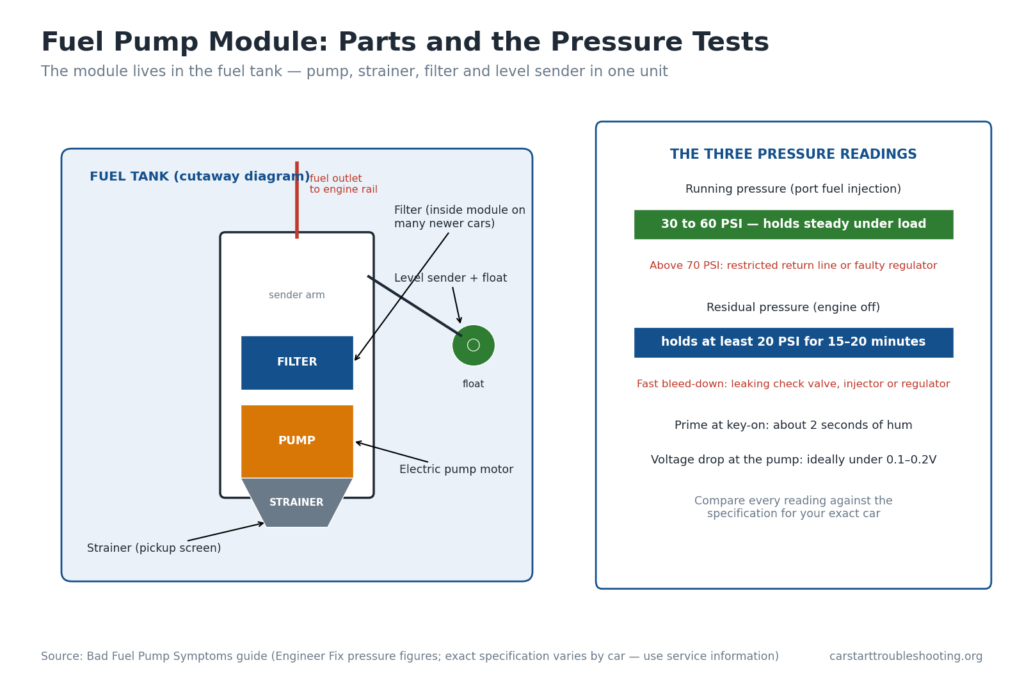
The gauge connects to the Schrader test port on the fuel rail where the car has one, or tees into the feed line with the correct adapters where the car has no port. Engineer Fix runs three readings, and each reading answers a different question.
| Reading | How you take it | What a healthy result looks like | What a bad result points at |
|---|---|---|---|
| Prime pressure | Key on, engine off, pump primes for about two seconds | Pressure builds at once toward the specification for your car | Zero pressure: dead pump or dead electrical feed. Low pressure: weak pump or restricted filter |
| Running pressure | Engine idling, then with a snap of the throttle | Holds steady in the specification window under load | Pressure that sags under load: pump flow cannot meet demand, or a restriction upstream |
| Residual pressure | Engine off, gauge watched for 15 to 20 minutes | Holds at least 20 PSI for 15 to 20 minutes | Fast bleed-down: leaking check valve in the pump, a leaking injector or a faulty regulator |
Engineer Fix puts running pressure for most gasoline engines with port fuel injection between 30 and 60 PSI, and stresses that the exact specification must come from the service manual for your car. Direct-injection systems run far higher pressures on the high-pressure side, so the 30 to 60 PSI window applies to the low-pressure supply side of port-injected engines. Treat any generic number, including the ones in this guide, as a screening range.
Read the three results together. Prime pressure low with running pressure low points at a weak pump, a restricted filter or low voltage at the pump, and the electrical checks in step four separate those three. Running pressure inside the window with residual pressure bleeding to zero in minutes points at the check valve inside the pump, a leaking injector or the regulator, and that pattern explains the long crank after sitting. Pressure far above the window, above 70 PSI on the systems Engineer Fix describes, points at a restricted return line or a regulator that fails to bleed off excess pressure. A pump can also pass a static pressure reading and still fail on volume, because pressure at idle asks little of the pump while acceleration asks a great deal.
One rule covers the whole test. Compare every reading against the specification for your car, taken under the conditions where the fault occurs.
Symptom, test, verdict: the decision table
Symptoms overlap. Measurements separate them. Find your sign, run its check, read the verdict.
| Sign | The one check that decides it | Verdict |
|---|---|---|
| Long crank after sitting | Residual pressure holds at least 20 PSI for 15 to 20 minutes | Holds: check valve fine, look elsewhere. Bleeds to zero: check valve, injector or regulator leak |
| Sputtering at speed or under load | Running pressure holds in specification with the throttle snapped open | Holds: pump cleared, test ignition and airflow. Sags: weak pump or restriction |
| Loss of power on hills | Same running pressure test under load | Same split as above |
| Surging or hesitation | Running pressure steady at idle and under load | Steady: pump delivery cleared. Unstable: delivery fault confirmed, find the cause in the exclusion order |
| Stalling while driving | Pressure reading taken while the fault occurs | Drops as it stalls: fuel delivery fault. Holds through the stall: ignition or sensor fault |
| Loud whine from the tank | Prime and running pressure against specification | In specification: monitor the noise. Low: pump or restriction, split by the electrical checks |
| Dies hot, restarts after cooling | Prime sound and pressure measured hot, during the fault | Absent hot and present cold: heat-sensitive pump motor or circuit fault |
| Cranks at normal speed, never fires | Prime sound at key-on, then prime pressure | Silent: fuse, relay or feed first. Primes with zero pressure: pump or feed. Pressure fine: spark side |
| Worse on a low tank | Repeat the failing test with the tank over a quarter full | Clears with fuel added: pickup, strainer or contamination. Unchanged: delivery fault elsewhere |
If the car will not crank at all, this guide is the wrong one. Our car won’t start but lights come on guide covers the no-crank diagnosis in order, from the battery through the starter to the safety switches. If a jump changes nothing either, our car won’t jump start guide covers that branch from the battery side.
Two patterns that confuse people
The first pattern starts after sitting. The car cranks long every morning, then starts fine all day. Resting pressure explains the split. A healthy system holds residual pressure overnight, so the first start fires on stored pressure. A leaking check valve inside the pump lets fuel drain back to the tank while the car sits, and the morning crank must rebuild pressure from zero before the injectors can deliver. Short stops during the day leave enough residual pressure to hide the leak. The residual pressure reading in the table above names this fault directly.
The second pattern dies hot. The car runs clean cold, stalls or refuses to restart after a hot drive, then behaves after cooling. Engineer Fix attributes the pattern to a pump motor overheating and cutting out, then recovering as temperature falls. Either way, the test must run hot. A shop that tests only on a cold engine will report a healthy fuel system on a car that strands its driver at every fuel stop.
What the fix costs
Test first, because the suspects live in different price brackets. RepairPal’s September 2026 national estimate puts fuel pump replacement at $1,344 to $1,513, with parts at $1,104 to $1,160 and labor at $241 to $353, before taxes and fees. Access drives much of the spread. AAA places commonly cited repairs around $1,150 to $1,400.
The cheaper suspects sit far below those figures. RepairPal puts fuel pump relay replacement at $89 to $108 and fuel filter replacement at $258 to $322. General automotive diagnosis runs $122 to $179 in the same estimator. A $150 diagnosis that finds a relay fault saves the owner most of a four-figure pump bill, and a diagnosis that confirms a dead pump still earns its fee by ruling out the wiring the new pump would inherit. Ask the shop for the pressure readings and the voltage at the pump in writing.
When to stop and call a mechanic
Hand the job over when any of these show up:
- You smell fuel strongly, see a leak, or find damaged fuel lines. Fuel work with an active leak belongs in a shop.
- The car stalls in traffic or loses power unpredictably. Park it and arrange diagnosis or a tow.
- Your car has no test port and the service procedure calls for adapters or high-pressure work you cannot do safely.
- Pressure readings pass cold and the fault only appears hot. The test needs to run during the failure.
- Every check above passes and the car still cranks without firing. The missing piece needs live data and service information for your exact engine.
What to do next
Work in this order:
- Name the sign. Long crank, sputtering, power loss, surging, stalling, whine, hot trouble or crank-no-start. Note when the fault happens: cold or hot, full tank or low, idle or under load.
- Add a gallon of fuel if the gauge reads low, and try again. Sender faults mimic pump faults for free.
- Listen for the two-second prime at key-on. Present means the motor runs. Absent sends you to the fuse and relay.
- Check the fuel pump fuse, then swap the relay with an identical relay from a non-essential circuit. A prime after the swap convicts the relay.
- Measure voltage at the pump and run the voltage drop test on feed and ground. Drops under 0.1 to 0.2 volts clear the wiring.
- Clear the filter and strainer, by service history or by replacement where the filter is serviceable.
- On a crank-no-start, watch the tachometer while cranking and read scan codes as directions. Zero rpm points away from fuel delivery.
- Run the three pressure readings against the specification for your car. Test hot if the fault runs hot.
- Match your sign to its check in the decision table and fix the row you land on. Retest after the fix, because a second fault can hide behind the first.
Do those in order and the symptoms either clear the pump or convict it with numbers. Either way, you stop buying pumps for wiring faults.
Sources & Further Reading
- Engineer Fix on diagnosing a bad fuel pump: early signs under load, the two-second key-on prime, relay swap test, prime pressure between 30 and 60 PSI compared against manufacturer specifications, residual bleed-down from a faulty check valve, clogged filter and regulator as mimics.
- Engineer Fix fuel pump pressure and electrical checks: pressure relief before opening lines, Schrader test port on the fuel rail, running pressure of 30 to 60 PSI for port fuel injection with the exact specification from the service manual, residual pressure holding a minimum of 20 PSI for at least 15 to 20 minutes, pressure above 70 PSI pointing at a return restriction or regulator, voltage drop at the pump ideally under 0.1 to 0.2 volts.
- Mechanic Fixa on bad fuel pump symptoms: the ten common signs, sound change as the meaningful clue, low-fuel symptoms pointing at the pickup area, pressure and volume as separate questions, filter, relay, injector, ignition and sensor faults as mimics.
- Car Repair Atlas fuel pump replacement cost guide: RepairPal September 2026 national estimate of $1,344 to $1,513, parts $1,104 to $1,160, labor $241 to $353; access through a rear seat panel or by lowering the tank; keeping at least a quarter tank helps keep in-tank pumps cool.
- ThePricer fuel pump replacement cost guide: RepairPal September 2026 figures for the pump job, general diagnosis at $122 to $179, relay replacement at $89 to $108, filter replacement at $258 to $322; AAA commonly cited repairs around $1,150 to $1,400.
- Our car won’t start but lights come on guide: the full no-crank diagnosis when the starter never turns.
- Our car cranks but won’t start guide: the fuel, spark and sensor split for a crank-no-start.
- Our car won’t jump start guide: behavior during a failed jump, including the cranks-but-never-fires branch.
- Our OBD2 scanner guide: reading codes and live data without turning a code into a parts order.
Every figure in this guide comes from a page opened and read on 25 November 2026. Fuel pressure specifications vary by car; compare every reading against the service specification for your exact engine.
Automotive Safety Notice
Lead-acid batteries produce flammable hydrogen gas and contain corrosive sulfuric acid. Always wear ANSI-rated eye protection, disconnect the negative terminal before electrical servicing, and consult an ASE-certified technician for fuel leaks or high-voltage hybrid systems.

Alexander Reed, MEng
Automotive engineer (MEng, 2021) specializing in no-start diagnostics, parasitic draw isolation, and starter-charging systems.
Verified Gravatar Profile ↗
Reader Discussion & Questions
1 Comments