
Table of Contents (12 Sections)
If your car won’t jump start, stop cranking and read what the car just told you. A correct jump with good cables rules the battery in or out. When the jump fails, the behavior during the attempt names the next suspect. Rapid clicking points at the cables. One solid click points at the starter. Silence points at the control side. A normal crank that never fires points at fuel or spark. An engine that starts, then dies when the cables come off, points at the alternator. Match your symptom below and test that branch.
First, was the jump itself right?
Half of failed jumps fail before the key turns. The setup was wrong, the cables were weak, or nobody waited.
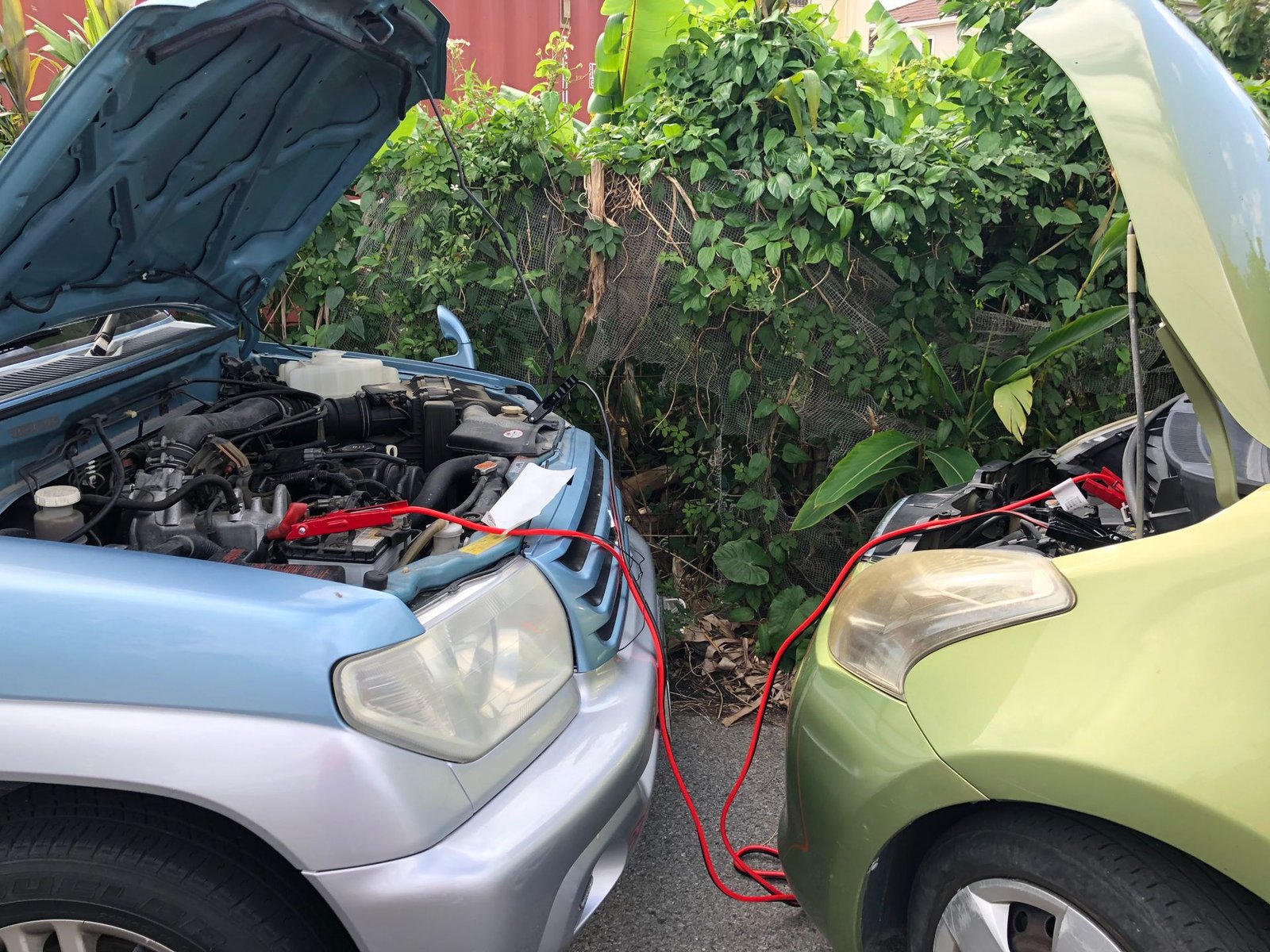
Red clamp to the dead battery’s positive terminal. The other red clamp to the good battery’s positive terminal. Black clamp to the good battery’s negative terminal. The last black clamp to bare metal on the dead car’s engine, away from its battery. AAA puts that last clamp on unpainted metal like a bolt or the engine block, because the final connection can spark and a dead battery can vent hydrogen gas.
Then wait. AAA says to start the working car and let it run a minute or two before trying the dead car, and to wait a few more minutes if the first try fails. A flat battery needs that time to take a surface charge. Cranking the second the clamps land asks the cables to carry everything, and thin cables cannot. AAA also puts jumper cables at 10 to 20 feet.
Our guide to jumping a car with jumper cables covers the full setup. If your jump followed that order, with the donor running and a few minutes of wait, the jump was right.

Read the failed jump: behavior splits the diagnosis
Every guide on this symptom lists causes. None of them ask what the car did while you tried. The behavior during the attempt rules out whole groups of causes before you touch a tool.
| What happens during the jump | Most likely group | Next check |
|---|---|---|
| Still rapid-clicks | Cables too thin, poor clamp contact, or ground path | Reseat each clamp on clean metal, wait longer, then the voltage drop test |
| One solid click, no crank | Starter motor or solenoid | Battery voltage during the attempt, then voltage at the starter |
| Silence, dash lights on | Relay, ignition switch, safety switch, fuse, immobilizer | Shifter in Park or Neutral, spare key, then fuses and relay |
| Cranks at normal speed, never fires | Fuel delivery or ignition | Fuel pump prime sound, security light, then scan codes |
| Starts, then dies when the cables come off | Alternator or charging system | Running voltage. 13.7V to 14.7V is the pass mark |
| Clicks slow down and die away | Battery too far gone to accept charge | Resting voltage ladder, then charge and retest |
| Heavy click, engine will not turn by hand | Seized engine or locked accessory | Stop. Tow it. |
Keep attempts short and few. Engineer Fix puts the limit at 10 to 15 seconds of cranking to prevent starter overheating.
Cause 1: Still rapid-clicks. The cables or connections are starving the starter
Rapid clicking during a jump usually means current is not arriving. The solenoid grabs, the voltage collapses, the solenoid lets go, and the cycle repeats.
Run the maths. Engineer Fix puts starter draw at 100 to 200 amps for a warm four-cylinder engine, 150 to 250 amps for a six-cylinder, over 300 amps for a large V8, and 400 amps or more for a diesel.
Every one of those amps travels through your jumper cables, out and back, and cable resistance steals voltage on the way. The table uses the AWG resistance figures for copper wire and the Conduitwise formula: voltage drop = 2 × cable length × current × resistance per 1000 feet ÷ 1000. The example is a 16-foot set at 200 amps.
| Cable gauge (copper) | Resistance per 1000 ft | Voltage lost over a 16 ft set at 200A | Verdict |
|---|---|---|---|
| 2 AWG | 0.156 ohms | About 1.0V | Heavy-duty, diesel-ready |
| 4 AWG | 0.249 ohms | About 1.6V | The right buy for most cars |
| 6 AWG | 0.395 ohms | About 2.5V | Works on smaller engines |
| 8 AWG | 0.628 ohms | About 4.0V | Marginal, small cars only |
| 10 AWG | 0.999 ohms | About 6.4V | Fails most jumps |
| 12 AWG | 1.588 ohms | About 10.2V | Not a jump cable |
A donor battery at 12.6V pushing 200 amps through a 16-foot 10-gauge set would lose about 6.4V inside the cables. In practice the current collapses long before that: the starter cannot pull 200 amps at 6 volts. The lost voltage also becomes heat: over 1,200 watts in a 10-gauge set at 200 amps, against about 320 watts in a 4-gauge set.
So buy 4-gauge or 6-gauge. Many budget cables are copper-clad aluminum, marked CCA. The Conduitwise chart puts 4 AWG aluminum at 0.406 ohms per 1000 feet, almost identical to 6 AWG copper at 0.395, so a “4-gauge” CCA set performs like a 6-gauge copper set.
Before you buy anything, fix the connections you have. Twist each clamp as you fit it so the teeth bite through corrosion to clean metal, then try to rotate each battery clamp by hand. If the posts wear white, blue or green powder, clean them first; our battery terminal corrosion guide covers the method.
If good cables on clean metal still click, run the voltage drop test. Fluke’s guide: red probe on the battery positive post, black probe on the starter’s main stud, crank for 4 to 5 seconds. An acceptable total drop is 0.2V to 0.5V, about 0.3V on the positive side and 0.2V or less on the ground side.
Cause 2: One solid click. The starter or solenoid is refusing
One loud click, then nothing, is a different fault from rapid clicking. Engineer Fix describes it plainly: the solenoid engages the pinion gear, but its internal contacts are too corroded or worn to pass the high current to the motor. The dash lights usually stay bright, because power is available.
Test the battery anyway before you condemn the starter. Watch the voltage during the attempt. Battery Tender puts the floor at 9.6V at about 70°F: a good battery holds above it while cranking, 9.0V to 9.6V signals a weak battery, and under 9.0V on a fully charged battery means replacement. A battery that holds voltage while the starter only clicks has done its job.
Then check what reaches the starter, using the voltage drop test from Cause 1. If both sides pass and full voltage arrives, the fault sits inside the starter assembly: burned solenoid contacts, worn brushes, or a motor that cannot turn.
Watch for the heat-soak pattern: a starter that works cold, clicks after a hot drive, then works again once cool. A starter can pass a cold bench test and still be the fault.
RepairPal puts starter replacement at $565 to $796 nationally, parts $375 to $516 and labor $191 to $280, in estimates updated September 2026. Approve a starter on the click alone and you can spend $565 or more fixing a corroded ground strap. Our car won’t start but lights come on guide covers the full no-crank diagnosis in order.
Cause 3: Silence with dash lights on. The start signal never arrives
No click at all, with the dash lit, means the starter is not receiving its signal.
Work the control side in this order:
Try Neutral. On an automatic, shift to Neutral and try again, and wiggle the shifter while holding the key at Start. A worn neutral safety switch often fails in Park and works in Neutral. On a manual, press the clutch fully to the floor.
Try the spare key. The immobilizer cuts fuel or spark when it does not recognize the key’s transponder chip. A damaged chip or a dead fob battery produces a silent no-start, usually with a flashing security light. A car that starts on the spare key has told you the fault is in the first key. Do not try to bypass the immobilizer.
Swap the relay. Find the starter relay in the fuse box. Swap it with an identical relay from a non-essential circuit, such as the horn, and try again. RepairPal puts starter relay replacement at $83 to $101, the cheapest fix on this page.
Check the fuses. A blown starter or ignition fuse stops the signal before it starts. Engineer Fix points at the bigger devices too: high-amperage maxi-fuses and fusible links guard the main wiring, and a blown link severs the high-current path. Check fuses with the meter; a fuse can look intact and still be open.
A safety switch fault usually produces no click at the starter at all. If you hear a heavy click at the starter, the safety switch already passed.
Cause 4: Cranks at normal speed, never fires. Fuel or spark is missing
A jump that makes the engine crank at normal speed has done its job. The starter turns. Combustion does not happen. The engine needs fuel under pressure and a spark at the right moment, and one of those is missing.
Start with the free checks. Turn the key to the “on” position without cranking and listen at the rear of the car. A healthy electric fuel pump primes with a short hum or buzz from the tank. Silence at key-on points to the pump, its relay, its fuse or the wiring feeding it. A sender stuck at a quarter tank can leave you cranking on an empty tank, and no jump fixes an empty tank. Add a gallon of fuel before you test anything else.
A flashing lock or key symbol means the immobilizer has not recognized the key. Try the spare key before you buy parts.
Watch the tachometer while cranking. If the needle does not move at all, the crankshaft position sensor signal is likely absent, and the computer will withhold fuel and spark on purpose. A scan tool showing zero engine RPM during cranking confirms the direction.
If you smell raw fuel after repeated attempts, the cylinders may be flooded. Hold the accelerator pedal all the way down while cranking. On most modern cars that tells the computer to stop injecting fuel while the engine pumps the excess out.
A basic OBD2 scanner reads the codes the computer stored during the failed starts. Read them before you clear anything. Treat codes as directions, not verdicts. A code does not prove the named part failed.
Cause 5: Starts, then dies when the cables come off. The alternator is not carrying the car
This one fools people, because the jump worked. The engine started. Then the cables came off, the engine died, and a second jump changed nothing. The alternator simply cannot hold the car up alone.
The test takes one minute and a multimeter. With the engine running near 2,000 rpm and the lights and blower on, measure across the battery terminals. Battery Tender puts healthy running voltage at 13.7V to 14.7V. Below 13.5V suggests a weak alternator or a loose belt. Above 15.0V suggests a failing voltage regulator that can cook a battery.
Check the belt before you buy the alternator. A loose, cracked or glazed serpentine belt can slip under load and starve the alternator of speed. A belt is cheap. An alternator is not.
RepairPal puts alternator replacement at $809 to $1,088 nationally, parts $613 to $800 and labor $196 to $288, in estimates updated September 2026. That is why the one-minute voltage test comes first. Replacing the alternator on suspicion leaves the real fault in place.
One warning about driving on a dead alternator. Once it stops charging, the car runs on battery power until it dies, sometimes within minutes. A jump gets you to a safe place to stop. It does not get you home across town.
Cause 6: The clicks slow down and die away. The battery cannot accept the charge
Sometimes the jump almost works. The clicking starts strong, slows, weakens, and stops. The dead battery is the problem, and it is past the point where a jump can help.
Engineer Fix explains the two failure modes. A battery left discharged develops sulfation: hard lead sulfate crystals form a dense layer on the plates, raising internal resistance. The second mode is an internal short circuit. A shorted cell drops the voltage in 2-volt increments, so a battery reading around 10V at rest has likely lost a cell.
Read the resting voltage against the ladder. Battery University puts the minimum rest at four hours for an accurate reading, and battery makers recommend 24.
| Resting voltage (12V flooded) | Charge level | What to do |
|---|---|---|
| 12.65V | 100% | Move on to the cranking test |
| 12.45V | 75% | Charge it before you judge it |
| 12.24V | 50% | Recharge, then test again |
| 12.06V | 25% | Recharge now, then test again |
| 11.89V or lower | Discharged | Full recharge, then test again |
Those figures come from the BCI table in Battery University BU-903, read at 78°F after a 24-hour rest. An AGM battery rests higher, around 12.8V to 13.0V when full.
Charge it fully and retest. Battery Tender is blunt about the verdict: a battery that cannot climb above 12.4V after a full charge and a 12-hour rest is failing. A battery that reads around 10V at rest after charging has a shorted cell.
Car batteries usually last 3 to 5 years, and heat shortens that life more than cold does. RepairPal puts a shop-installed replacement at $456 to $493, parts $394 to $403 and labor $61 to $90, in estimates updated September 2026. The battery alone costs far less at a parts store: AAA prices a standard battery at about $45 to $150 and an AGM at $150 to $250. A dedicated tester gives a pass-or-fail verdict without the maths; our car battery testers guide covers those.
If the battery keeps going flat between drives, the cause sits upstream. Our sitting-for-a-week guide walks through the drain test. Normal parasitic draw is 25 to 50 milliamps; over 50 milliamps deserves investigation.
Cause 7: Heavy click, engine will not turn. Check for a locked engine
Rare, but serious, and cheap to check. A seized engine or a locked accessory on the belt drive can mimic a starter fault: one heavy click, no rotation, a good battery, a good jump. Take it seriously if the engine overheated, shut down suddenly, or made ugly mechanical noises right before the no-start began. Engineer Fix adds the current clue: a starter drawing excessive current can mean high mechanical resistance.
The check is simple if you can reach the crank pulley bolt safely. Ignition off, transmission in Neutral, parking brake on. Put a breaker bar and the correct socket on the crank bolt and turn the engine by hand. A healthy engine turns with steady resistance that rises and falls as each piston comes up on compression. If the engine will not turn at all, stop. The starter is not your problem, and more cranking attempts only heat the cables. Tow it to a shop and tell them the engine does not rotate by hand.
If you cannot reach the crank bolt safely, skip this check and hand the car over.
When to stop and call a mechanic
Hand the job over when any of these show up:
- The battery case is cracked, leaking or swollen, or the battery may be frozen after sitting discharged in hard frost. Ice expansion can rupture the case. That battery gets replaced, not jumped.
- You smell rotten eggs near the battery, burning insulation, or smoke. Stop cranking and keep ignition sources away.
- Cables or clamps get hot, smoke, or spark heavily during attempts.
- The engine will not turn by hand at the crank pulley.
- The starter stays engaged after you release the key. Disconnect the battery if you can do it safely, then call for help.
- The click comes with grinding. A starter drive chewing on the flywheel ring gear gets more expensive with every attempt.
- Every test above passes and the car still will not start. The missing piece needs live data and service information for your exact engine.
Ask the shop for the test results, not just a verdict. Resting voltage, cranking voltage, voltage drop on both sides, and running voltage are numbers you can check against this guide.
What to do next
Work in this order:
- Redo the jump properly. Clean metal, right order, donor running, a few minutes of wait. Our jumper cables guide covers the setup.
- Name the behavior during the attempt. Rapid clicks, one solid click, silence, normal crank with no fire, starts then dies, or clicks dying away.
- Rapid clicks: fix the connections first, then the voltage drop test. Under 0.5V total clears the cables.
- One solid click: watch battery voltage during the attempt. Above 9.6V at about 70°F clears the battery. Then voltage at the starter.
- Silence: Neutral test, spare key, relay swap, fuses. In that order.
- Normal crank, no fire: fuel pump prime sound, security light, tachometer movement, then scan codes.
- Starts then dies: running voltage at 2,000 rpm with lights and blower on. 13.7V to 14.7V passes. Below 13.5V points at the alternator or belt.
- Clicks dying away: resting voltage against the ladder, full charge, 12-hour rest, retest. Still under 12.4V means replace the battery.
- Engine overheated or stopped suddenly before this began: turn the crank pulley by hand. No movement means stop and tow.
Do those in order and the failed jump either gives up its cause or hands the shop a short list with your readings attached.
A portable jump starter runs the same test without a second car. If that fits your driving better than cables, our portable jump starter guide covers the picks and the sizes that match your engine.
Sources & Further Reading
- AAA, how to jump a car battery safely: connection order, last clamp on unpainted metal, wait time, cable lengths.
- Engineer Fix on why a car will not jump start: poor contact, sulfation, internal shorts, worn solenoid contacts, fusible links.
- Engineer Fix starter current draw ranges: starter draw ranges by engine size, crank limit 10 to 15 seconds.
- Fluke starter circuit voltage drop guide: acceptable voltage drop 0.2V to 0.5V while cranking.
- Battery Tender multimeter testing guide: cranking floor 9.6V, running voltage 13.7V to 14.7V, the 12.4V retest verdict, parasitic draw 25 to 50 milliamps.
- Battery University BU-903, how to measure state of charge: BCI resting voltage table, 12.65V full to 11.89V discharged.
- NAZ Solar Electric, electrical characteristics of AWG copper wire: copper resistance per 1000 feet by gauge.
- Conduitwise wire gauge chart: copper and aluminum resistance, and the voltage drop formula.
- Starter replacement cost breakdown: RepairPal September 2026 estimate, $565 to $796.
- Alternator replacement cost breakdown: RepairPal September 2026 estimate, $809 to $1,088.
- Car battery replacement cost breakdown: RepairPal September 2026 estimate, $456 to $493 installed; AAA part prices.
- ThePricer starter replacement cost guide: starter relay replacement near $83 to $101 nationally per RepairPal.
- Our car won’t start but lights come on guide: the full no-crank diagnosis in order.
- Our jumper cables guide: safe clamp order and cable gauge maths.
- Our sitting-for-a-week guide: parasitic draw testing.
- Our battery terminal corrosion guide: cleaning terminals back to bright metal.
- Our portable jump starter guide: jump starters that work without a second car.
- Our car battery testers guide: testers for the battery and charging system.
Every figure in this guide comes from a page opened and read on 25 November 2026. The cable voltage-drop table is arithmetic from the AWG figures above, not a measurement. Costs are national estimates, not quotes for your car.
Automotive Safety Notice
Lead-acid batteries produce flammable hydrogen gas and contain corrosive sulfuric acid. Always wear ANSI-rated eye protection, disconnect the negative terminal before electrical servicing, and consult an ASE-certified technician for fuel leaks or high-voltage hybrid systems.

Alexander Reed, MEng
Automotive engineer (MEng, 2021) specializing in no-start diagnostics, parasitic draw isolation, and starter-charging systems.
Verified Gravatar Profile ↗


Reader Discussion & Questions
1 Comments