
Table of Contents (20 Sections)
Disclosure: this post contains affiliate links. If you buy through a link on this page, we may earn a commission at no extra cost to you. Read our full affiliate disclaimer.
For most drivers, the best heavy duty jumper cables are a 4-gauge, 20-foot set: the Cartman BC0420K below. It reaches across awkward parking, fits top-post and side-post batteries, and costs less than the big sets. Step up by engine size. A V8 or diesel needs 1-gauge or 0-gauge wire, and the NOONE 0-gauge 25-foot set is the pick for those. The math below shows why size matters more than the amp number on the box.
What we looked for
We picked six cable sets sold on Amazon.com in the US that meet four tests. The wire must run 0-gauge to 4-gauge, because thinner wire starves a starter motor. The length must be 16 feet or more, so you can reach when cars cannot park nose to nose. The clamps must fit both top-post and side-post batteries, or say plainly which they fit. The maker or listing must state gauge, length and conductor material.
We ran no bench tests and jump-started no row of cars in a lab. This review is based on each maker’s own published specs where they exist, the product listings, and owner reviews. Where a figure is unpublished, we say so. Prices were checked on 25 November 2026; use the Check Price link for the live figure.
One thing most roundups skip: the voltage your starter actually gets. A starter motor draws 100 to 200 amps on a warm four-cylinder engine, 150 to 250 amps on a six-cylinder, 300 amps or more on a V8, and 400 amps or more on a diesel, and cold oil can double the draw (Engineer Fix, opened 25 November 2026). Every foot of cable eats some of that power as voltage drop. We calculated the drop for each set below from published wire resistance figures (NAZ Solar Electric and Conduitwise, both opened 25 November 2026): drop = 2 x length x current x resistance / 1000.
Best for big engines and diesels: NOONE 0 Gauge 25 ft
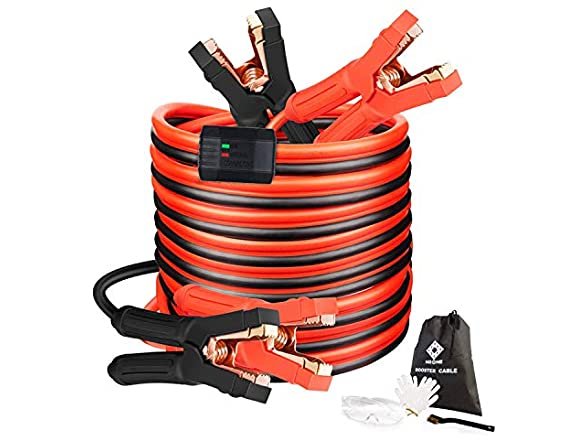
Verdict. Buy this set if you jump diesels, big V8 trucks, or other people’s cars often. Zero-gauge wire is the thickest here, 25 feet reaches across a truck bed, and the reverse-polarity protector cuts power if you clamp the leads on backwards. It is heavy.
Key specs (listing published):
- Gauge: 0-gauge; Length: 25 feet; Peak current rating: 1000A
- Engine rating: up to 8.0L gas / 6.0L diesel, 12V
- Conductor: CCA (copper-clad aluminum); Jacket: double-layer rubber, -40°F to 140°F
- Clamps: rubber-covered, jagged teeth, strong springs
- Safety: reverse-polarity protection with lights and audible warning
- In the bag: carrying case, gloves, brush, goggles
- Warranty: 2-year product service
- Price: check Amazon (checked 25 November 2026)
What it does well. At 200 amps this set drops about 1.6 volts across its 50-foot round trip (calculated), and about 2.4 volts at 300 amps, a cold V8 draw. The 4-gauge sets below lose about 4.9 volts at the same draw.
Flaws but not dealbreakers. The conductor is CCA, not solid copper. The warranty is 2-year product service, shorter than the 5-year guarantees below.
Who it suits. Diesel and V8 owners, farmers, fleet drivers. Who should skip it. Small-car drivers who want a light trunk kit.
Best long-reach name brand: Energizer ENB125

Verdict. The ENB125 is the long-reach pick from a name most drivers trust. One-gauge wire, 25 feet of reach, an 800-amp rating, and a travel bag. It reaches a battery from behind the vehicle when cars cannot sit side by side.
Key specs (listing published):
- Gauge: 1-gauge; Length: 25 feet; Current rating: 800A
- Conductor: CCA (copper-clad aluminum); Insulation: PVC, tangle-free, flexible to -40°F
- Clamps: insulated parrot clamps, PVC-coated and color-coded
- In the bag: cables and carrying bag
- Warranty: 2-year
- Price: check Amazon (checked 25 November 2026)
What it does well. Twenty-five feet lets you boost from behind a vehicle. At 200 amps the set drops about 2.0 volts (calculated), and about 3.0 volts at 300 amps: worse than the 0-gauge NOONE, better than any 4-gauge set here. The PVC jacket stays flexible to -40°F on the listing.
Flaws but not dealbreakers. The wire is CCA, so it conducts like copper about two gauges thinner. Parrot clamps grip top posts well; owners with side-post batteries report a fussier fit.
Who it suits. Truck, SUV and RV owners who want long reach from a known brand. Who should skip it. Drivers of small cars on a budget.
Best pro-grade clamps: Forney 52876

Verdict. The Forney 52876 is the no-nonsense set: Number 2 gauge wire, 16 feet, and 500-amp clamps built like welding gear. The listing says the cable is premium copper welding cable. Forney publishes no spec page for this model that we could find, so the conductor claim rests on listing copy.
Key specs (listing published):
- Gauge: Number 2 (2-gauge); Length: 16 feet; Clamp rating: 500 amps
- Conductor: copper welding cable (listing-stated)
- Weight: about 5 pounds; Warranty: 90 days against defects
- Price: check Amazon (checked 25 November 2026)
What it does well. If the conductor is copper as listed, the math is strong: about 1.0 volt of drop at 200 amps over 16 feet (calculated), and about 1.5 volts at 300 amps. The 500-amp clamps are the heaviest-duty ends in this list.
Flaws but not dealbreakers. Sixteen feet is the shortest reach here and fails when the dead car is nose-in against a wall. And the copper claim is listing copy: some secondary sources describe this class of cable as CCA. If the wire were CCA, the drop at 200 amps would be about 1.6 volts instead of 1.0.
Who it suits. Shops, fleet drivers and serious DIY mechanics who jump cars often and park close. Who should skip it. Anyone who needs 20-plus feet of reach.
Best for shop and fleet use: Clore 402252

Verdict. Clore makes the Jump-N-Carry booster packs that hang in repair shops, and the 402252 is its cable set built to the same standard: 2-gauge single cables, 25 feet, 600-amp parrot clamps, and a TPR jacket rated from -40°C to +80°C. It is the only set here with a full maker spec sheet we could open and check.
Key specs (Clore published):
- Gauge: 2-gauge single cables; Length: 25 feet; Clamp rating: 600A parrot clamps
- Conductor: Not published
- Jacket: TPR, -40°C to +80°C; Packaging: color display carton
- Warranty: 1-year limited against defects in materials and workmanship
- Price: check Amazon (checked 25 November 2026)
What it does well. The spec sheet is honest on the things shops care about: clamp rating matched to cable gauge, and a jacket that stays flexible at -40°C. At 200 amps, a 2-gauge copper set of this length drops about 1.6 volts (calculated). Clore does not state the conductor metal, so treat that as the copper case; a CCA version would drop about 2.6 volts.
Flaws but not dealbreakers. And the missing conductor spec is a real gap: for a pro set at a pro price, the metal should be printed on the sheet.
Who it suits. Repair shops, tow operators and fleet yards. Who should skip it. Drivers who want a bagged trunk kit.
Best value 4-gauge set: TOPDC TD-P0420

Verdict. The TD-P0420 is the value pick in the 4-gauge class: 20 feet of cable, clamps that fit top-post and side-terminal batteries, a proper Oxford bag, and a 5-year quality guarantee. It covers cars, SUVs and light trucks without the bulk of the 25-foot sets.
Key specs (listing published):
- Gauge: 4-gauge; Length: 20 feet; Conductor: CCA (copper-clad aluminum)
- Insulation: PVC, -40°F to 140°F; Certification: UL-listed (listing-stated)
- Clamps: jagged-teeth alligator clamps, reinforced jaws; fit top-post and side-terminal batteries
- In the bag: 600D Oxford carry bag with zipper, step-by-step guide
- Weight: 5.15 pounds; Warranty: 5-year quality guarantee
- Price: check Amazon (checked 25 November 2026)
What it does well. The clamp design is the best in this price class: jagged teeth, strong springs, and jaws shaped for both terminal styles. At 100 amps, a warm four-cylinder draw, this set drops about 1.6 volts (calculated). Fine.
Flaws but not dealbreakers. The math turns at bigger draws: about 3.2 volts of drop at 200 amps and about 4.9 volts at 300 amps (calculated). The conductor is CCA, so 4-gauge here conducts like 6-gauge copper. It is not a diesel set.
Who it suits. Car, crossover and light-truck drivers who want one dependable trunk set. Who should skip it. V8 and diesel owners. Step up to 1-gauge or 0-gauge.
Best first set for most drivers: Cartman BC0420K
Verdict. The Cartman BC0420K is the set we tell most people to buy: 20 feet of 4-gauge cable, clamps that fit top-post and side-post batteries, a bag that holds gloves and a terminal brush, and a 5-year warranty. It is the everyday trunk set done right.
Key specs (listing published):
- Gauge: 4-gauge; Length: 20 feet; Current rating: 400A
- Conductor: CCA (copper-clad aluminum); Insulation: T-Prene coating, flexible to -13°F
- Clamps: top-post and side-post, rubber-insulated, color-coded
- Certification: UL listed (listing-stated)
- In the bag: cables, work gloves, wire brush, carrying bag
- Weight: about 5.5 pounds; Warranty: 5-year
- Price: check Amazon (checked 25 November 2026)
What it does well. The kit is complete: gloves, a terminal brush, and a bag so the coil stays a coil. The clamps fit both terminal styles. At 100 to 150 amps, the draw of most warm four-cylinder and smaller six-cylinder engines, the drop runs about 1.6 to 2.4 volts (calculated). That starts the car.
Flaws but not dealbreakers. Same CCA math as the TOPDC: about 3.2 volts of drop at 200 amps and about 4.9 volts at 300 amps (calculated). The T-Prene jacket is rated flexible to -13°F, a narrower cold claim than the -40°F figures above.
Who it suits. Sedan, hatchback, crossover and half-ton pickup drivers buying a first set. Who should skip it. Diesel and large V8 owners.
All six side by side
| Set | Gauge | Length | Conductor | Clamp or current rating | Drop at 100A (calc.) | Drop at 200A (calc.) | Drop at 300A (calc.) | Warranty |
|---|---|---|---|---|---|---|---|---|
| NOONE 0 Gauge 25 ft | 0-gauge | 25 ft | CCA | 1000A peak | 0.8V | 1.6V | 2.4V | 2-year service |
| Energizer ENB125 | 1-gauge | 25 ft | CCA | 800A | 1.0V | 2.0V | 3.0V | 2-year |
| Forney 52876 | 2-gauge | 16 ft | Copper (listing-stated) | 500A clamps | 0.5V | 1.0V | 1.5V | 90 days |
| Clore 402252 | 2-gauge | 25 ft | Not published | 600A clamps | 0.8V | 1.6V | 2.3V | 1-year limited |
| TOPDC TD-P0420 | 4-gauge | 20 ft | CCA | Not published | 1.6V | 3.2V | 4.9V | 5-year |
| Cartman BC0420K | 4-gauge | 20 ft | CCA | 400A | 1.6V | 3.2V | 4.9V | 5-year |
Drops are calculated from published wire resistance (NAZ Solar Electric and Conduitwise tables, both opened 25 November 2026), using each set’s stated gauge and length over the full round trip. Forney and Clore figures use copper resistance; Forney’s conductor is listing-stated and Clore does not publish its conductor metal. CCA sets use aluminum resistance, because a CCA core conducts like aluminum with a copper skin.
Buying guide: how to choose
Gauge: match the wire to your starter draw
A 0-gauge wire is thicker than a 4-gauge wire. Use your engine, not the box art:
| Engine | Typical starter draw (Engineer Fix) | Minimum sensible gauge | Sets here that fit |
|---|---|---|---|
| 4-cylinder, warm | 100 to 200A | 4-gauge, 16 to 20 ft | TOPDC, Cartman, Forney |
| 6-cylinder | 150 to 250A | 2-gauge, or 4-gauge short | Forney, Clore, Energizer |
| V8 gas | 300A and up | 1-gauge or 0-gauge | NOONE, Energizer |
| Diesel | 400A and up | 0-gauge | NOONE |
| Any engine, cold morning | Up to double the warm draw | One gauge thicker than the warm pick | Size up |
Cold is the trap: a starter that pulls 150 amps on a warm day can draw 300 amps on a cold one (Engineer Fix). If you live where winters bite, buy one gauge thicker than the warm-weather row says.
Length: reach costs voltage
Twenty feet covers most parking mistakes. Twenty-five feet lets you boost from behind a vehicle or across a truck bed, But every extra foot adds drop: the same wire at 25 feet drops about a quarter more voltage than at 20 feet. Buy the shortest length that reaches your worst parking case, then spend the savings on thicker wire.
Copper vs CCA: the two-gauge lie
Most consumer cable sets are CCA: an aluminum core with a copper skin. Aluminum resists current about 1.64 times more than copper at the same gauge (Conduitwise table: 4 AWG copper 0.248 ohm per 1000 ft, aluminum 0.406). So a 4-gauge CCA set conducts like a 6-gauge copper set, and a 1-gauge CCA set conducts like 3-gauge copper. The gauge printed on the jacket is the size of the hole, not the strength of the flow. That is why the 4-gauge CCA sets above drop 3.2 volts at 200 amps while a 2-gauge copper set drops about 1.0 to 1.6 volts. Just size up one step when the box says CCA.
Clamp design: the connection is half the circuit
Look for jagged teeth that bite through terminal corrosion and strong springs that hold under a tug. Side-post batteries need jaws that reach the bolt head; the TOPDC and Cartman sets state side-post fit, and the Energizer parrot clamps are reported fussier on side posts. If your clamps spark, slip or get hot during a jump, the connection is the problem, not the battery. Our guide covers the hookup order: how to jump a car with jumper cables.
Cold-weather flexibility: jackets that stay soft
PVC jackets stiffen in deep cold; TPR and T-Prene jackets stay softer. The ratings here: NOONE, Energizer and TOPDC state -40°F; Clore states -40°C to +80°C for its TPR jacket; Cartman states -13°F for its T-Prene coating. If your winters go below -13°F, the Cartman claim is the thinnest in this list. Store the set in the trunk.
Storage: weight, coil and bag
A bag with a zipper (TOPDC) or a drawstring (Cartman) keeps the coil honest. The Clore ships in a carton and belongs on a shop hook. If you would rather skip cables, a lithium pack does the job without a second car: see our best portable jump starter for cars guide.
The competition
Sets we looked at and left out:
- A ABIGAIL 1 Gauge 25 ft 800A. A near-twin of the Energizer ENB125: 1-gauge, 25 feet, 800A, CCA, about 8.8 pounds, with 6V/24V support and a 36-month replacement promise. We kept the Energizer for the brand. If the A ABIGAIL is cheaper on the day, it is a fair swap.
- TOPDC TD-P0125 1 Gauge 25 ft. A second TOPDC set, 1-gauge and 25 feet. Good specs, but two TOPDC picks would crowd out the pro-grade Forney and Clore sets.
- ExtreSpo 0 Gauge 25 ft 1000A. Same headline numbers as the NOONE. No maker spec page could be found to verify gauge or conductor, so it stays out until that changes.
- POWERBEST 0 Gauge 30 ft. It is CCA, heavy, and no maker page verifies the specs. Thirty feet also adds drop you do not need.
- Goodyear 4 Gauge 16 ft. A tidy set with a hard case, but 16 feet is short for awkward parking.
- Energizer 6-gauge and 2-gauge 16 ft sets. Fine cables, wrong list: this guide covers 0-gauge to 4-gauge sets.
- NOCO. NOCO sells jump starters, not jumper cable sets. If you want a NOCO, you want a lithium pack, covered in our jump starter guide linked above.
- EverStart. Walmart’s house brand. No maker spec page with gauge and conductor detail could be found, so it cannot be checked against the math in this guide.
Your next steps, in order
- Find your engine size and starter draw in the table above. Cold climate? Move one row down.
- Measure the worst-case distance between your battery and a donor car’s battery in your usual parking spots. Add 3 feet of slack.
- Pick the gauge and length that cover both numbers. When in doubt, buy the thicker wire.
- Match the clamps to the posts.
- Order the set, coil it loose in its bag, and put it in the trunk today.
- If a jump fails with good cables and clean terminals, stop. The fault is elsewhere: read car won’t start even with a jump start and call a mechanic if the starter only clicks.
FAQ
What gauge jumper cables do I need for a V8 or diesel?
1-gauge or 0-gauge. A V8 starter draws 300 amps or more and a diesel 400 amps or more (Engineer Fix). A 4-gauge CCA set drops about 4.9 volts at 300 amps (calculated), which leaves too little for the starter. The NOONE 0-gauge set drops about 2.4 volts at the same draw.
Are copper-clad aluminum cables any good?
CCA conducts like copper about two gauges thinner. For big engines, buy 0-gauge or 1-gauge CCA, or pay for copper.
Is 20 feet long enough?
Twenty feet reaches front-to-back on most cars and across one parking space. Choose 25 feet if you park nose-in or jump trucks with long hoods.
Why did my jump fail with new cables?
Corroded terminals or clamps on paint instead of bare metal will starve the starter. Clean the posts, clamp to bare metal, run the donor engine, and wait two minutes before cranking. If it still only clicks, the starter or battery is faulty.
Do I need cables if I own a jump starter pack?
Many drivers carry both.
How we review
We ran no bench tests for this guide. Every spec comes from the maker’s own spec sheet where one exists (Clore), the product manual (TOPDC), or the product listing as read on 25 November 2026. Voltage-drop figures are arithmetic from published wire resistance tables, labeled calculated. Prices were checked on 25 November 2026; the Check Price link carries the live figure. Where a maker does not publish a figure, we print Not published.
Sources & Further Reading
- NAZ Solar Electric: electrical characteristics of AWG copper wire (copper resistance table, opened 25 November 2026)
- Conduitwise: wire gauge chart with copper and aluminum resistance (updated 23 November 2026, opened 25 November 2026)
- Engineer Fix: how many amps should a starter draw? (starter draw ranges, opened 25 November 2026)
- Clore Automotive: Jump-N-Carry booster cables spec sheet (maker PDF, opened 25 November 2026)
- TOPDC TD-P0420 product manual (specs and connection steps, opened 25 November 2026)
- Heavy Duty PR: heavy duty jumper cables compared (NOONE listing specs, opened 25 November 2026)
- Vehicle Scene: best jumper cables (Energizer ENB125 and Cartman BC0420K listing specs, opened 25 November 2026)
Figures in this guide come from pages opened on 25 November 2026. Check the live listing before you buy.
Automotive Safety Notice
Lead-acid batteries produce flammable hydrogen gas and contain corrosive sulfuric acid. Always wear ANSI-rated eye protection, disconnect the negative terminal before electrical servicing, and consult an ASE-certified technician for fuel leaks or high-voltage hybrid systems.

Alexander Reed, MEng
Automotive engineer (MEng, 2021) specializing in no-start diagnostics, parasitic draw isolation, and starter-charging systems.
Verified Gravatar Profile ↗


Reader Discussion & Questions
0 Comments