
Table of Contents (21 Sections)
Disclosure: this post contains affiliate links. If you buy through a link on this page, we may earn a commission at no extra cost to you. Read our full affiliate disclaimer.
How many amps to jump start a car depends on your engine, so buy by the engine-size rating and treat the peak-amp number as a size label. A warm four-cylinder starter draws 100 to 200 amps, a six-cylinder 150 to 250, a V8 over 300, and a diesel 400 or more. Cold oil can double the draw. For most gas cars up to 6.0L, a 1000A unit like the NOCO GB40 is enough. Bigger engines step up through the 1500A and 2000A classes, and the biggest diesels need the 4000A class.
What we looked for
This guide answers one question: what size jump starter does your engine actually need? We compared four units across the size classes, all sold on Amazon.com in the US, on the figures their makers publish: peak current, engine-size rating, battery size, starts claimed per charge, and maker-site price.
Here is what we did not do. We ran no bench test and jump-started no row of cars in a lab. Every spec below comes from NOCO’s product pages and data sheets and GOOLOO’s GP4000 manual, opened on 25 November 2026. Where a maker does not publish a figure, we say so. Prices are maker-site prices checked on 25 November 2026.
One gap shapes this guide. NOCO publishes a peak current figure for the GB40, GB50 and GB70 and no starting current for any of them. GOOLOO publishes both for the GP4000. Peak current is a split-second maximum. Starting current is closer to what your starter motor feels while it cranks. Since only one maker here publishes the second number, this guide shops by the engine-size rating.
The maths: what your starter actually draws
Engineer Fix puts sustained starter draw at 100 to 200 amps for a warm four-cylinder, 150 to 250 amps for a six-cylinder, over 300 amps for a large V8, and 400 amps or more for a diesel. Cold oil thickens and raises the load: a starter that pulls 150 amps warm might draw 300 amps on a cold winter start.
Now the supply side. The peak current on the box, 1000A, 1500A, 2000A or 4000A, is the maximum the cells can push for a split second, not the current your starter motor receives while it cranks. GOOLOO’s GP4000 manual is the only document in this guide that publishes a starting current: 800A, against a 4000A peak. That five-to-one gap is why a 4000A pack is not four times as strong as a 1000A pack in any way your starter can feel.
Battery size works differently. Watt-hours measure stored energy, and stored energy decides repeats: how many starts, and how much is left after the first failed attempt. NOCO claims up to 20 jump starts per charge from the GB40’s 24Wh battery, up to 30 from the GB50’s 35Wh, and up to 40 from the GB70’s 56Wh. GOOLOO claims over 60 from the GP4000’s 74Wh. Amps decide whether one start works. Watt-hours decide how many chances you get.
Worked example: a 3.5L V6, warm day and cold morning
Take a 3.5L V6 crossover. Warm, its starter draws in the 150 to 250 amp range. Call it 200 amps, the middle of the range (calculated for this example). On a cold morning, the same starter can ask for roughly double, about 400 amps (calculated from Engineer Fix’s cold-oil figures).
Set that against the units. NOCO rates the GB40 for gas engines up to 6.0L, so a 3.5L V6 sits well inside its rating, warm or cold. The GP4000’s published 800A starting current is about twice the cold-morning ask in this example, and its 74Wh battery holds about three times the energy of the GB40’s 24Wh (74 divided by 24 is about 3.1, calculated). For this engine, the GB40 is not undersized, and the GP4000’s bigger numbers buy margin and repeats, not a different first-try outcome.

Decision table: engine size and climate
Find your engine, then read across to your climate. The classes are the four units in this guide: 1000A (GB40), 1500A (GB50), 2000A (GB70) and 4000A (GP4000).
| Engine | Mild climate | Cold winters |
|---|---|---|
| 4-cylinder gas, up to 2.5L | 1000A class | 1000A class |
| 6-cylinder gas, 3.0L to 4.0L | 1000A class | 1500A class for headroom |
| V8 gas, 5.0L to 6.0L | 1000A class | 1500A or 2000A class |
| V8 gas, 6.1L to 7.0L | 1500A class | 2000A class |
| Gas over 7.0L | 2000A class | 2000A class |
| Diesel up to 3.0L | 1000A class | 1500A class |
| Diesel 3.1L to 4.5L | 1500A class | 2000A class |
| Diesel 4.6L to 6.0L | 2000A class | 2000A or 4000A class |
| Diesel over 6.0L | 4000A class | 4000A class |
The pattern is simple. The smaller class wins on price wherever the engine sits well inside its rating. Cold weather moves every borderline case one step up.
Small class, most gas cars: NOCO Boost Plus GB40
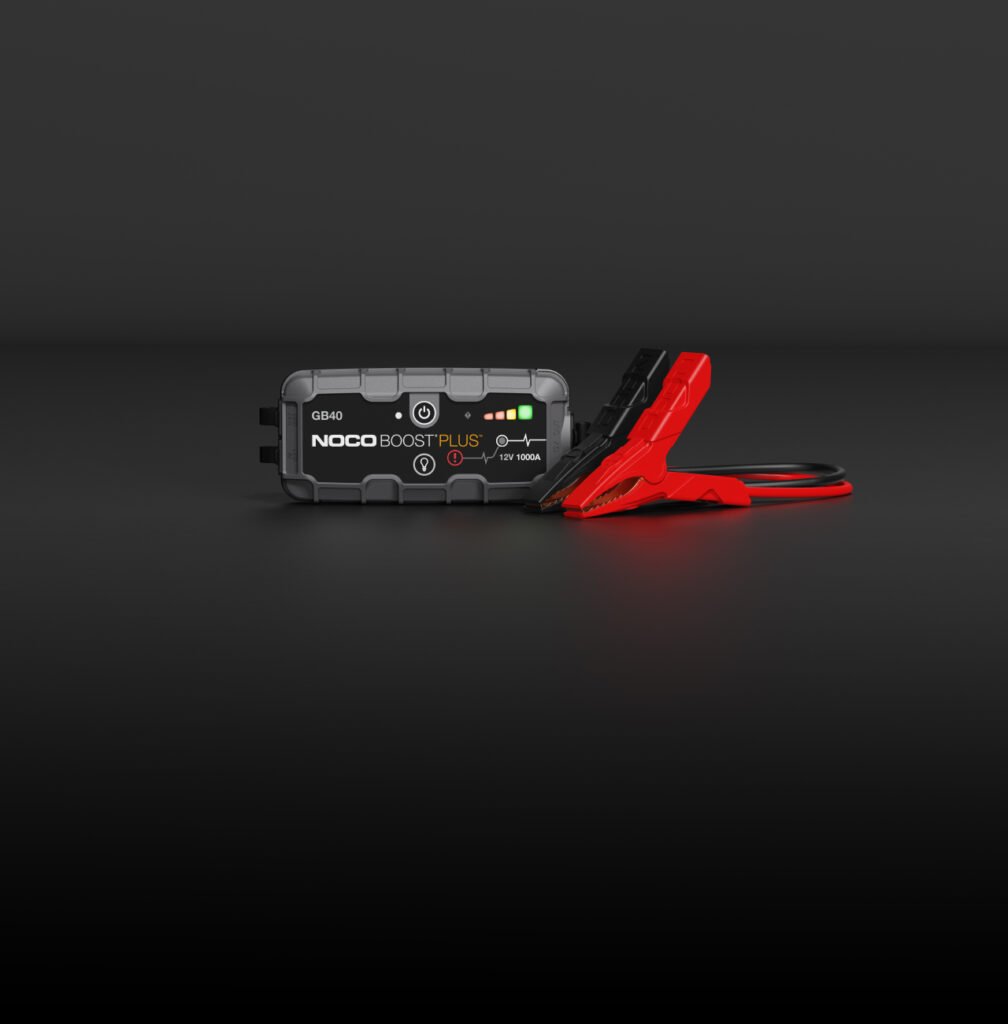
Price checked: $99.95 list price on no.co, 25 November 2026.
Verdict. The GB40 is the right size for most drivers reading this page. NOCO rates it for gas engines up to 6.0L and diesel engines up to 3.0L, which covers nearly every sedan, hatchback and crossover in the US.
Key specs (NOCO published):
- Peak current: 1000A; starting current: not published
- Engine rating: up to 6.0L gas / 3.0L diesel
- Battery: 24 Watt-Hour lithium ion; up to 20 starts per charge
- USB in / out: 5V, 2.1A; recharge 3 hours at 2A
- Flashlight: 100 lumens; IP65; weight: 1.65 lb unit only, 2.4 lb with clamps; clamp cable: 23 inches (58.4cm)
What it does well. Size and simplicity. The unit weighs 1.65 lb and lives in a glovebox, so it is in the car when you need it. NOCO claims up to 20 jump starts per charge. Spark-proof connections and reverse polarity protection remove the two mistakes people make at 6 AM in the rain.
Flaws but not dealbreakers. The 24Wh battery is the smallest in this guide, so it holds fewer repeat attempts than the bigger units. The 3.0L diesel ceiling rules out most diesel pickups. Recharging is slow: 3 hours at 2A, 6 hours at 1A.
Who it suits. Sedan, hatchback and crossover owners, plus first-time buyers. Who should skip it. Owners of gas engines over 6.0L, diesels over 3.0L, and cold-climate drivers with borderline engines.
Full review context: see our best portable jump starter for cars roundup and NOCO GB40 vs GB50 comparison.
Mid class, bigger engines and cold headroom: NOCO Boost XL GB50
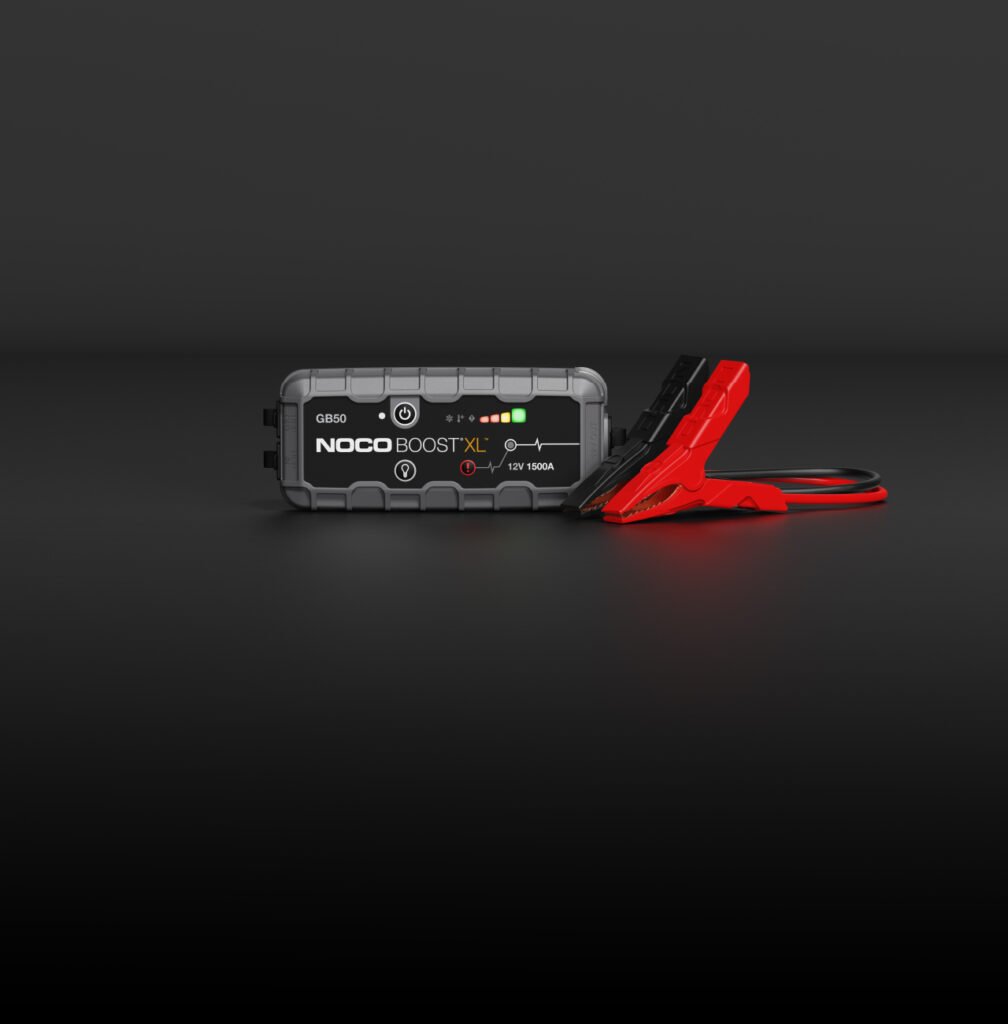
Price checked: $149.95 list price on no.co, 25 November 2026.
Verdict. The GB50 is the GB40 with headroom. NOCO rates it for gas engines up to 7.0L and diesel engines up to 4.5L, with a 35Wh battery and up to 30 jump starts per charge. Buy this class if your engine sits near the top of the GB40’s rating, or if your winters are cold.
Key specs (NOCO published):
- Peak current: 1500A; starting current: not published
- Engine rating: up to 7.0L gas / 4.5L diesel
- Battery: 35 Watt-Hour lithium ion; up to 30 starts per charge
- USB in / out: 5V, 2.1A
- Recharge time: data sheet 4.5 hours at 2A; product page 3 hours at 2.1A (see note below)
- Flashlight: 200 lumens; IP65; weight: 1.65 lb unit only, 2.71 lb with clamps; clamp cable: 23 inches (58.4cm)
What it does well. The 35Wh battery is about half again the size of the GB40’s 24Wh, and NOCO’s claims scale with it: up to 30 jump starts per charge against 20, and up to 6 smartphone recharges against 4. The 200-lumen light is twice as bright as the GB40’s.
Flaws but not dealbreakers. Start with a conflict inside NOCO’s own pages. The product page says the unit recharges in 3 hours at 2.1A. The data sheet says 4.5 hours at 2A, 9 hours at 1A and 18 hours at 0.5A. Both documents are NOCO’s. Budget for the slower figure. There is no fast charging and no 12V out port.
Who it suits. V8 gas owners up to 7.0L, small diesel owners up to 4.5L, and cold-climate drivers with borderline engines. Who should skip it. Anyone whose engine fits well inside the GB40’s rating. Diesel owners above 4.5L should step up a class.
Full review context: see our NOCO GB40 vs GB50 comparison and best car jump starter for winter guide.
Large class, V8s and diesels to 6.0L: NOCO Boost HD GB70
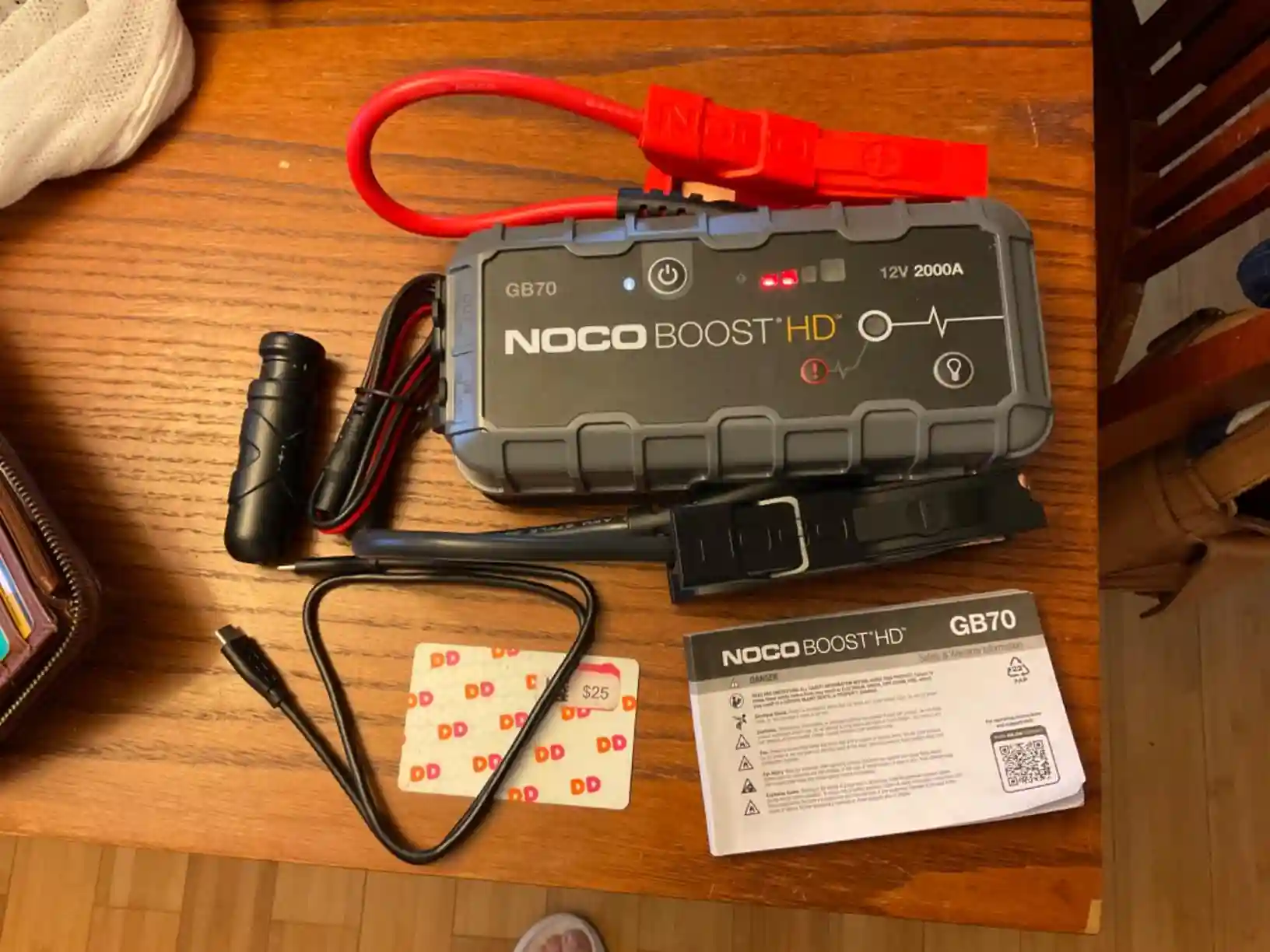
Price checked: $199.95 list price on no.co, 25 November 2026.
Verdict. The GB70 is the large class in this guide: 2000A peak, rated for gas engines up to 8.0L and diesel engines up to 6.0L, with a 56Wh battery and up to 40 starts per charge. Buy this class for big gas V8s, mid-size diesels, boats and RVs.
Key specs (NOCO published):
- Peak current: 2000A; starting current: not published
- Engine rating: up to 8.0L gas / 6.0L diesel
- Battery: 56 Watt-Hour lithium ion; up to 40 starts per charge
- USB in / out: 5V, 2.1A; XGC input 12 VDC, 3A; XGC output 12 VDC, 15A
- Recharge time: 7 hours at 2A over USB; faster via XGC 12V input
- Flashlight: 400 lumens; IP65; weight: 4 lb unit only, 5 lb with clamps; clamp length: not published in the data sheet checked
What it does well. Headroom and stored energy. The 56Wh battery is more than double the GB40’s, and NOCO claims up to 40 jump starts and up to 6 smartphone recharges. The 12V output port powers a tire inflator.
Flaws but not dealbreakers. Weight and price. At 5 lb with clamps it is a trunk unit, not a glovebox unit, and at $199.95 list it costs double the GB40. A full USB refill takes 7 hours at 2A by the data sheet, so use the faster XGC 12V input.
Who it suits. Large V8 and diesel owners to 6.0L, boat and RV owners, and multi-vehicle households. Who should skip it. Small-car drivers on a budget, and diesel owners above 6.0L.
Full review context: see our best portable jump starter for cars roundup.
Diesel class, the biggest engines: GOOLOO GP4000
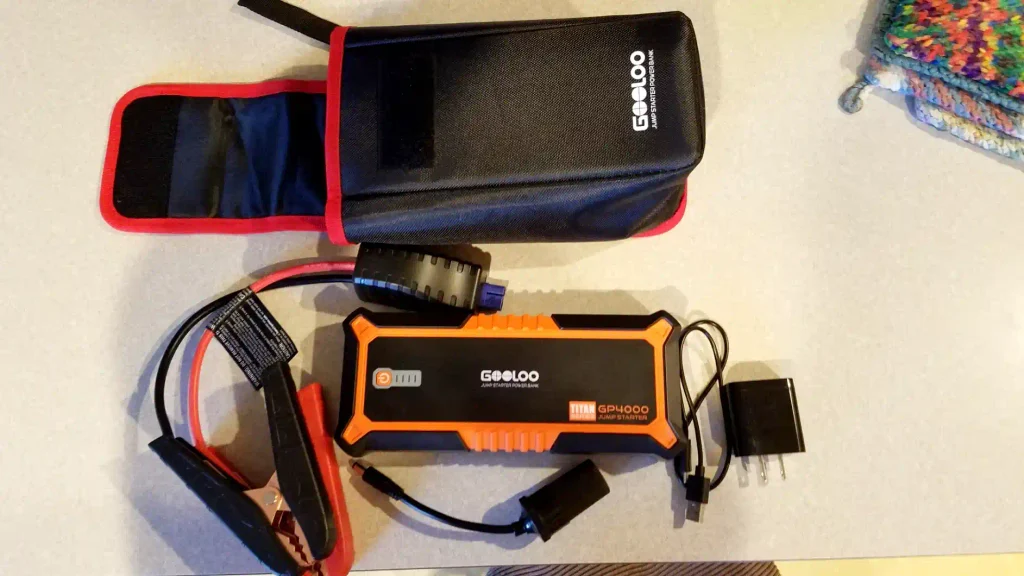
Price checked: $79.99 sale price on us.gooloo.com, 25 November 2026 (was $189.99). Amazon prices move daily, so check the live figure.
Verdict. The GP4000 is the diesel class in this guide. GOOLOO’s manual rates it for all gasoline engines and diesel engines up to 10.0L, with a 4000A peak, an 800A starting current, and a 74Wh battery. It is the only unit here whose maker publishes a starting current.
Key specs (GOOLOO published, manual):
- Peak current: 4000A; starting current: 800A
- Engine rating: all gas engines / diesel up to 10.0L
- Battery: 74Wh (5000mAh at 14.8V); over 60 starts claimed per charge
- Charging: Type-C 15W in (5V/3A); full charge 6 to 8 hours
- Outputs: Quick Charge USB, 5V/2.1A USB, 15V/10A DC; size: 228 x 99.5 x 38 mm; weight: 820g; clamp length: not published in the manual checked
What it does well. Two numbers matter here, and GOOLOO publishes both. Peak current is the headline figure every brand shouts about. Starting current is what your starter motor feels, and 800A is strong for this price.
Flaws but not dealbreakers. The casing is plastic and feels less rugged than the NOCO units. A full recharge takes 6 to 8 hours at 5V/3A, the slowest refill in this guide. One warning on the battery figure: a secondary manual copy lists 88.8Wh. GOOLOO’s own manual PDF says 74Wh. Use 74Wh.
Who it suits. Large diesel truck and SUV owners, boat owners, and anyone who wants maximum stated power for the money. Who should skip it. Drivers who want the toughest case and the longest track record.
Full review context: see our best portable jump starter for cars roundup.
The four classes side by side
| Class | Unit | Peak amps | Starting current | Battery | Gas limit | Diesel limit | Starts claimed | List price |
|---|---|---|---|---|---|---|---|---|
| Small | NOCO GB40 | 1000A | Not published | 24Wh | 6.0L | 3.0L | Up to 20 | $99.95 |
| Mid | NOCO GB50 | 1500A | Not published | 35Wh | 7.0L | 4.5L | Up to 30 | $149.95 |
| Large | NOCO GB70 | 2000A | Not published | 56Wh | 8.0L | 6.0L | Up to 40 | $199.95 |
| Diesel | GOOLOO GP4000 | 4000A | 800A | 74Wh | All gas | 10.0L | Over 60 | $79.99 sale |
Prices are maker-site prices checked 25 November 2026. Peak amps are the makers’ stated figures, measured differently by each brand. Shop by the engine limits and battery sizes.
How to choose your size
Engine size comes first
Check your owner’s manual for the engine size in liters. At or under 6.0L gas, or at or under 3.0L diesel, the 1000A class covers you on NOCO’s rating. Between 6.1L and 7.0L gas, or between 3.1L and 4.5L diesel, step up to the 1500A class. Between 7.1L and 8.0L gas, or between 4.6L and 6.0L diesel, the 2000A class. Above 6.0L diesel, only the 4000A class here is rated for your engine.
Cold weather moves the line
All four units share a published operating floor of -4°F, and the NOCO units will not charge below 32°F. Below -4°F, none of them is rated to operate. The bigger winter factor is your engine, not the pack: cold oil can double starter draw. If your engine sits near the top of its class rating and your winters run below freezing for weeks, buy one class up.
Battery size is about repeats, not single jumps
Watt-hours decide how many chances you get. One dead battery on a Tuesday morning needs one start, and every unit here delivers it if the engine rating matches. The bigger battery earns its keep in a household with several vehicles, or where the pack doubles as a power bank. It also buys failed attempts: a corroded terminal can eat two or three tries, and a 24Wh pack feels that faster than a 74Wh pack.
Clamp reach is short on all of them
The GB40 and GB50 data sheets list 23-inch clamp cables, so both units sit close to the battery. NOCO’s GB70 data sheet and GOOLOO’s GP4000 manual do not publish a clamp length in the documents checked, so this guide prints none for them. Measure the run before you buy.
USB charging is slow, so charge ahead
None of these units fast-charges the way a modern phone does. The NOCO units take 5V at 2.1A over USB, with the GB70 adding a faster 12V XGC input. The GP4000 takes Type-C 15W and needs 6 to 8 hours for a full refill. Charge the pack the day it arrives.
Warranty is a tie on paper
NOCO’s data sheets reference a user guide and warranty document without stating the term, and GOOLOO’s manual does not state a term either. The term sits in the paperwork that ships with each unit. Register whichever unit you buy and keep the receipt.
The competition
Three strong units from our best portable jump starter for cars roundup sit outside this size guide because they duplicate classes already covered: the HULKMAN Alpha 85 (2000A class), the TOPDON JS3000 (3000A class), and the Fanttik T8 APEX (2000A class). Any of them is a fair buy in its class. One name stays out on evidence: the AVAPOW A68 advertises 6000A, and we could not verify a starting current or a manual behind it.
Questions drivers ask
How many amps do I need for a V8? Match the rating, then add cold headroom. A gas V8 up to 6.0L fits the 1000A class on NOCO’s rating in mild weather, but a V8 starter draws over 300 amps warm and can ask for roughly double in the cold, so buy the 1500A or 2000A class in cold climates.
Is a 4000A jump starter four times as strong as a 1000A one? No. Peak amps are split-second maximums, measured differently by each brand. GOOLOO publishes an 800A starting current behind its 4000A peak. NOCO publishes no starting current behind its peaks. Shop by the engine-size rating, not by peak-amp arithmetic.
Can these units start a car with a completely dead battery? Often, yes. The NOCO units have a manual override mode, engaged by holding the button for 3 seconds, that forces power through when the battery is too low for the unit to detect. The GP4000 has a Boost button that does the same job. If the car still will not start, the battery may not be the problem. See our car won’t start but lights come on guide.
How long will the pack hold its charge in the trunk? Lithium packs lose charge slowly in storage. Charge the unit fully when it arrives and top it up every three months. The NOCO units do not charge below 32°F, so bring the pack indoors for its top-up in winter.
How we review
We compare maker-published specs, official data sheets and manuals, and owner reviews. We run no bench tests and we jump-start no cars in a lab, so this guide prints no test scores and no measured figures of our own. Every spec above is the maker’s, read on the maker’s pages on 25 November 2026. Where a maker’s own documents disagree, as NOCO’s do on the GB50 recharge time, both figures are printed. Where a maker publishes nothing, the gap is stated rather than filled.
What to do next
First, check your engine size in the owner’s manual. Second, find your row in the decision table and note whether your winters push you a class up. Third, buy the class whose rating sits above your engine: 1000A for most gas cars, 1500A for bigger engines and cold headroom, 2000A for large V8s and diesels to 6.0L, 4000A for the biggest diesels. Fourth, charge it fully the day it arrives. Fifth, store it in the car and set a three-month reminder.
Sources & Further Reading
- NOCO GB40 product page: 1000A peak, 6.0L gas / 3.0L diesel, $99.95 list price, checked 25 November 2026.
- NOCO GB40 data sheet (PDF): 24 Watt-Hour battery, recharge 3 hours at 2A, 23-inch clamp cables.
- NOCO GB50 product page: 1500A peak, 7.0L gas / 4.5L diesel, $149.95 list price, checked 25 November 2026.
- NOCO GB50 data sheet (PDF): 35 Watt-Hour battery, recharge 4.5 hours at 2A, 23-inch clamp cables.
- NOCO GB70 product page: 2000A peak, 8.0L gas / 6.0L diesel, $199.95 list price, checked 25 November 2026.
- NOCO GB70 data sheet (PDF): 56 Watt-Hour battery, recharge 7 hours at 2A, XGC 12V input and output.
- GOOLOO GP4000 official manual (PDF): 4000A peak, 800A starting current, 74Wh, all gas / diesel to 10.0L.
- GOOLOO jump starter collection: GP4000 listed at $79.99 sale price (was $189.99), checked 25 November 2026.
- Engineer Fix, how many amps should a starter draw: starter draw by engine size, cold oil doubling it.
- NOCO GB40 on Amazon, NOCO GB50 on Amazon, NOCO GB70 on Amazon and GOOLOO GP4000 on Amazon: listings for model and ASIN; check the live price before you buy.
No cable gauge and no NOCO starting current is printed in this guide, because NOCO publishes neither figure for these models. Every figure in this guide comes from a page opened and read on 25 November 2026.
Automotive Safety Notice
Lead-acid batteries produce flammable hydrogen gas and contain corrosive sulfuric acid. Always wear ANSI-rated eye protection, disconnect the negative terminal before electrical servicing, and consult an ASE-certified technician for fuel leaks or high-voltage hybrid systems.

Alexander Reed, MEng
Automotive engineer (MEng, 2021) specializing in no-start diagnostics, parasitic draw isolation, and starter-charging systems.
Verified Gravatar Profile ↗


Reader Discussion & Questions
1 Comments