
Table of Contents (18 Sections)
Disclosure: this post contains affiliate links. If you buy through a link on this page, we may earn a commission at no extra cost to you. Read our full affiliate disclaimer.
For most gas cars, buy the NOCO GB40 and keep the $50. NOCO rates it for gas engines up to 6.0L and diesel engines up to 3.0L, which covers the great majority of cars on the road. Buy the GB50 if your engine is over 6.0L gas or over 3.0L diesel, or if you want more jump starts per charge and a brighter light. Diesel owners above 4.5L should skip both and step up to the GB70 class.
What we looked for
This comparison covers two units from the same NOCO Boost line, so the safety kit, the case design and the charging ports match. What differs is power, battery size and price. We compared them on five things: the engine sizes NOCO rates each unit for, the battery capacity in watt-hours, how many jump starts NOCO claims per charge, the cold-weather limits NOCO publishes, and the list price on NOCO’s own site.
Here is what we did not do. We ran no bench test and jump-started no row of cars in a lab. Every spec below comes from NOCO’s product pages and NOCO’s data sheet PDFs, opened on 25 November 2026. Where NOCO does not publish a figure, we say so instead of borrowing one from a review site. Prices are NOCO list prices checked on 25 November 2026. Amazon prices move daily, so use the Check Price link for the live figure before you buy.
One gap matters more than the rest. NOCO publishes a peak current figure for both units and no starting current for either. Peak current is a split-second maximum. Starting current is what your starter motor feels while it cranks. Since NOCO does not publish the second number, this guide shops by the engine-size rating, which is the figure NOCO stands behind.
Best for most cars: NOCO Boost Plus GB40
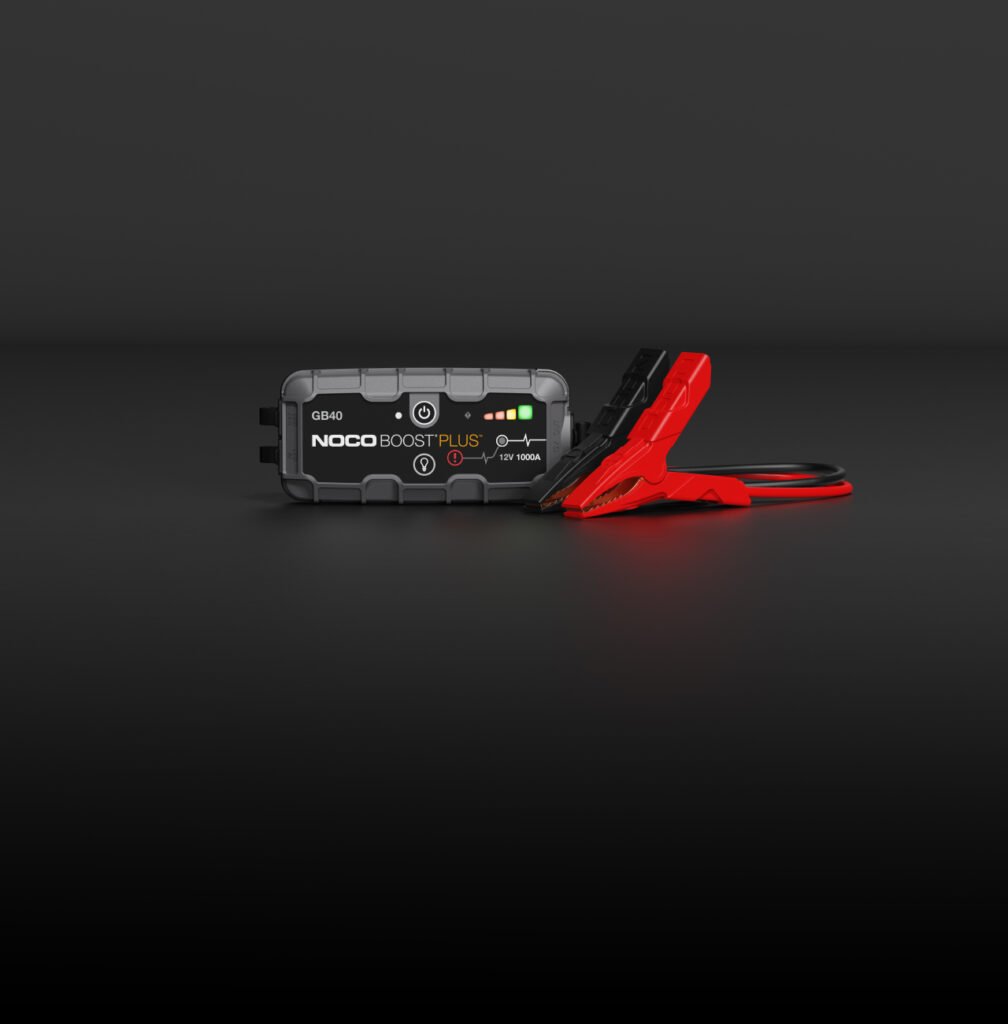
Price checked: $99.95 list price on no.co, 25 November 2026.
Verdict. The GB40 is the right buy for most drivers reading this page. It covers gas engines up to 6.0L, which takes in nearly every sedan, hatchback and crossover sold in the US, plus small diesels to 3.0L. It costs $50 less than the GB50 and gives up little that a typical car owner will ever miss.
| Spec | NOCO published |
|---|---|
| Peak current | 1000A |
| Engine rating | Up to 6.0L gas / 3.0L diesel |
| Internal battery | 24 Watt-Hour lithium ion |
| Jump starts per charge | Up to 20 |
| Operating temperature | -4°F to +122°F |
| Charging temperature | 32°F to +104°F |
| USB in / out | 5V, 2.1A / 5V, 2.1A |
| Recharge time | 3 hours at 2A |
| Flashlight | 100 lumens, 7 modes |
| Water resistance | IP65 with ports closed |
| Weight | 1.65 lb unit only, 2.4 lb with clamps and accessories |
| Clamp cable length | 23 inches (58.4cm) |
| Starting current | Not published |
| Cable gauge | Not published |
| Warranty | Limited warranty, activated by registration; term stated in the user guide, not on the product page or data sheet |
What it does well. Size and simplicity. The unit itself weighs 1.65 lb and lives in a glovebox or under a seat, so it is in the car when you need it. NOCO claims up to 20 jump starts per charge and up to 4 smartphone recharges from the USB out port. Spark-proof connections and reverse polarity protection are standard, which removes the two mistakes people make at 6 AM in the rain. The manual override mode forces power through when a battery is too flat for the unit to detect.
Flaws but not dealbreakers. The 24Wh battery is the smaller of the two here, so it holds fewer phone charges and fewer jumps than the GB50. The 100-lumen light shows you the battery terminals at night and not much else. The 3.0L diesel ceiling rules out most diesel pickups. And the recharge rate is slow by modern standards: 5V at 2.1A, so a full refill takes 3 hours at 2A and 6 hours at 1A. None of that stops it starting a gas car under 6.0L.
Who it suits. Sedan, hatchback and crossover owners, plus anyone buying a first jump starter. Who should skip it. Owners of gas engines over 6.0L, diesels over 3.0L, and drivers in cold climates whose engine sits near the top of the rating. That last group is covered in the decision table below.
Full review context: the GB40 also appears in our best portable jump starter for cars roundup, and smaller cars should also read our best compact jump starter for small cars guide.
Best for bigger engines: NOCO Boost XL GB50
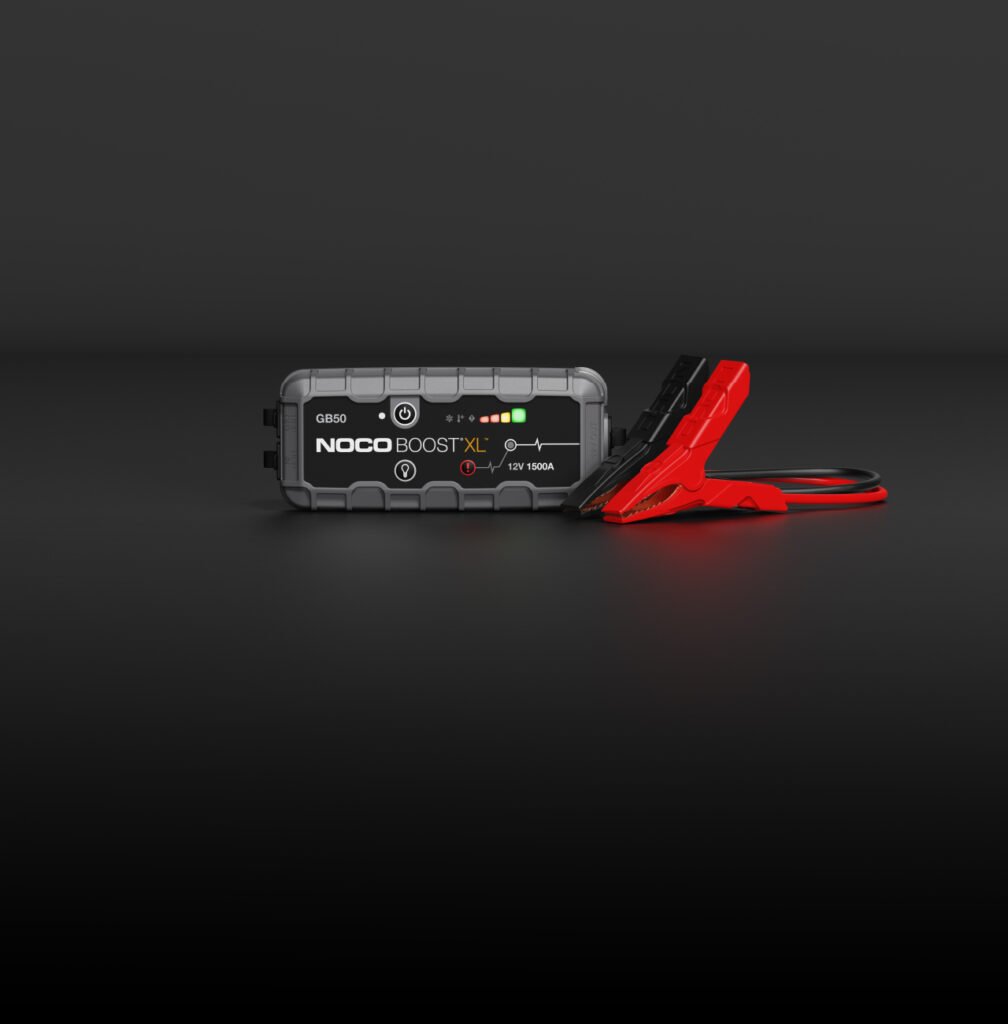
Price checked: $149.95 list price on no.co, 25 November 2026.
Verdict. The GB50 is the GB40 with headroom. NOCO rates it for gas engines up to 7.0L and diesel engines up to 4.5L, with a bigger 35Wh battery and up to 30 jump starts per charge. That extra liter of gas rating and extra 1.5 liters of diesel rating are the whole reason to pay the $50 premium. If your engine sits inside the GB40’s limits, the premium buys capacity you will rarely use.
| Spec | NOCO published |
|---|---|
| Peak current | 1500A |
| Engine rating | Up to 7.0L gas / 4.5L diesel |
| Internal battery | 35 Watt-Hour lithium ion |
| Jump starts per charge | Up to 30 |
| Operating temperature | -4°F to +122°F |
| Charging temperature | 32°F to +104°F |
| USB in / out | 5V, 2.1A / 5V, 2.1A |
| Recharge time | Data sheet: 4.5 hours at 2A. Product page: 3 hours at 2.1A (see note below) |
| Flashlight | 200 lumens, 7 modes |
| Water resistance | IP65 with ports closed |
| Weight | 1.65 lb unit only, 2.71 lb with clamps and accessories |
| Clamp cable length | 23 inches (58.4cm) |
| Starting current | Not published |
| Cable gauge | Not published |
| Warranty | Limited warranty, activated by registration; term stated in the user guide, not on the product page or data sheet |
What it does well. The 35Wh battery is about half again the size of the GB40’s 24Wh, and NOCO’s claims scale with it: up to 30 jump starts per charge against 20, and up to 6 smartphone recharges against 4. The 200-lumen light is twice as bright as the GB40’s, which helps when you are changing a tire on a dark shoulder. The support page also documents hot and cold indicator LEDs that warn when the unit is too hot or too cold to jump start, so the unit tells you before you waste an attempt. The unit itself weighs the same 1.65 lb as the GB40. The extra weight in the box is in the clamps and accessories, 2.71 lb all in against 2.4 lb.
Flaws but not dealbreakers. Start with a conflict inside NOCO’s own pages. The GB50 product page says the unit recharges in 3 hours at 2.1A. The GB50 data sheet says 4.5 hours at 2A, 9 hours at 1A and 18 hours at 0.5A. Both documents are NOCO’s. Budget for the slower figure. The USB ports also stay at 5V and 2.1A, so there is no fast charging in either direction, and there is no 12V out port for a tire inflator. The 4.5L diesel ceiling still rules out full-size diesel pickups.
Who it suits. V8 gas owners up to 7.0L, small diesel owners up to 4.5L, multi-car households, and drivers who want more starts between recharges. Who should skip it. Anyone whose engine fits inside the GB40’s rating and who would rather keep the $50. Diesel owners above 4.5L should skip it too and step up a class.
Full review context: for the wider field, including units rated for bigger diesels, read our best portable jump starter for cars roundup.
GB40 and GB50 side by side
| Spec | GB40 | GB50 |
|---|---|---|
| Peak current | 1000A | 1500A |
| Gas engine rating | Up to 6.0L | Up to 7.0L |
| Diesel engine rating | Up to 3.0L | Up to 4.5L |
| Internal battery | 24Wh | 35Wh |
| Jump starts per charge | Up to 20 | Up to 30 |
| Smartphone recharges | Up to 4 | Up to 6 |
| Flashlight | 100 lumens | 200 lumens |
| Recharge time at 2A | 3 hours | 4.5 hours (data sheet) |
| Operating temperature | -4°F to +122°F | -4°F to +122°F |
| Weight with clamps | 2.4 lb | 2.71 lb |
| List price (no.co, 25 Nov 2026) | $99.95 | $149.95 |
Read the table from the top. The first three rows decide the purchase. The rest is convenience.
The maths: what your starter actually draws
Most comparisons stop at the peak amp number. That number misleads, so here is the demand side of the equation.
Engineer Fix puts sustained starter draw at 100 to 200 amps for a warm four-cylinder, 150 to 250 amps for a six-cylinder, over 300 amps for a large V8, and 400 amps or more for a diesel. Cold oil thickens and raises the load: a starter that pulls 150 amps on a warm day might draw 300 amps on a cold winter start. In other words, winter can double what your starter asks for.
Now set that against the two units. Both are lithium packs whose job is to deliver a short, heavy burst while the car battery is flat. The GB40’s 1000A peak and the GB50’s 1500A peak are split-second maximums, not sustained figures, and NOCO publishes no starting current for either unit. So the honest way to use the maths is this: pick the unit whose engine-size rating sits above your engine, then add headroom if you live where winters bite. A 3.5L V6 in a mild climate asks for 150 to 250 amps warm and sits deep inside the GB40’s rating. The same engine at -10°F asks for roughly double, and the GB50’s extra headroom starts to earn its price. A diesel asks for 400 amps or more before winter doubles anything, which is why the diesel ratings, 3.0L against 4.5L, matter more than the peak amp gap.
Decision table: engine size and climate
Find your engine, then read across to your climate. “Neither” means step up to the GB70 class, rated by NOCO at 2000A peak for gas engines up to 8.0L and diesel engines up to 6.0L.
| Engine | Mild climate | Cold winters |
|---|---|---|
| 4-cylinder gas, up to 2.5L | GB40 | GB40 |
| 6-cylinder gas, 3.0L to 4.0L | GB40 | GB50 for headroom |
| V8 gas, 5.0L to 6.0L | GB40 | GB50 |
| V8 gas, 6.1L to 7.0L | GB50 | GB50 |
| Gas over 7.0L | Neither, GB70 class | Neither, GB70 class |
| Diesel up to 3.0L | GB40 | GB50 |
| Diesel 3.1L to 4.5L | GB50 | GB50 |
| Diesel over 4.5L | Neither, GB70 class | Neither, GB70 class |
The pattern is simple. The GB40 wins on price wherever the engine sits well inside its rating. The GB50 wins wherever the engine sits near the top of the GB40’s rating or past it. Cold weather moves every borderline case one step up.
How to choose between them
Engine size comes first
Check your owner’s manual for the engine size in liters. At or under 6.0L gas, or at or under 3.0L diesel, the GB40 covers you on NOCO’s rating. Between 6.1L and 7.0L gas, or between 3.1L and 4.5L diesel, only the GB50 of these two covers you. Above those limits, neither unit is rated for your engine. Match the rating first and the decision mostly makes itself.
Cold weather moves the line
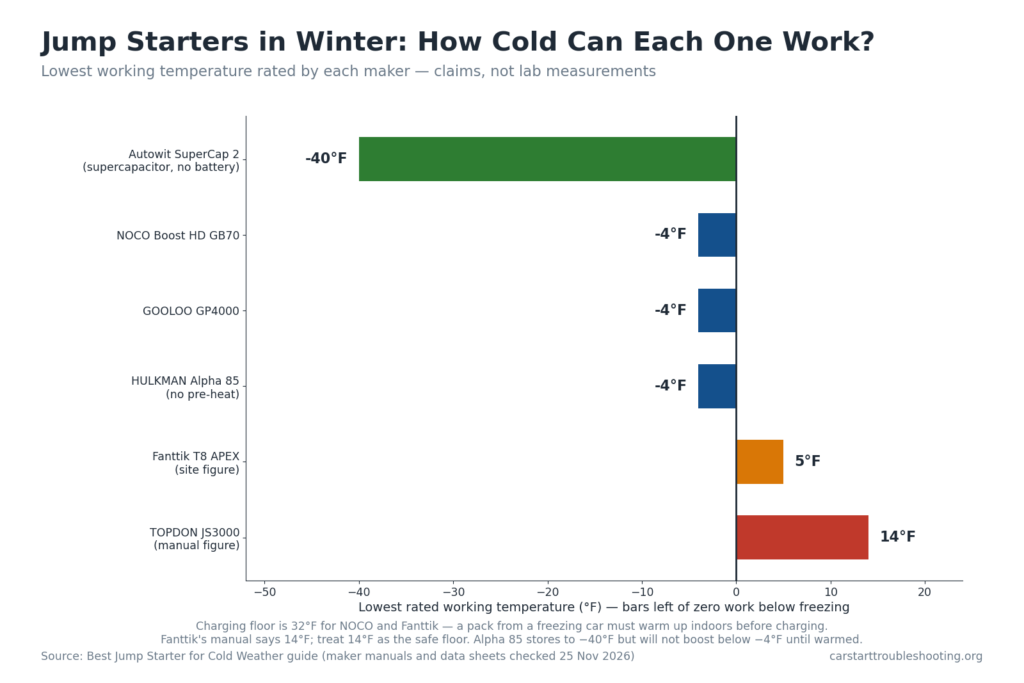
Both units share the same published operating range, -4°F to +122°F, and the same charging range, 32°F to +104°F. Below -4°F, neither unit is rated to operate, and the GB50’s cold LED will tell you when the unit is too cold to jump start. The bigger winter factor is your engine, not the pack: cold oil can double starter draw. If your engine sits near the top of the GB40’s rating and your winters run below freezing for weeks, buy the GB50. For the full cold-weather picture, read our best car jump starter for winter guide.
Battery size is about repeats, not single jumps
The 35Wh battery in the GB50 against 24Wh in the GB40 shows up as repeats: up to 30 jump starts against 20, and up to 6 phone recharges against 4. One dead battery on a Tuesday morning needs one start, and both units deliver it. The bigger battery earns its keep in a household with several vehicles, on a boat or RV, or on a long trip where the pack doubles as a power bank.
USB charging is slow on both
Neither unit fast-charges. Both take 5V at 2.1A in and give 5V at 2.1A out. The GB40 refills in 3 hours at 2A. The GB50 takes 4.5 hours at 2A by its data sheet, whatever the product page says. Plan around that: charge the pack the day it arrives, top it up every three months, and never rely on a same-morning refill. If fast USB-C charging matters to you, neither of these two units offers it.
Clamp reach is identical
Both data sheets list 23-inch clamp cables, so both units sit close to the battery and neither wins on reach. The clamps themselves are NOCO’s heavy-duty precision clamps on both models. If your battery sits deep in the engine bay, measure the run before you buy, because 23 inches is the same constraint on both.
Warranty is the same process on both
NOCO’s support pages describe a limited warranty activated by registering the product, with claims handled through support using your proof of purchase and serial number. The warranty term itself is not stated on the product pages, the data sheets or the warranty page we checked; it sits in the user guide that ships with each unit. Register whichever unit you buy, keep the receipt, and keep the serial number photo on your phone. On warranty, this comparison is a tie.
The competition
Two nearby NOCO models frame this choice. Below the GB40 sits the smaller GB20, aimed at compact cars. If you drive a small hatchback and want the smallest pack that still works, our best compact jump starter for small cars guide covers that end of the market. Above the GB50 sits the GB70, rated at 2000A peak for gas engines up to 8.0L and diesel engines up to 6.0L, with a 12V out port the GB40 and GB50 both lack. Diesel pickup owners and anyone running several large vehicles should start there instead. The GB40 and GB50 earn their place between those two: full-size car coverage without full-size truck money.
Questions drivers ask
Is the GB50 worth $50 more than the GB40? Only if your engine needs it. Over 6.0L gas or over 3.0L diesel, yes, because the GB40 is not rated for your engine. Inside those limits, the $50 buys a bigger battery, 10 more claimed jump starts and a brighter light. Useful, not necessary.
Will either unit start a diesel truck? Only a small one. The GB40 stops at 3.0L diesel and the GB50 at 4.5L diesel. Most diesel pickups run larger engines than that, so diesel truck owners should step up to the GB70 class or beyond.
Can these units start a car with a completely dead battery? Often, yes. Both have a manual override mode, engaged by holding the button for 3 seconds, that forces power through when the battery is too low for the unit to detect. NOCO’s support page puts that threshold at below 2 volts. If the car still will not start, the battery may not be the problem. Our car won’t start but lights come on guide covers the other causes.
How long will the pack hold its charge in the trunk? Lithium packs lose charge slowly in storage. Charge the unit fully when it arrives and top it up every three months. Remember the charging temperature floor too: neither unit charges below 32°F, so bring the pack indoors for its top-up in winter.
How we review
We compare maker-published specs, official data sheets and manuals, and owner reviews. We run no bench tests and we jump-start no cars in a lab, so this guide prints no test scores and no measured figures of our own. Every spec above is NOCO’s, read on NOCO’s pages on 25 November 2026. Where NOCO’s own documents disagree, as they do on the GB50 recharge time, both figures are printed. Where NOCO publishes nothing, as with cable gauge and starting current, the gap is stated rather than filled.
What to do next
First, check your engine size in the owner’s manual. Second, find your row in the decision table and note whether your winters push you a step up. Third, buy the unit whose rating sits above your engine, GB40 for most gas cars and GB50 for the bigger engines and colder climates. Fourth, charge it to 100 percent the day it arrives, register it for the warranty, and store it in the car. Fifth, set a three-month reminder to top it up. Do those five things and a dead battery becomes a ten-minute delay instead of a tow truck bill.
Sources & Further Reading
- NOCO GB40 product page: 1000A peak, 6.0L gas / 3.0L diesel, up to 20 starts, IP65, $99.95 list price, checked 25 November 2026.
- NOCO GB50 product page: 1500A peak, 7.0L gas / 4.5L diesel, up to 30 starts, IP65, $149.95 list price, checked 25 November 2026.
- NOCO GB40 data sheet (PDF): 24 Watt-Hour battery, recharge 3 hours at 2A, operating -4°F to +122°F, unit weight 1.65 lb.
- NOCO GB50 data sheet (PDF): 35 Watt-Hour battery, recharge 4.5 hours at 2A, operating -4°F to +122°F, unit weight 1.65 lb.
- NOCO GB50 support page: hot and cold indicator LEDs, manual override below 2 volts, warranty registration.
- NOCO warranty and returns: claim process, proof of purchase and serial number requirements.
- Engineer Fix, how many amps should a starter draw: starter draw by engine size, cold oil doubling the draw.
- NOCO GB40 on Amazon and NOCO GB50 on Amazon: listings for model and ASIN; Amazon prices move daily, so check the live price before you buy.
No cable gauge and no starting current is printed in this guide, because NOCO publishes neither figure for these two models. Where a spec is missing, this guide leaves it out.
Every figure in this guide comes from a page opened and read on 25 November 2026.
Automotive Safety Notice
Lead-acid batteries produce flammable hydrogen gas and contain corrosive sulfuric acid. Always wear ANSI-rated eye protection, disconnect the negative terminal before electrical servicing, and consult an ASE-certified technician for fuel leaks or high-voltage hybrid systems.

Alexander Reed, MEng
Automotive engineer (MEng, 2021) specializing in no-start diagnostics, parasitic draw isolation, and starter-charging systems.
Verified Gravatar Profile ↗


Reader Discussion & Questions
1 Comments