

Table of Contents (17 Sections)
Best Battery Maintainer for Motorcycle: 5 Winter Picks
The verdict. For most riders, buy the NOCO GENIUS1. It costs the least here, covers 6V and 12V, and charges lead-acid and lithium batteries. Buy the NOCO GENIUS2 if your battery is large or often comes back flat. Buy the Battery Tender Junior 800mA Selectable for the longest warranty and a simple chemistry switch. Buy the OptiMate 4 Quad Program for BMW CAN-bus sockets and battery health testing. Buy the CTEK US 0.8 only if every battery you own is 12V lead-acid.
No bench test was run for this guide. Every figure below comes from a maker page, a maker manual, or a retailer listing read on 28 November 2026. Where sources disagree, the conflict is printed next to the figure. Prices change often, so each price carries the place it was read and the date.
Why motorcycle batteries die in storage
A stored bike drains its battery in two ways. The battery loses charge on its own, and the bike draws a small current with the key off. Clocks, alarms, trackers, and engine computers all sip power while parked.
Yuasa, a major powersport battery maker, puts numbers on the first drain. A battery connected to nothing can lose up to one percent of its charge each day at 70 degrees F. A battery left in the bike can drain faster because of the loads above.
The maths is plain. Take a common 12 amp-hour motorcycle battery. One percent a day is about 0.12 amp-hours a day. Over 30 days that is about 3.6 amp-hours, close to a third of the battery, before any bike loads are counted. Over a full winter the battery can sit near empty.
A flat lead-acid battery is not just an inconvenience. Yuasa states that a fully charged battery can sit below minus 75 degrees F with no damage. A discharged battery can freeze at 27 degrees F. Freezing can crack the case and buckle the plates. A battery left at low charge also forms sulfate on its plates, and hard sulfate does not charge away.
Yuasa gives a simple check. Read the battery with a voltmeter. Below 12.25 volts, charge it. A maintainer does this watching for you, all winter, without overcharging. That is the whole job this guide covers.
If your battery keeps dying in days rather than months, a maintainer is the second purchase, not the first. Our guide to car battery keeps dying works through drain tests in order. Our guide to signs of a dying car battery helps you judge whether the battery itself is finished.
Maintainer, trickle charger, or full charger?
A maintainer charges the battery, then watches it and tops it up only when needed. You can leave it connected for months. Every pick in this guide works this way.
An old-style trickle charger pushes a small current all the time. Left on a sealed battery for months, it can overcharge and dry the battery out. None of the five picks here is a plain trickle charger, even when a listing uses that word.
Output is measured in amps. For storage, amps matter far less than most riders think. Replacing 0.12 amp-hours a day takes about 9 minutes of output from a 0.8 amp maintainer. Every pick here covers storage drain with room to spare. Amps decide how fast a flat battery comes back, not whether it stays full.
Chemistry matters more than amps. Lead-acid covers flooded, AGM, and gel batteries. Lithium motorcycle batteries use lithium iron phosphate, written LiFePO4 or LFP. The two chemistries need different charge profiles. A lithium battery needs a charger with a lithium mode. A lead-acid-only charger is the wrong tool for it, full stop.
How these five maintainers were picked
A maintainer only made this list if its maker publishes the key figures in its own documents. Output, battery types, battery size range, and start voltage all had to be readable on a maker page or in a maker manual. Models sold only through listing copy with no maker document were left out.
Each pick below states the maker figures, the warranty, and a price read on 28 November 2026 with its source. One figure is missing on purpose. CTEK does not print a US store price for the US 0.8 that could be read in full, so no price is printed for that model. Check the listing before you order.
One safety note applies to every pick. Never charge a frozen, swollen, cracked, or leaking battery. Charge in a ventilated space, away from sparks and flames. Follow the battery maker’s instructions first, then the charger manual.
The five maintainers at a glance
| Maintainer | Output | Voltages | Chemistries | Maker battery range | Lowest start voltage | Warranty | Price read 28 Nov 2026 |
|---|---|---|---|---|---|---|---|
| NOCO GENIUS1 | 1A | 6V and 12V | Lead-acid + LiFePO4 | Charges to 30Ah | 1V, Force Mode to 0V | 3 years | $23.96 maker sale (list $29.95) |
| NOCO GENIUS2 | 2A | 6V and 12V | Lead-acid + LiFePO4 | Charges to 40Ah | 1V, Force Mode to 0V | 3 years | $39.96 maker sale (list $49.95) |
| Battery Tender Junior 800mA Selectable | 0.8A | 12V only | Lead-acid + LiFePO4, switchable | Not published | Not published | 5 years | $52.95 maker store (sold out) |
| CTEK US 0.8 | 0.8A | 12V only | Lead-acid only | 1.2 to 32Ah, maintains to 100Ah | 2.0V | 5 years | Check listing |
| OptiMate 4 Quad Program TM631 | 1.25A | 12V and 12.8V | Lead-acid + LiFePO4 | Pb 4 to 60Ah, LFP to 15Ah | 0.5V | 3 years | $100.95 maker price list, Jan 2024 |
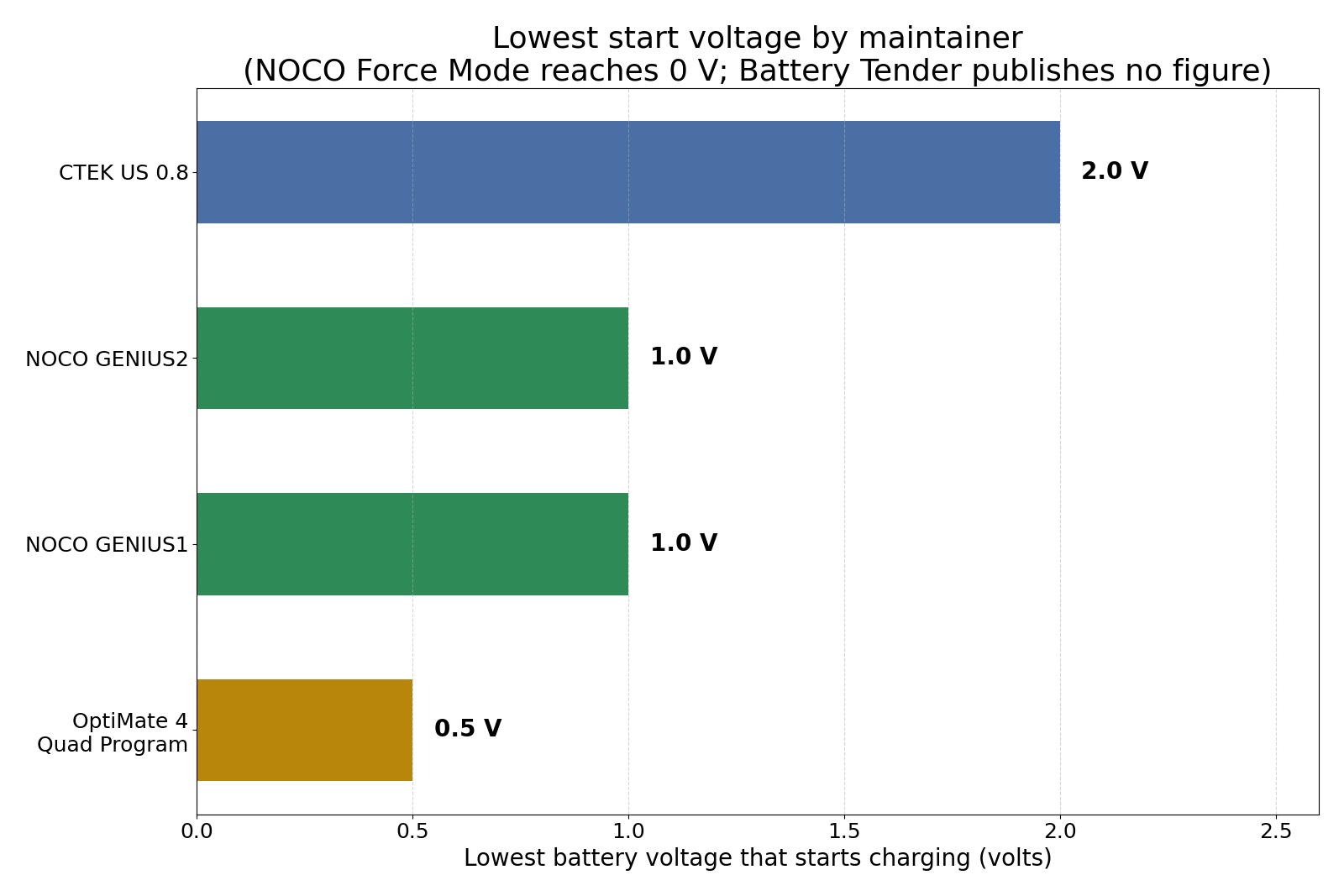
Read the start voltage column with care. It decides whether the charger will even try on a flat battery. The spread here runs from 0.5 volts to 2.0 volts. A battery found at 1 volt after winter starts charging on three picks and sits ignored on one.
The refill maths
Listings rank maintainers by amps and stop there. Amps alone do not tell you the wait. The wait depends on how much charge the battery has lost.
Worked example. A 12 amp-hour battery at half charge needs about 6 amp-hours put back. Divide 6 by the charger output for the ideal time. A 0.8 amp unit needs 7.5 hours. A 1 amp unit needs 6 hours. A 1.25 amp unit needs 4.8 hours. A 2 amp unit needs 3 hours.
Real charging takes longer than the ideal figure. Every smart charger slows down near full charge to protect the battery. NOCO’s own table for the GENIUS2 lists 4.5 hours for a 12 amp-hour battery at half discharge, against the 3 hour ideal figure. Budget with the maker table where one exists, and treat the ideal figure as a floor.
The lesson cuts both ways. For pure storage, the smallest pick here is already more than enough. For recovery of a flat touring battery, output is the difference between riding tomorrow and riding next week.

1. NOCO GENIUS1: best pick for most riders
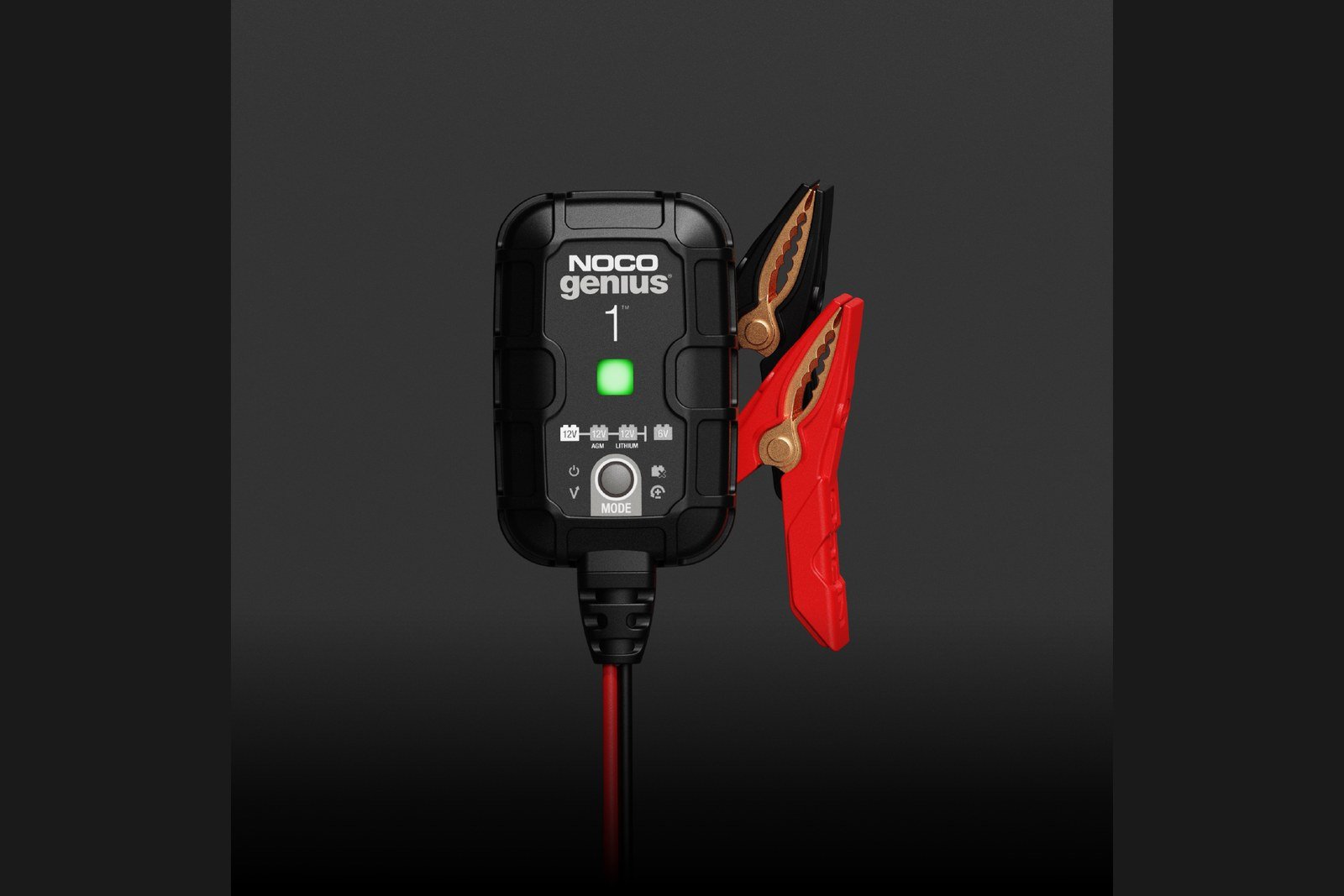
The GENIUS1 is NOCO’s small wall-plug maintainer. NOCO rates it at 1 amp for 6 volt and 12 volt batteries, lead-acid and lithium-ion, including flooded, gel, AGM, and maintenance-free types. NOCO rates it to charge batteries up to 30 amp-hours and to maintain larger batteries once full. A typical motorcycle battery near 10 amp-hours sits well inside that range.
Flat battery recovery is its strongest card. NOCO states the start-voltage sensor detects batteries as low as 1 volt. For batteries below 1 volt, Force Mode charges down to zero volts. Stored batteries are usually found flat, not full, so this matters more than headline amps.
Temperature compensation is built in. NOCO states the thermal sensor avoids under-charging in cold weather down to minus 4 degrees F and over-charging in hot weather up to 104 degrees F. For a charger left alone in a cold shed for months, that guard earns its keep.
One figure conflicts in NOCO’s own documents. The user guide rates the housing IP60. Some listing fields state IP65. This guide prints the guide figure. Treat the unit as dust protected with no proven water rating, and mount it under cover.
The price on NOCO’s own store on 28 November 2026 was $29.95, with a 20 percent sale price of $23.96 shown on the same page. Confirm the model number GENIUS1 on the listing before you order.
Check price: NOCO GENIUS1 on Amazon
Skip it if your battery is a large touring unit that often comes back flat. The GENIUS2 below refills it in about half the time. Skip it also if the wall outlet sits far from the bike, because the GENIUS1 plugs straight into the wall with no AC cord. For car batteries, see our car battery charger guide.
2. NOCO GENIUS2: best for large or flat batteries
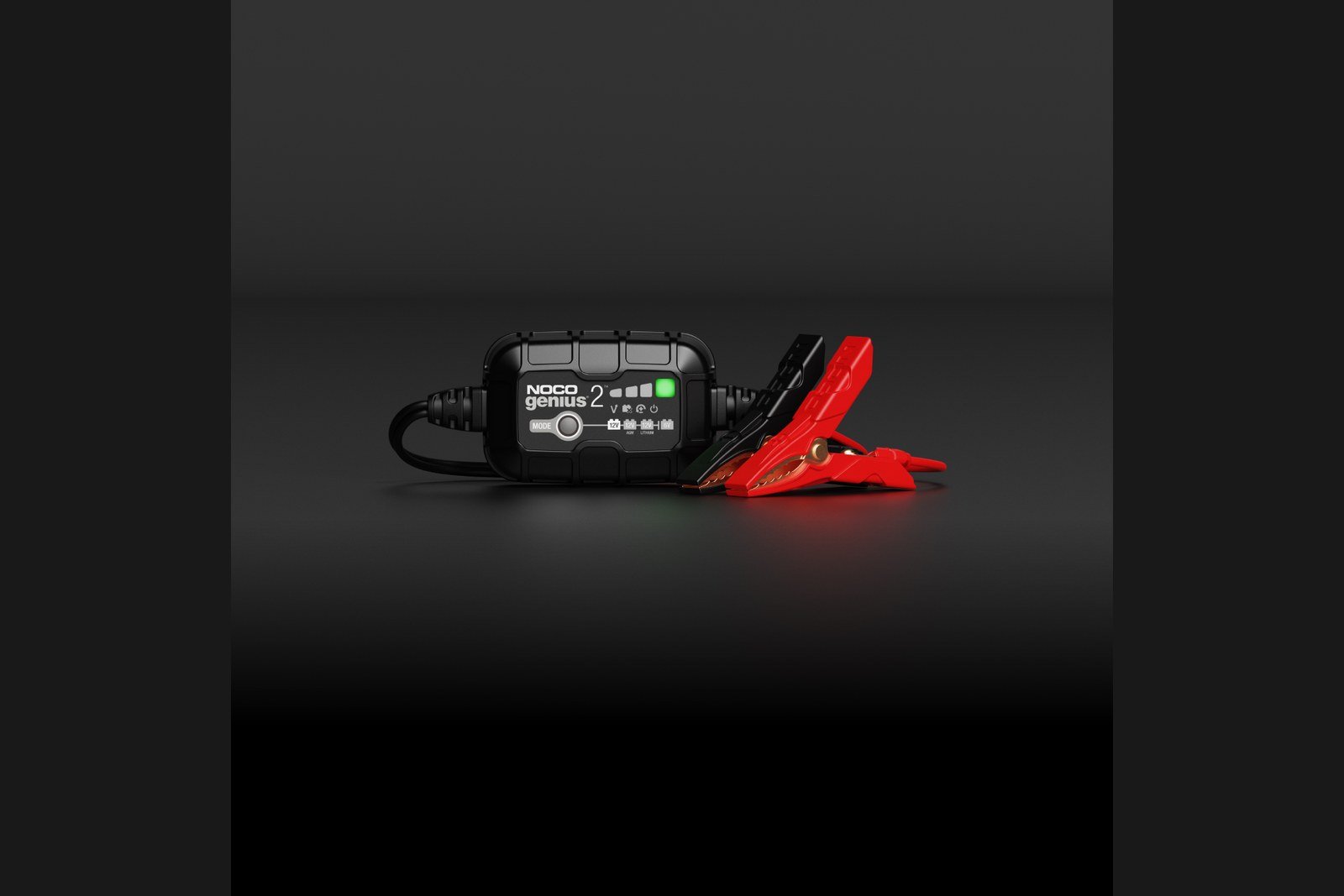
The GENIUS2 is the same idea with double the output. NOCO rates it at 2 amps for 6 volt and 12 volt batteries, lead-acid and lithium-ion. Crutchfield’s product research lists a charging range up to 40 amp-hours, with maintenance for all sizes once full. That covers large cruiser and touring batteries with room to spare.
Modes cover the cases riders actually meet. Crutchfield lists 12V at 14.5 volts, 12V AGM at 14.84 volts, 12V Lithium at 14.6 volts for batteries with a management system, 6V at 7.25 volts, and Force Mode below 1 volt. The lithium mode is for lithium batteries with a battery management system only. Check your battery label before you select it.
NOCO’s charge time table, reproduced by Crutchfield, lists 3 hours for an 8 amp-hour battery, 4.5 hours for 12 amp-hours, 6.75 hours for 18 amp-hours, and 15 hours for 40 amp-hours, each from half discharge. Use those figures to plan, not the ideal maths.
Unlike the GENIUS1, the GENIUS2 has cables. Crutchfield lists a 6 foot AC cord and a 4.5 foot DC cable, plus a mounting bracket. Crutchfield rates the housing IP65. The warranty is 3 years.
The price on NOCO’s own store on 28 November 2026 was $49.95, with a 20 percent sale price of $39.96 shown on the same page. Crutchfield listed $49.95 on backorder the same week.
Check price: NOCO GENIUS2 on Amazon
Skip it if your battery is small and healthy and never goes flat. The GENIUS1 does the storage job for less money. Skip it also if you need one charger to recover large car or truck batteries often. That job belongs to a 5 amp or larger unit.
3. Battery Tender Junior 800mA Selectable: best warranty and simplest switch
This is the selectable-chemistry Junior, model 022-0199-DL-WH. Read that model number twice before ordering. Deltran sells a Junior 750mA, model 021-0123, that charges lead-acid only. The two look alike and cost about the same. Only the 022-0199-DL-WH in this guide switches to lithium.
Output is 800 milliamps at 12 volts. Deltran’s own Harley guide lists it for AGM, GEL, lithium, and standard sealed or flooded lead-acid batteries. A button selects lead-acid or lithium (LiFePO4). The manual describes a 4-step program ending in float maintenance, with spark-proof connection and reverse polarity detection before power flows.
Two safety timers are published by retailer Union Garage from the maker specification. The lead-acid timer is 80 hours. The lithium timer is 18 hours. The warranty is 5 years, the joint longest here.
One naming conflict needs printing. Deltran’s store page calls this SKU a 1 Amp charger in its product title. The manual, the Harley guide, and the listings call it 800mA. This guide uses 800mA, the figure in the manual specification. Judge refill times on 0.8 amps.
Two figures are not published, so neither is printed as fact. Deltran publishes no battery size range and no lowest start voltage for this model in the documents read. The manual troubleshooting section warns that a completely dead battery may need a larger charger first. Plan on this unit for storage and top-ups, not for recovery from zero volts.
The price on Deltran’s store on 28 November 2026 was $52.95, marked sold out. Union Garage listed $49.95 the same day. Confirm model 022-0199-DL-WH and the chemistry switch on the listing before you order.

Check price: Battery Tender Junior 800mA Selectable on Amazon
Skip it if your battery often sits below the voltage where small chargers start, or you own a 6V machine. This model is 12V only. Skip it also if you need temperature compensation for an unheated shed. The NOCO picks above publish it. This model does not.
4. CTEK US 0.8: best lead-acid-only storage charger
The US 0.8 is CTEK’s smallest 12 volt charger, model 56-865. The maker manual rates it at 0.8 amps with a 6-step fully automatic cycle. Battery capacity is 1.2 to 32 amp-hours for charging, up to 100 amp-hours for maintenance. That range fits motorcycle batteries exactly.
The limit is chemistry. The manual states all types of 12V lead-acid batteries: wet, maintenance-free, Ca/Ca, AGM, and GEL. There is no lithium mode. If any battery in your garage is lithium, this is the wrong charger for it.
The start voltage is 2.0 volts, the highest floor in this guide. A battery that has fallen below 2 volts will not start charging. For a bike stored on the maintainer from autumn, that floor never matters. For a battery found flat in spring, it can.
Other maker figures are strong. Charging voltage is 14.4 volts. Back current drain is under 1 amp-hour per month if the mains fails. Ambient range is minus 4 to 122 degrees F. The warranty is 5 years. Clamps and eyelets are included.
No maker store price is printed for this model. CTEK’s US store pages read on 28 November 2026 did not show a US 0.8 price that could be verified in full. Retailer prices vary by region. Confirm model 56-865 and the price on the listing before you order. Two Amazon ASINs appear for this model in listing data, so check the model number on the listing page with extra care.
Check price: CTEK US 0.8 on Amazon
Skip it if you own, or plan to own, a lithium motorcycle battery. Skip it also if your stored battery is often found near zero volts. The NOCO and OptiMate picks start far lower.
5. OptiMate 4 Quad Program TM631: best for BMW sockets and battery testing
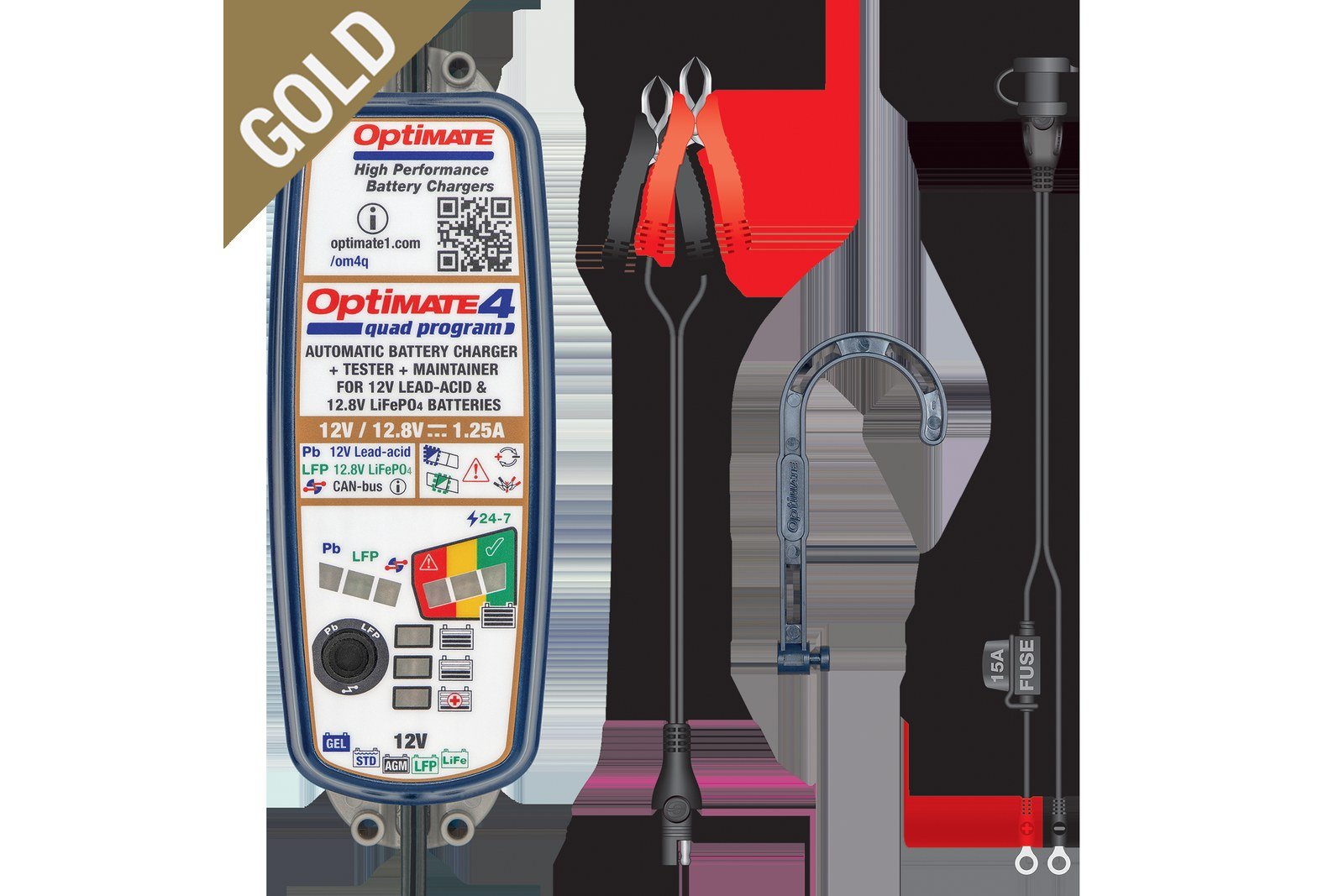
The OptiMate 4 Quad Program is TecMate’s top powersport charger. The maker manual rates it at 1.25 amps. Lead-acid range is 4 to 60 amp-hours. Lithium (LiFePO4) range is 1.25 to 15 amp-hours on the manual cover. A secondary manual summary states 2 to 15 amp-hours for lithium instead. This guide uses the manual cover figure.
Recovery is the headline. TecMate states the charger can save a dead-flat lead-acid or lithium battery from as low as 0.5 volts, the lowest floor here. It also tests the battery before and after charging, so you get a health read rather than a single green light.
The Quad name means four programs. Programs 1 and 3 charge directly at the battery, for lead-acid and lithium. Programs 2 and 4 charge through a BMW CAN-bus controlled 12V socket on models from 2004 onward. If your BMW keeps its socket asleep, this is the pick that still reaches the battery. The Premium edition adds the DIN adapter cable. Confirm which edition the listing sells.
The case is rated IP54 and the manual states use down to minus 40 degrees. The warranty in the manual is three years from date of purchase. TecMate’s January 2024 price list puts the TM631 at $100.95 and the Premium edition at $115.95. That list is dated, so confirm the current price on the listing.
Check price: OptiMate 4 Quad Program TM631 on Amazon
Skip it if you only store one standard lead-acid battery and never use a bike socket. The GENIUS1 covers that job for far less money. Skip it also if four programs sound like four chances to pick the wrong one. The Battery Tender switch is simpler.
Lead-acid or lithium: the choice that decides the charger
Read the battery label first. Flooded, AGM, and gel are all lead-acid. LiFePO4, LFP, and lithium iron phosphate mean lithium. The charger must match the label.
For lead-acid, every pick in this guide works. Choose on output, warranty, and start voltage. For lithium, only four picks work. The CTEK US 0.8 is out. Among the four, note the conditions. NOCO’s lithium mode is for batteries with a battery management system. The Battery Tender needs the button set to lithium. The OptiMate needs program 3 or 4 selected.
Cold adds a second rule for lithium. Low temperature charging limits vary by battery model. Follow the battery maker’s storage and charging instructions for your exact battery. No charger in this guide overrides those instructions.
If you do not know your battery type, stop and find out before ordering. A photo of the label settles it. Our battery tester guide covers testers that read chemistry and health before winter.
Fitting the maintainer so winter is one plug
Every pick here includes clamps for temporary use. The better winter setup is a fused ring terminal lead bolted to the battery once. The charger then connects through a quick plug without lifting the seat each time.
Check three fit points before ordering. First, cable reach from outlet to bike. The GENIUS1 has no AC cord, so the outlet must sit within lead reach. Second, terminal access. Some bikes bury the battery under bodywork, which makes the permanent lead worth fitting in autumn. Third, socket charging. Only the OptiMate here charges through a BMW CAN-bus socket.
Leave the maintainer connected all winter. Check the indicator when you pass the bike. A charger stuck on full output for days, or a battery that never reaches the maintain light, means the battery needs testing. For a jump start in spring, our guide to how to jump a car with jumper cables covers safe cable order.
Flaws but not dealbreakers
The GENIUS1 plugs into the wall, so outlet position rules the install. Its ingress rating is printed two ways by its maker. The GENIUS2 costs about double the GENIUS1 at list prices for output many storage-only riders never use. The Battery Tender Junior 800mA publishes no start voltage and no battery range, and its store title calls it 1 Amp against the manual 800mA figure. The CTEK US 0.8 cannot charge lithium and will not start below 2.0 volts. The OptiMate costs the most here and asks you to select one of four programs correctly.
None of those flaws breaks the storage job. Each one rules the model out for a specific rider, which is why the skip notes above name the rider, not just the flaw.
What we looked for
Output in amps, checked against battery size in amp-hours. Voltage coverage, including 6V for older machines. Chemistry coverage, with lithium treated as a hard gate. Lowest start voltage, because stored batteries are found flat. Temperature compensation for unheated storage. Published warranty length. Maker documents opened in full for every figure.
The competition
The Battery Tender Junior 750mA (021-0123) is the model most riders confuse with pick 3. It charges lead-acid only and costs $44.95 on Deltran’s store. It was left out because the selectable 800mA covers lithium for a small price step. The Battery Tender Plus 1.25A ($64.95 on Deltran’s store) adds output for lead-acid, but still has no lithium mode. The NOCO GENIUS5 adds 5 amp recovery for car batteries, which is output a motorcycle battery does not need. Riders who must also recover car batteries should read our car battery charger guide instead. Riders with no mains power where the bike sits should read our solar trickle charger guide.
Sources
- NOCO GENIUS1 product page: 1A, 6V/12V, lead-acid and lithium, 1V detection and Force Mode to 0V, thermal range, maker prices. Read 28 Nov 2026.
- NOCO GENIUS2 product page: 2A, 6V/12V, chemistries, Force Mode, maker prices. Read 28 Nov 2026.
- Crutchfield NOCO Genius 2 research: 40Ah range, mode voltages, charge time table, IP65, cables, 3-year warranty. Read 28 Nov 2026.
- Winch Insider NOCO GENIUS1 review: GENIUS1 ASIN, 30Ah rating, IP60/IP65 conflict, warranty. Read 28 Nov 2026.
- Auto Median NOCO GENIUS2 review: GENIUS2 ASIN and specification table. Read 28 Nov 2026.
- Battery Tender Harley charger guide: Junior 800mA selectable output and chemistries. Read 28 Nov 2026.
- Battery Tender store page: Junior Multi-Chemistry SKU 022-0199-DL-WH at $52.95, Junior 750mA SKU and price. Read 28 Nov 2026.
- Battery Tender Junior 800mA manual summary: model, 800mA output, chemistry switch, LED states, 5-year warranty, dead battery warning. Read 28 Nov 2026.
- Union Garage Battery Tender Jr listing: safety timers, size, weight, $49.95 price. Read 28 Nov 2026.
- CTEK US 0.8 user manual: 0.8A, 6-step, 1.2 to 32Ah, 2.0V start, 14.4V, lead-acid only. Read 28 Nov 2026.
- CTEK US 0.8 manual page: model 56-865 specification table and 5-year warranty. Read 28 Nov 2026.
- Pelican Parts CTEK page: US 0.8 description, clamps and eyelets included. Read 28 Nov 2026.
- OptiMate 4 Quad Program manual: 1.25A, Pb 4 to 60Ah, LFP range, 0.5V start, three-year warranty. Read 28 Nov 2026.
- OptiMate motorcycle charger page: Quad Program features, CAN-bus programs, 0.5V recovery, maintenance program. Read 28 Nov 2026.
- OptiMate 4 Quad Program manual summary: TM631 specification table, IP54, program table. Read 28 Nov 2026.
- TecMate January 2024 price list: TM631 $100.95 and TM631-PR $115.95 list prices. Read 28 Nov 2026.
- Yuasa winter battery storage guide: one percent daily loss, freezing points by charge state, 12.25V recharge point. Read 28 Nov 2026.
Affiliate disclosure: CarStartTroubleshooting.org earns from qualifying purchases made through Amazon links on this page, at no extra cost to you. Prices and availability change. Confirm the model number on the listing before you order. No bench test was run for this guide. Figures come from the maker and retailer pages listed above, read on 28 November 2026.
Automotive Safety Notice
Lead-acid batteries produce flammable hydrogen gas and contain corrosive sulfuric acid. Always wear ANSI-rated eye protection, disconnect the negative terminal before electrical servicing, and consult an ASE-certified technician for fuel leaks or high-voltage hybrid systems.

Alexander Reed, MEng
Automotive engineer (MEng, 2021) specializing in no-start diagnostics, parasitic draw isolation, and starter-charging systems.
Verified Gravatar Profile ↗


Reader Discussion & Questions
0 Comments