

Table of Contents (15 Sections)
The verdict. Buy the NOCO Boost Pro GB150 if your RV runs a large gas V8 or a diesel up to 7.0 liters and you want the most headroom in one lithium pack. Buy the NOCO Boost HD GB70 if your Class B or Class C runs a gas engine up to 8.0 liters and you want the proven mid-size pack. Buy the GOOLOO GP3000 if price decides it and you accept slower charging. Buy the DEWALT DXAEJ14 if you want one box that jumps the engine and tops up RV tires. Buy the Clore Jump-N-Carry JNC660 if the rig sits for months and you want a booster that lives on charge with long cables.
No bench test was run for this guide. Every figure below comes from a maker page, a maker manual, or a retailer listing read on 29 November 2026. Where sources disagree, the conflict is printed next to the figure. Prices change often, so each price carries the place it was read and the date.
Why an RV needs a different pick
An RV carries two battery systems. Good Sam puts the split plainly. The chassis battery is a 12 volt starting battery. It starts the engine and powers headlights, turn signals, and dash electronics. The house batteries are deep cycle batteries. They power lights, appliances, the water pump, and outlets while parked.
A jump starter fixes the first system. When the engine will not crank, the fault sits at the chassis battery in most cases. Charging the house bank will not crank the engine unless your rig has a battery boost switch that ties the banks together for one start. Try that switch first if your dash has one. When both banks sit low after dry camping, the switch has nothing left to lend. That is the moment a jump pack earns its space.
Storage is the second RV problem. Good Sam states that batteries self discharge at 5 to 15 percent per month when unused. Propane detectors, stereos with memory, and charge controllers draw power with everything switched off. Cold is the third problem. Good Sam states that batteries lose up to 50 percent of capacity in freezing conditions. A pack sized exactly to your engine on a warm day can fall short on a cold campground morning. Reach is the fourth problem. Chassis batteries hide under hoods, front steps, and front compartments. Long cables let the pack sit on the ground where it belongs.
One limit applies to every pick here. All five are 12 volt tools for 12 volt lead-acid starting batteries. None is a house battery charger. If your chassis system is 24 volt, buy a 24 volt tool instead.
If your RV cranks slowly and clicks, read our guide to car clicks rapidly and will not start before you buy. If the battery dies every few days, our guide to car battery keeps dying works through drain tests in order.
How these five packs were picked
A pack only made this list if its maker publishes the key figures in its own documents. Peak amps or cranking amps, engine ceiling or engine fit, battery type, and warranty all had to be readable on a maker page or in a maker manual. Models sold only through listing copy were left out.
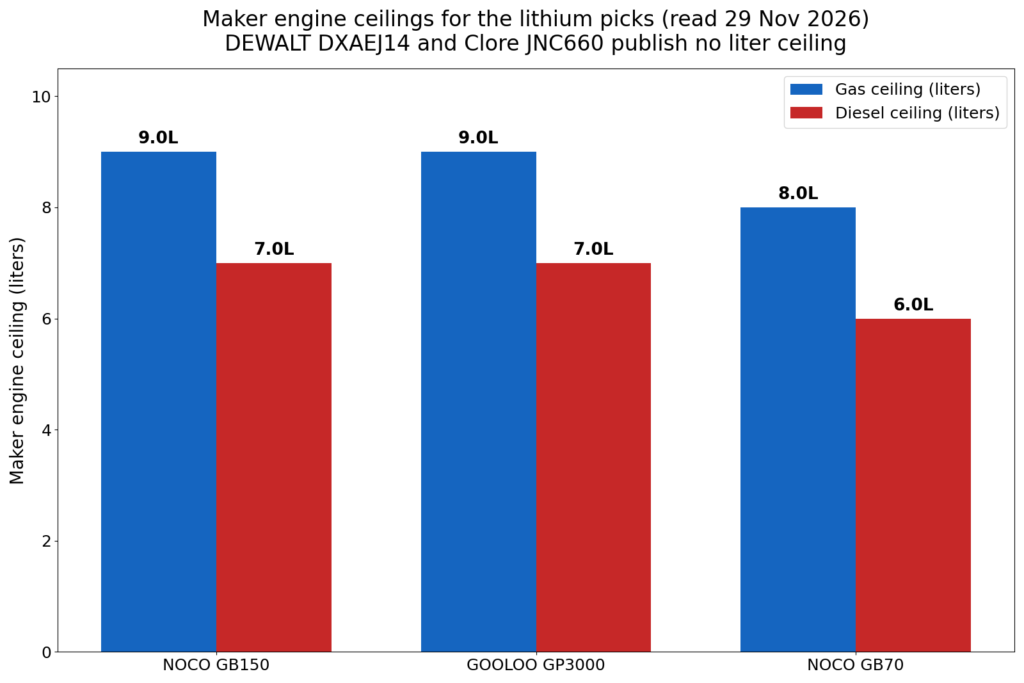
Each pick below states the maker figures, the warranty, and a price read on 29 November 2026 with its source. Two picks publish no liter ceiling. The DEWALT and the Clore state engine fit in cylinders or in shop use instead. That gap is printed in their sections.
Never jump a cracked, leaking, swollen, or frozen battery. Turn off all loads before you connect. Work with ventilation, because battery compartments can trap hydrogen gas. Remove rings and watches before you touch terminals.
The five packs at a glance
| Pack | Maker rating | Gas / diesel ceiling | Battery inside | Weight | Warranty | Price read 29 Nov 2026 |
|---|---|---|---|---|---|---|
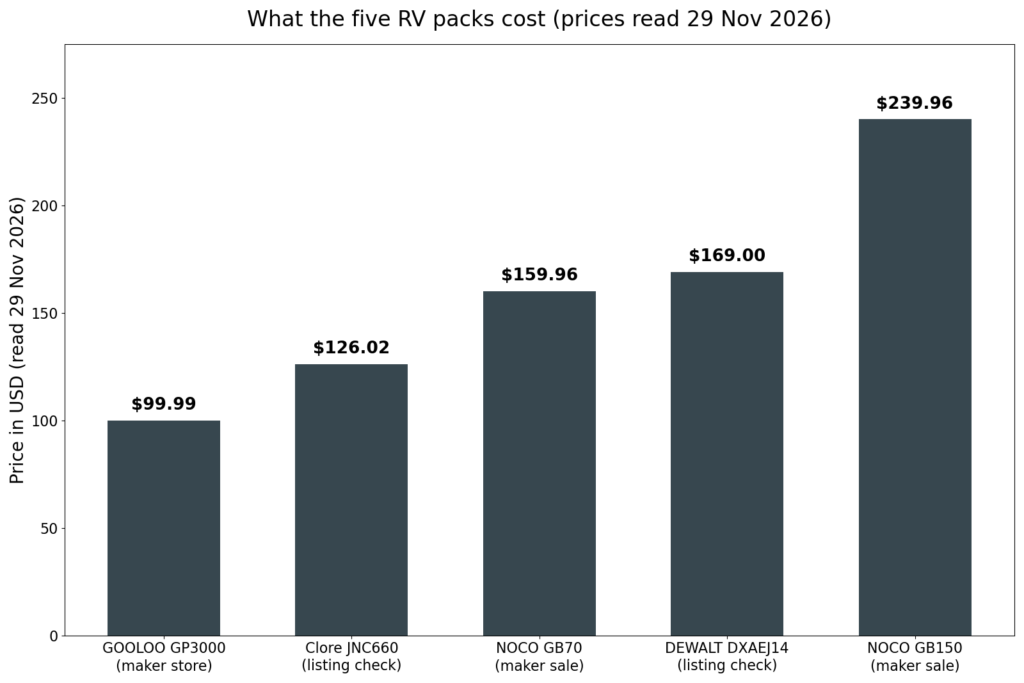
| NOCO Boost Pro GB150 | 3,000A peak | 9.0L / 7.0L | Lithium-ion | 7.5 lb | 1 year | $239.96 maker sale, list $299.95 |
| NOCO Boost HD GB70 | 2,000A peak | 8.0L / 6.0L | Lithium-ion | 5.0 lb | 1 year | $159.96 maker sale, list $199.95 |
| GOOLOO GP3000 | 3,000A peak | 9.0L / 7.0L | Lithium polymer | 1.4 lb | 18 months | $99.99 maker store, list $119.99 |
| DEWALT DXAEJ14 Type3 | 1,600A peak | Most 4, 6, 8 cyl, no liter rating | Sealed lead-acid | 17.3 lb | 1 year | $169.00 listing check |
| Clore Jump-N-Carry JNC660 | 1,700A peak, 425A cranking | No liter rating published | Lead-acid AGM, 22Ah | 18 lb | 1 year | $126.02 listing check |
Read the rating column with care. Peak amps use no single test method across brands. Compare peak amps inside one brand line. Compare across brands on the engine ceiling, the cable reach, and how the pack stores.
The storage maths
Listings rank packs by amps and stop there. Storage habits decide whether the pack is charged when you need it.
Worked example. Take the Good Sam self discharge range of 5 to 15 percent per month. Leave an RV parked for three months with no maintainer. At 5 percent a month, about 86 percent of charge remains. At 15 percent a month, about 61 percent remains. Key-off loads pull both figures lower.
Cold cuts the result again. At up to 50 percent capacity loss in freezing conditions, a battery at 61 percent charge behaves near 30 percent of its warm rating on a freezing morning. That is why this guide favors headroom.
Recharge habits split the five picks. The Clore can stay plugged into AC. The DEWALT needs a top-up every 30 days. The lithium packs need a check every few months and a recharge after each use. Pick the habit you will actually keep.
1. NOCO Boost Pro GB150: best for large gas and diesel RVs
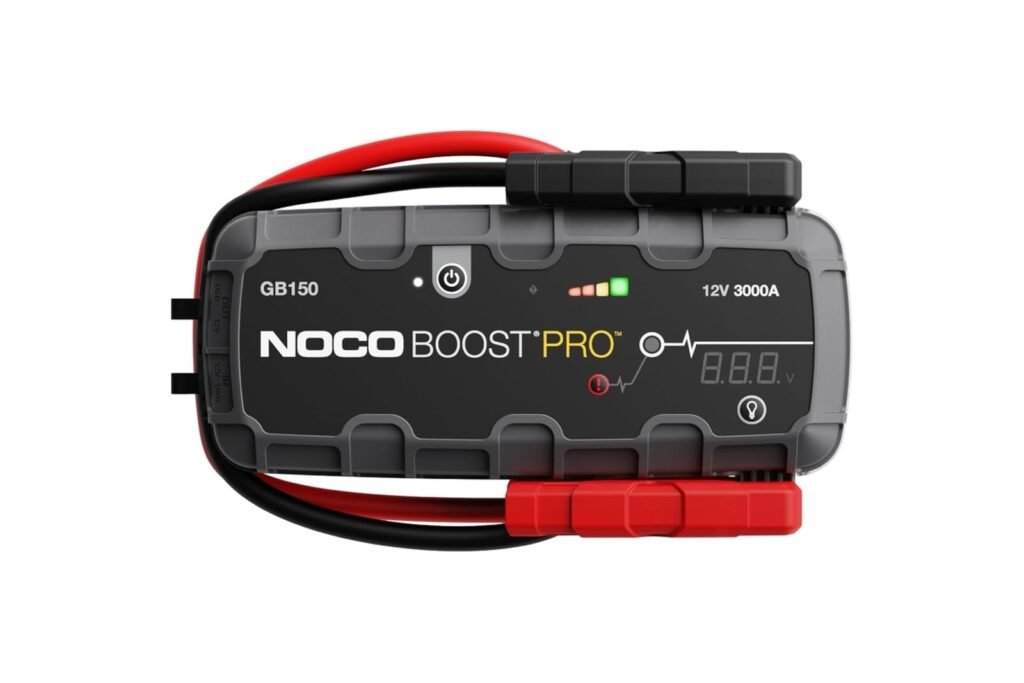
The GB150 is NOCO’s large Boost pack. NOCO rates it at 3,000 amps for gas engines up to 9.0 liters and diesel engines up to 7.0 liters, with up to 80 jump starts on one charge. NOCO names RVs in the intended vehicles on its product page. The case is rated IP65. Weight is 7.5 pounds on the maker page.
Two extras suit RV use. The built-in voltmeter reads the vehicle battery voltage before you crank. The 12 volt output runs tire inflators and other 12 volt gear. The light is 500 lumens with seven modes, the brightest here.
Manual override matters after long storage. NOCO’s how-to page states the pack detects batteries down to 2 volts. Below 2 volts the Boost light stays off. Press and hold the override button for three seconds to force boost on. That step disables spark-proof and reverse polarity protection. Check the posts twice before you use it.
Two conflicts need printing. NOCO’s how-to video text calls this pack a 2,000 amp unit. The product page states 3,000 amps. This guide uses 3,000 amps and treats the video text as an error. On charging, one review describes slow charging over older USB. The maker page image labels a 10 watt USB-C input. Check the port on the unit you receive. Either way, plan on hours to refill.
The price on NOCO’s own store on 29 November 2026 was $299.95, with a 20 percent sale price of $239.96 shown on the same page. Confirm the part number GB150 on the listing before you order.
Check price: NOCO Boost Pro GB150 on Amazon
Skip it if your diesel is larger than 7.0 liters, or your chassis battery bank needs a shop booster for repeated starts. Skip it also if fast refill between jobs matters most. For the dead battery case in detail, see our guide to the best jump starter for a completely dead battery.
2. NOCO Boost HD GB70: best for most Class B and Class C gas RVs
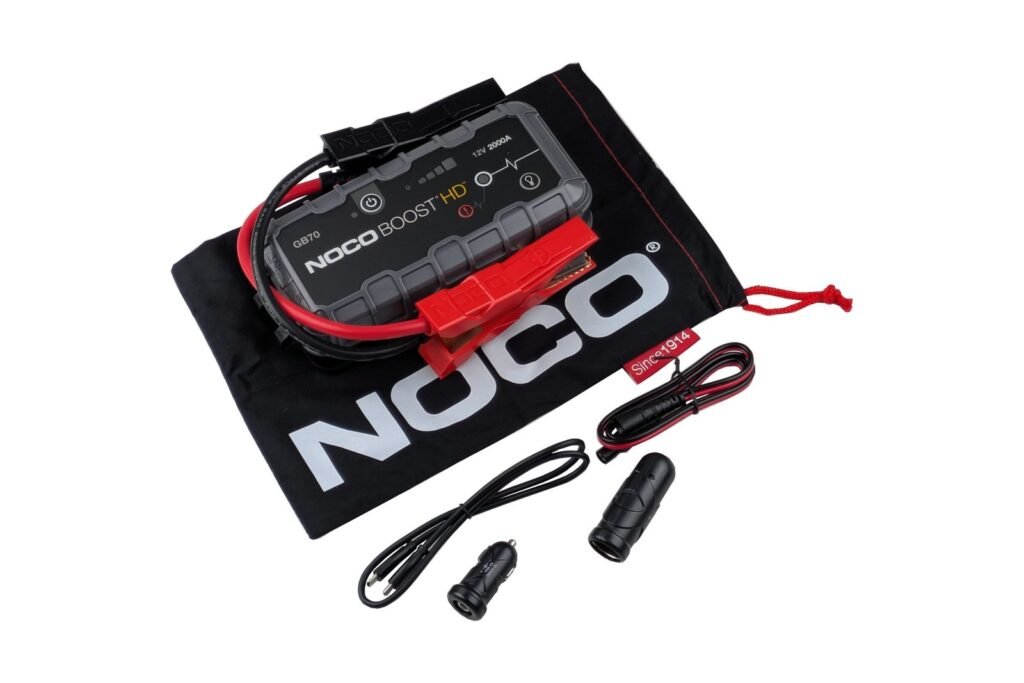
The GB70 is the mid-size Boost pack, and it fits the most common RV engines. NOCO rates it at 2,000 amps, for gas engines up to 8.0 liters and diesel engines up to 6.0 liters, with up to 40 jump starts on one charge. Weight is 5.0 pounds. The case is rated IP65. The light is 400 lumens.
That ceiling covers most gas Class B vans and Class C motorhomes with room to spare. A light diesel at or under 6.0 liters also fits. A larger diesel does not. Match the diesel limit to your engine, not the gas limit.
The clamp system matches the GB150. Spark-proof technology and reverse polarity protection guard the connection. The pack adds USB charging and a 12 volt output. NOCO does not publish a cable gauge for the GB70, so no gauge figure is printed here.
The price on NOCO’s own store on 29 November 2026 was $199.95, with a 20 percent sale price of $159.96 shown on the same page. That puts the GB70 about eighty dollars under the GB150 at sale prices, for a smaller ceiling and half the starts per charge.
Check price: NOCO Boost HD GB70 on Amazon
Skip it if your gas engine is over 8.0 liters or your diesel is over 6.0 liters. The GB150 above covers both. Skip it also if you want the lightest pack for a small van. The GOOLOO below weighs far less. For cold mornings, see our winter jump starter guide.
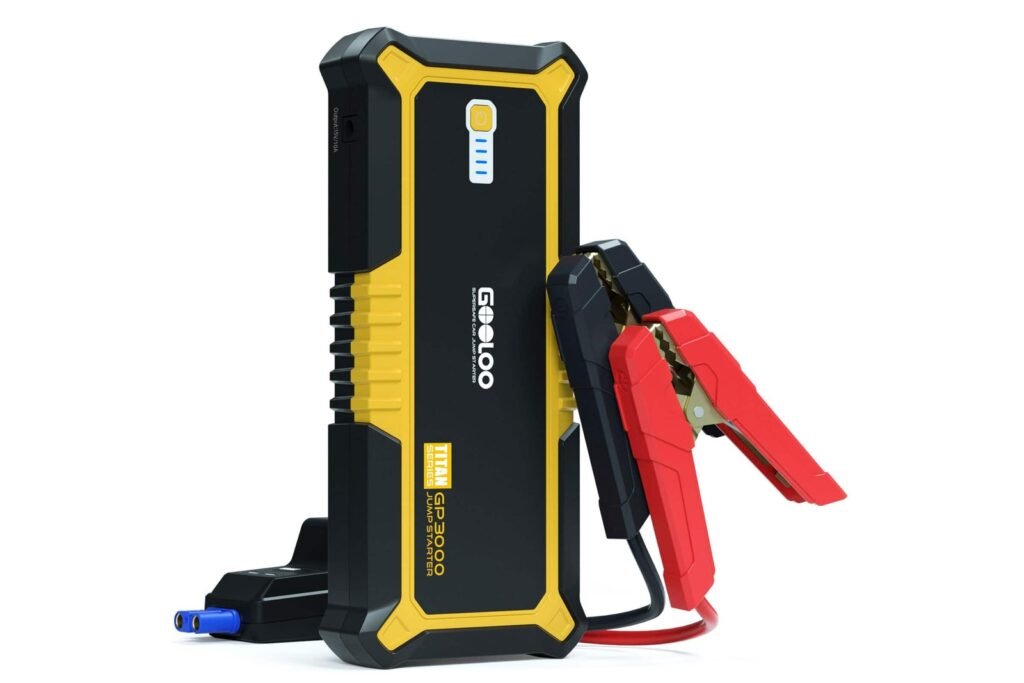
3. GOOLOO GP3000: best value lithium pack for RVs
The GP3000 is the budget pick, and its paperwork is clear. GOOLOO rates it at 3,000 amps peak for gas engines up to 9.0 liters and diesel engines up to 7.0 liters. The maker store states over 50 starts on one charge. The manual rates the unit for 12 volt vehicles only. Weight in the opened manual is 1.4 pounds.
Cold range is published in full. The maker store and the manual both state minus 4 to 140 degrees F. For an RV that winters outside, a printed floor beats a guess.
Boost mode handles a flat chassis battery. The maker store states boost activates below 9 volts. The manual states manual override applies below 8 volts. Both thresholds are printed here because both appear in maker documents. Hold the BOOST button on the smart cable for 3 seconds, then start within 30 seconds. The button sits on the cable, not on the unit.
Extras cover camp use. The pack charges phones over USB-C at 15 watts and over two USB-A ports. The 15 volt DC output runs 12 volt gear such as tire inflators. The light is 400 lumens. A full recharge takes about 5 hours. The warranty is 18 months, the longest here.
Two figures stay out on purpose. GOOLOO does not state a watt-hour capacity in the opened manual specification table, so no capacity figure is printed here. Standby claims differ inside the maker store page, which states 18 months in one section and 24 months in another. Recharge every 3 months per the manual.
The price on GOOLOO’s own US store on 29 November 2026 was $99.99, list $119.99, marked out of stock at the time of reading. Confirm the model number GP3000, part Epower-136, on the listing before you order.
Check price: GOOLOO GP3000 on Amazon
Skip it if you need fast recharging between starts, or you want a voltmeter on the pack. The GB150 covers both. Skip it also if you dislike cable-mounted controls. For more low cost options, see our budget jump starter guide.
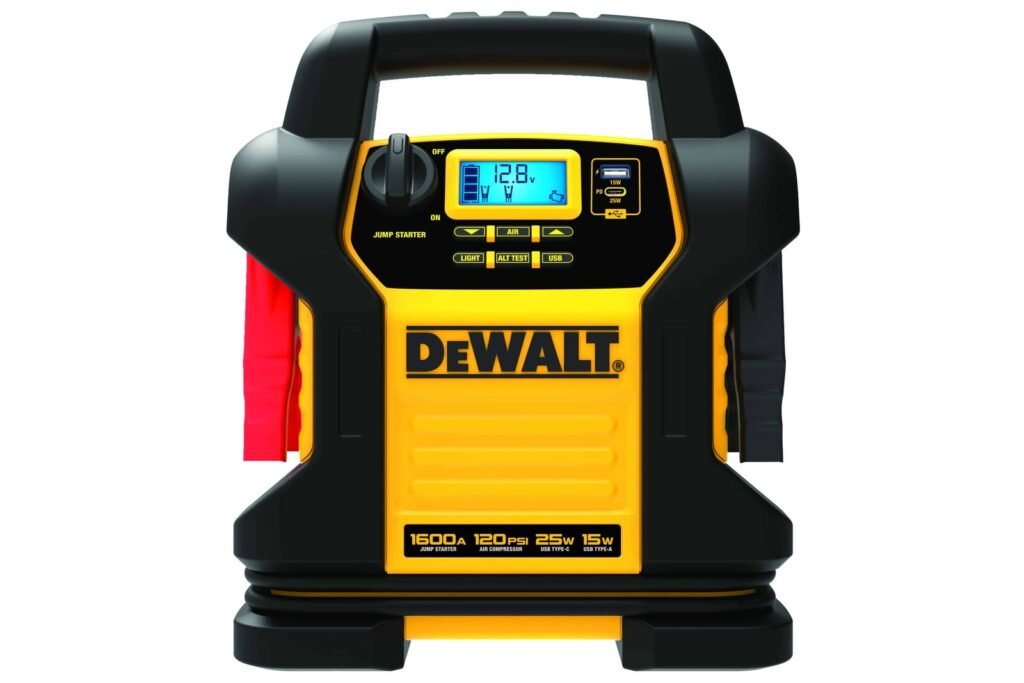
4. DEWALT DXAEJ14 Type3: best all-in-one box with a compressor
The DXAEJ14 is a sealed lead-acid power station, not a lithium pack. DEWALT jump starters are made by Baccus Global under license. The current Type3 manual rates it at 1,600 peak amps for 12 volt wet, gel, and AGM batteries. Weight is 17.3 pounds.
The compressor is the reason to buy it for an RV. The digital inflator runs to 120 PSI with automatic shut-off at the set pressure. A 10 minute auto shut-off guards against overheating. For RV tires that sit for months, one box that jumps and inflates saves a second tool.
Other extras fit roadside work. USB-A runs at 15 watts. USB-C runs at 25 watts. The alternator check button reads charging voltage with the engine running. A reverse polarity alarm sounds on a wrong connection. The warranty is 1 year.
Read the limits plainly. DEWALT publishes no liter ceiling for this model. Listings state most 4, 6, and 8 cylinder cars and trucks, and up to a V8. That covers gas Class B and Class C rigs in most cases. It does not prove coverage for a large diesel.
Version control matters here. Older DXAEJ14 units carry 1,400 peak amps with 700 instant amps. The current Type3 carries 1,600 peak amps. Check that the listing title says 1600 peak amps and Type3. Recharge time also differs by document. The Type3 manual summary states about 12 to 24 hours for the first charge. A specification listing states about 40 hours from flat. Plan on overnight at minimum, and top up every 30 days in storage.
The price in a listing check read on 29 November 2026 was $169.00. Retail prices for this model vary by seller. Confirm Type3 on the listing before you order.
Check price: DEWALT DXAEJ14 Type3 on Amazon
Skip it if your RV runs a large diesel, or you want a pack you can carry in one hand to a battery bay. The lithium picks above weigh a fraction of this box. Skip it also if you will not top it up monthly. For inflation alone, see our portable tire inflator guide.
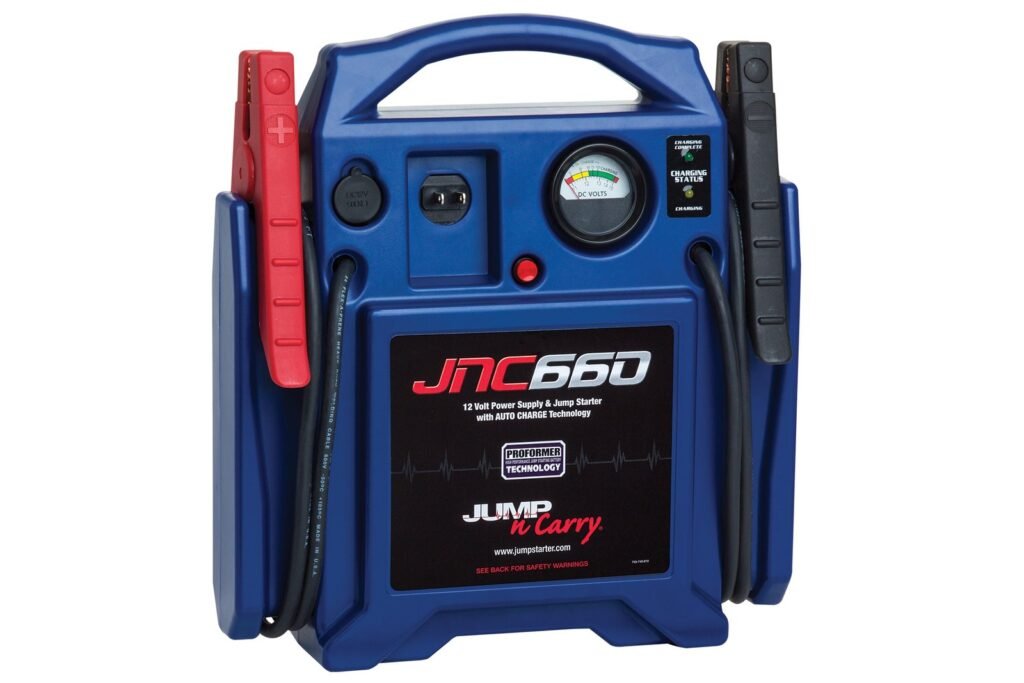
5. Clore Jump-N-Carry JNC660: best for rigs that sit for months
The JNC660 is the shop booster that garages and fleets keep on charge. Clore rates it at 1,700 peak amps and 425 cranking amps. The battery inside is a 22 amp-hour Clore PROFORMER lead-acid AGM unit. Weight is 18 pounds. The warranty is 1 year.
Cables are the headline for RV work. Clore states 46 inch number 2 AWG welding cable leads with industrial grade clamps. That reach covers batteries in front compartments and under steps. One retailer page prints number 4 gauge in one line and number 2 in another. This guide uses the maker figure, number 2 AWG.
Storage is the second headline. The built-in automatic charger can stay connected to AC for continuous maintenance charging. For an RV in storage with shore power nearby, that habit beats every lithium check schedule. The voltmeter shows onboard charge at a button press. A 12 volt DC outlet powers accessories.
Limits are clear. Clore publishes no liter ceiling for the JNC660. Judge it on cranking amps and cable reach. There is no USB port, no flashlight, and no reverse polarity protection. Check polarity yourself, every time. An AC extension cord is required for wall charging and is not included.
The price in a listing check read on 29 November 2026 was $126.02. Confirm the model number JNC660 on the listing. A JNC660C variant also exists under a different part number. Order the part your seller names in full.
Check price: Clore Jump-N-Carry JNC660 on Amazon
Skip it if you want USB charging, a light, or polarity protection in the pack. The lithium picks cover all three. Skip it also if the pack must live in a cab pocket. At 18 pounds, this box lives in a bay or a garage. For cable-only rescues, see our guide to how to jump a car with jumper cables.
Sizing by RV class
Match the pack to the engine, then check the battery layout. Engine size decides cranking need. Battery layout decides whether one pack can do the job alone.
| RV type | Typical engine task | Picks that fit on maker ratings |
|---|---|---|
| Class B van, gas | Gas V6 or V8, single chassis battery | GB70, GP3000, GB150, DXAEJ14 on cylinder fit |
| Class C, gas chassis | Gas V8 or V10, single chassis battery | GB70 to 8.0L, GB150 and GP3000 to 9.0L |
| Class C, light diesel | Diesel at or under 6.0L to 7.0L | GB70 to 6.0L, GB150 and GP3000 to 7.0L |
| Class A, gas | Large gas V8 or V10 | GB150 and GP3000 to 9.0L, GB70 only under 8.0L |
| Class A, diesel | Diesel over 7.0L in many rigs | No pick here is rated in full, see note below |
| Travel trailer tow vehicle | Truck engine that tows the trailer | Size to the truck engine, same rules as above |
The diesel note needs plain words. Many diesel pushers run engines over 7.0 liters and carry two chassis batteries wired in parallel. No pick in this guide publishes a rating that covers that job in full. Confirm your engine liters first. Buy above the ceiling, not at it.
Dual batteries need care. Connect to the chassis bank as your chassis manual directs. Do not connect across house batteries to start the engine unless the manual names that method.
How to jump an RV chassis battery
Find the chassis battery at home, in daylight. Note the jump points your manual names. Some rigs name a remote positive post instead of the battery itself. Use the named points.
Turn off headlights, dash loads, and house loads that share the chassis ground. Inspect the battery. Stop if the case is cracked, swollen, leaking, or frozen. Clean corroded terminals with a wire brush.
Connect red to positive. Connect black to the negative post or to the ground point your manual names. Switch the pack on. Crank for a few seconds. Wait between tries. Remove black first, then red, with the engine running.
After a start, drive or idle long enough for the alternator to recharge. Good Sam states a healthy charging system reads 13 to 14 volts with the engine running. Below 13 volts points to a charging fault. Get the battery load tested at the next stop.
If the engine cranks but will not fire, the fault sits past the battery. Our guide to car cranks but will not start covers fuel, spark, and sensor checks in order.
Flaws but not dealbreakers
The GB150 charges slowly for its price and carries a video text error on amps. The GB70 stops at 6.0 liters diesel, which rules out larger diesels. The GP3000 recharges in about 5 hours and prints two standby claims. The DXAEJ14 weighs 17.3 pounds, needs monthly top-ups, and publishes no liter ceiling. The JNC660 has no USB, no light, and no polarity protection, and needs your own extension cord.
None of those flaws breaks the RV job. Each one rules the model out for a specific rig, which is why the skip notes above name the rig, not just the flaw.
What we looked for
Engine ceiling in liters where the maker publishes one. Cranking amps where the maker publishes them instead. Cable reach for compartment batteries. Storage habit and top-up interval. Manual override for batteries found near zero volts. Weight for bay storage. Published warranty length.
The competition
The NOCO Boost X GBX75 covers gas to 8.5 liters and diesel to 6.5 liters with fast USB-C charging. Owners who value refill speed should read our completely dead battery guide, where the GBX75 leads. The GOOLOO GP4000 covers diesel to 10.0 liters on maker figures at a low price. Diesel owners over 7.0 liters should start with that guide. Small glovebox packs under 1,500 amps were left out in full. RV engines and storage drain need headroom that small packs do not publish.
Sources
- NOCO GB150 product page: 3,000A, 9.0L gas and 7.0L diesel, 80 starts, 7.5 lb, IP65, 500 lumens, maker prices. Read 29 Nov 2026.
- NOCO GB150 how-to page: 2 volt detection floor, override hold 3 seconds, voltmeter, video text amp error. Read 29 Nov 2026.
- WinterCarPicks NOCO GB150 review: GB150 ASIN, 88Wh cell, slow charging note, weight range. Read 29 Nov 2026.
- NOCO GB70 product page: 2,000A, 8.0L gas and 6.0L diesel, 40 starts, 5.0 lb, IP65, 400 lumens, maker prices. Read 29 Nov 2026.
- Winch Insider jump starter guide: GB70 ASIN and rating cross-check. Read 29 Nov 2026.
- GOOLOO GP3000 store page: 3,000A, 9.0L and 7.0L, over 50 starts, boost below 9V, temperature range, maker prices. Read 29 Nov 2026.
- GOOLOO GP3000 manual: Epower-136 specs, override below 8V, 1.4 lb, 5 hour recharge, 18 month warranty. Read 29 Nov 2026.
- DEWALT DXAEJ14 Type3 manual: 1,600A peak, 120 PSI AUTOSTOP, USB watts, 17.3 lb, 1 year warranty. Read 29 Nov 2026.
- RoadHubs DEWALT jump starter review: DXAEJ14 ASIN, Type3 versus 1,400A version trap, cylinder fit. Read 29 Nov 2026.
- GearRanking DEWALT DXAEJ14 page: $169.00 price check, 40 hour recharge listing, no liter rating. Read 29 Nov 2026.
- Clore JNC660 product page: 1,700 peak amps, 425 cranking amps, 46 inch number 2 AWG leads, built-in charger. Read 29 Nov 2026.
- Clore JNC660 manual: 22Ah battery, 18 lb, charging steps, extension cord note. Read 29 Nov 2026.
- GearRanking Clore JNC660 page: $126.02 price check, no liter rating, storage notes. Read 29 Nov 2026.
- Good Sam RV battery guide: chassis versus house split, 5 to 15 percent monthly self discharge, cold capacity loss, 13 to 14 volt charge check. Read 29 Nov 2026.
Affiliate disclosure: CarStartTroubleshooting.org earns from qualifying purchases made through Amazon links on this page, at no extra cost to you. Prices and availability change. Confirm the model number on the listing before you order. No bench test was run for this guide. Figures come from the maker and retailer pages listed above, read on 29 November 2026.
Automotive Safety Notice
Lead-acid batteries produce flammable hydrogen gas and contain corrosive sulfuric acid. Always wear ANSI-rated eye protection, disconnect the negative terminal before electrical servicing, and consult an ASE-certified technician for fuel leaks or high-voltage hybrid systems.

Alexander Reed, MEng
Automotive engineer (MEng, 2021) specializing in no-start diagnostics, parasitic draw isolation, and starter-charging systems.
Verified Gravatar Profile ↗


Reader Discussion & Questions
0 Comments