
Table of Contents (12 Sections)
Your car dies while driving then restarts. That restart carries the best clue you own, because a fault that drops out for a moment and then returns will meet you again under the same heat, vibration, or load that triggered it the first time. Get off the road first, then write down how the engine quit, how long the restart took, and what the dashboard did while it happened. Those three facts split six cause families apart before any part comes off the car.
No bench test stands behind this guide. Every voltage band, restart timing, code and price below comes from a page opened for this post and listed in Sources with its read date, and where two sources disagree on a number this post prints both figures side by side. Repair costs are planning bands drawn from those opened pages, so treat them as budget ranges for a diagnosis conversation rather than quotes for your car.
What to do in the moment it dies
Steering and brakes change in the second the engine stops, because power steering assist ends at once and the wheel turns heavy in your hands, while brake assist survives only on vacuum stored inside the booster. Steer puts that brake reserve at one or two firm pedal applications, after which the pedal goes hard and stopping distance grows, so brake once and firmly instead of pumping the reserve away. Switch on the hazard lights, keep both hands on the wheel, and steer for the shoulder or the safest open space you can reach on momentum alone.
Leave the transmission in Drive while you roll, because that choice keeps the steering unlocked, and save any restart attempt until the car has stopped in full. Once stopped, shift an automatic to Park and try one restart, then move only to a safe place off the road if the engine fires, because a car that stalled once at speed will stall again. Tow instead when the stall repeats in one trip or the dash went dark. Tow also when the battery light burned before the stall, when you smell fuel or burning wiring, or when the stall struck in a turn, a merge, or fast traffic.
Warning lamps at the instant of the stall confuse many drivers, because the battery light can be normal at that moment since the alternator stopped spinning when the engine stopped. Motor Glen states that point directly, and the distinction matters, because a battery light that burned for minutes before the stall tells a charging story while a light that arrived with the stall tells almost nothing. Engineer Fix gives the blunt version of the same warning, since a temporary restart leaves the fault in place and the next stall can land in a far worse place.
The three clue split
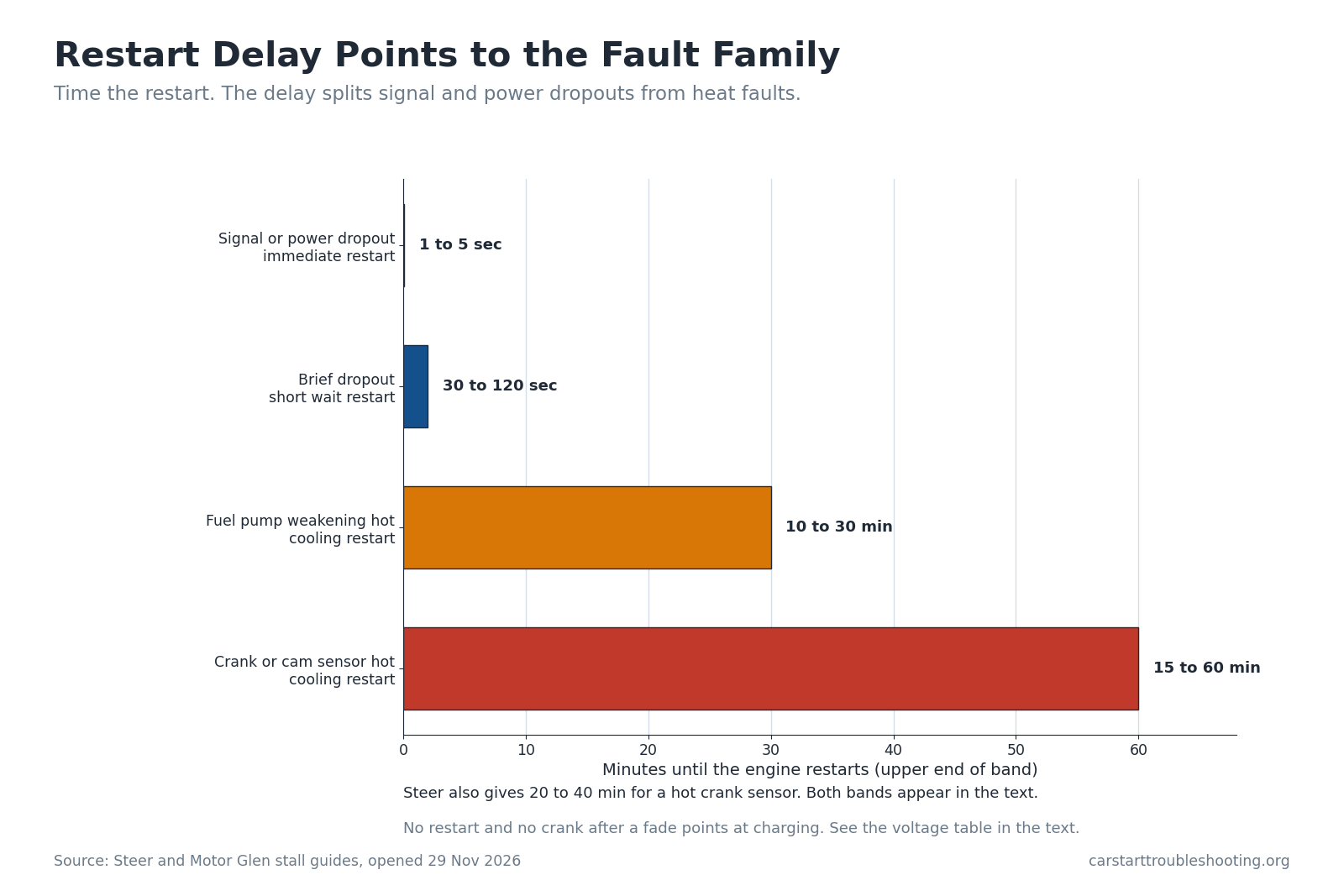
How the engine quit comes first, because an instant cut that feels like a turned key, with no stumble and no fade, points at lost spark, lost crank signal, or lost electrical power. Sputtering and fading over several seconds point the other way, toward fuel starvation under load, and Steer and Motor Glen draw that same dividing line in their stall guides. Restart timing comes second, and Motor Glen sorts restarts into an immediate band of 1 to 5 seconds, a short wait band of 30 to 120 seconds, and a cooling band of 10 to 30 minutes.
Steer adds a longer heat band on top of those figures, because a crank sensor that fails hot can need 20 to 40 minutes of cooling before it fires again. The hot stall guide from Steer widens that cooling band to 15 to 60 minutes for a crank or cam sensor, so this post prints both bands and asks you to trust your own stopwatch reading over either range edge. Dash behaviour comes third, since a dash that stayed lit points at sensor signal, ignition, or fuel delivery, while a dash that went dark, flickered, or reset points at power feed. Radio presets and a reset clock count as clues, and tach behaviour helps too, because a needle that drops to zero at the cut fits lost crank signal while a needle that falls with engine speed fits fuel starvation.
| What you noticed | Likely family | First check |
|---|---|---|
| Instant cut, restarts in seconds, dash stayed lit | Crank or cam signal dropout, wiring or ground | Stored and pending codes, live RPM while cranking |
| Instant cut, cranks with no fire, restarts after cooling | Heat sensitive crank sensor, ignition module or coil | Codes P0335 to P0339 and P0340, freeze frame coolant temperature |
| Instant cut, dash flickered or went dark, bump related | Ignition switch, main relay, battery cables or grounds | Terminal tug test, ground inspection, fuse box heat marks |
| Sputter and fade under load, worse hot or uphill | Fuel pump weakening hot, filter restriction | Fuel pressure under load, pump current draw |
| Fade after 15 to 30 minutes, instant restart after gas cap opens | Blocked fuel tank vent | Gas cap rush test, vent valve and vent filter check |
| Battery light first, slow fade, dim dash, no crank after | Alternator, battery, cables or grounds | Running voltage under load, voltage drop tests |
Keep a short log for the shop, because intermittent faults hide during a workshop visit and a written pattern gives the technician something solid to chase. Write the minutes from cold start to stall, the road speed, the fuel level, and the weather, then add the restart delay and any warning lights you saw. That log costs nothing, and it often decides which test runs first.
Cause 1: Crankshaft sensor dropout when hot
This branch leads the instant cut list, because the crankshaft position sensor tells the computer where the crankshaft sits and how fast it turns, and without that signal the computer has no reference for spark or injection timing. Carista states the job in plain terms, since the computer cannot time spark or injection without a clean signal, and Steer states the result with equal clarity, because no signal means no spark and no injection. The engine stops in one revolution, cleanly, the way a switched off engine stops.
Heat drives the classic failure, because the sensor works cold, then engine bay heat soaks the part until fine windings and solder joints expand and a hairline crack opens. Signal drops at that moment, cooling closes the crack again, and the car starts as if nothing happened, which explains the long roadside wait that so many drivers describe. Steer puts under hood temperatures well past 200 degrees Fahrenheit once the engine warms, and Carista lists the same root causes, with heat cycling cracking windings and electronics while oil and coolant leaks soak the sensor and its connector. Chafed wiring and corroded pins interrupt the signal through the same path, so the sensor body and its wiring deserve equal suspicion.
Codes help when they store, and Carista lists P0335, P0336, P0337, P0338 and P0339 for the crank circuit, with cam sensor codes near P0340 and misfire or correlation codes sometimes stored beside them. A complete dropout can leave no code at all, and Steer states that limit for hot crank failures, so scan anyway because pending codes and freeze frame data often survive the restart. Live RPM gives a strong clue during a no fire spell, since a reading of 0 RPM while the starter turns points at missing crank signal, and Carista and Motor Glen give the same check. Motor Glen adds a fair caveat, because some cars derive RPM differently and some tools lag, so treat 0 RPM as a clue and pair it with codes and wiring inspection.
Check wiring before you buy a sensor, because Carista gives that order for good reason, since wiring faults and reluctor faults set the same codes as a failed sensor. Look for oil soaking, rubbed insulation, loose plugs, and green pins, and remember that metal debris on a magnetic sensor can blur the signal while a wrong air gap after earlier repair work can weaken it. Bent or missing reluctor teeth can mimic sensor failure, so a sensor swap without that inspection can replace a good part and leave the fault untouched. Our P0336 code guide covers the erratic signal version of this fault, with hot stalls and cold restarts at its centre. Our crankshaft position sensor replacement cost guide splits the bill by access, because location drives labour more than the part price.
Honest disagreement belongs here, because AutoZone calls crank and cam sensors slightly less common among general stalling causes, while stall specific guides rank the crank sensor first for an instant cut with a restart. Both statements can hold at once, since ranking depends on the pattern in front of you, and a sputter stall rarely starts with this sensor while an instant cut often does. Match the branch to your quit pattern rather than to a universal ranking.
Cause 2: Ignition switch, main relay, or ECU power dropout
This branch mimics a hand on the key, because power to the computer, coils, injectors, or fuel pump breaks for a fraction of a second, the engine dies cleanly, power returns, and the engine restarts cleanly. Dash flicker, a dark cluster, or a reset radio separates this branch from sensor loss, since sensor loss leaves the dash powered while power loss takes the dash with it. Engineer Fix describes worn ignition switch contacts that separate under vibration from bumps or steering movement, cutting power to ignition and fuel until the contacts snap back together and the engine fires again at once.
Motor Glen adds the key wiggle clue, because a stall tied to bumps or slight key movement raises this branch, and a heavy keychain can add wear on older cars over years of swinging loads. Steer lists the same suspect set together, with a chafed wiring loom, a bad ground, and worn switch contacts sharing one branch. Battery cables and grounds belong here too, since a terminal you can turn by hand can break contact over a bump, and a corroded ground strap at the block can do the same without warning.
Engineer Fix explains the instant recovery through clamp spring tension, because the cable reconnects on its own and power returns in a blink while dash lights flicker or reset. Main relays wear the same disguise, and Motor Glen names the variants across makes, including EFI relay, ECM relay, PGM-FI main relay, and ASD relay. A flaky main relay can cut computer power with no helpful code, because the computer lost power and had no chance to log the event. Heat marks in the fuse box, loose fuses, and melted plastic around high current connections support this branch.
Driveway checks stay simple, and each one takes seconds, so tug each battery terminal by hand, inspect the negative cable at the body and at the engine, and seat each relay and fuse firmly. Look for heat discoloration in the fuse box, then wiggle the key gently at idle in Park while you watch the dash, because any flicker or stall during that wiggle deserves a full inspection. Stop driving if the dash goes dark at speed, since that pattern risks a stall in the worst possible place.
Cause 3: Fuel pump relay that drops out
The relay branch sits between power loss and fuel loss, because the pump itself may stay healthy while its power feed fails, and that split explains why this fault fools drivers into buying pumps. Engineer Fix explains the mechanism through heat soak, since high engine bay temperatures expand relay internals until contacts separate or the coil warps, while arcing pits the contact faces over time and resistance rises with heat. Vibration cracks solder joints or separates pitted contacts, power breaks for a fraction of a second, the pump starves, and the engine cuts.
Timing fits heat, and Motor Guy puts relay stalls after 10 to 20 minutes of driving, sometimes with a click under the dash at the cut. Engineer Fix describes the prime sound test, because a healthy pump gives a brief two to three second whir at key on, while a prime sound that comes and goes across key cycles points at the relay circuit. Listen at the rear of the car with a helper at the key, and repeat the cycle several times, since one silent cycle among noisy ones carries real weight.
The swap test costs nothing, so find the fuel pump relay in the fuse box and swap it with an identical non essential relay, since horn and air conditioning clutch relays often match. Engineer Fix gives that method, and the logic stays clean, because a stall that moves or vanishes after the swap convicts the original relay, while a horn that dies after the swap shows the fault moving with the relay. Match part numbers and pin layouts exactly, and put relays back with care once the test ends.
A multimeter settles stubborn cases, and Engineer Fix gives coil resistance across pins 85 and 86 at 50 to 120 ohms for a healthy coil. Energized contacts across pins 30 and 87 should read under 1 ohm, while high or shifting resistance points at pitted contacts, and pin numbers vary by relay design so read the diagram printed on your relay case. Inspect the socket too, because corrosion or melted terminals add resistance and heat the next relay. Motor Glen draws a useful line here, since a two second restart with no extra cranking fits an electrical interruption better than a worn out pump, while long cranks, lean codes, and power loss under load fit pump wear.
Cause 4: Fuel pump weakening hot, or a restricted filter
Fuel faults warn you first, because sputtering under load leads the list, hesitation on hills and highway merges follows, and symptoms worsen on hot days and with the tank below one quarter. Steer explains the low tank link through cooling, since fuel around the pump cools it and less fuel means less cooling. A worn pump fails hot through two paths, and Steer describes both, because the motor draws more current and moves less fuel as it heats while warm fuel vaporizes more easily at the inlet. Pressure sags, the engine fades, and cooling restores output for a while, so restarts after 10 to 30 minutes fit this branch in the Steer hot stall table.
Filter restriction adds load sensitivity, and AutoZone calls the filter the easiest and least expensive fuel part to replace where it sits outside the tank. Flow that passes at cruise can fail under acceleration demand, and Motor Guy links hesitation before the stall to filter restriction, so location matters because many filters sit inside the tank module. Your manual governs service access, so check that page before you assume a roadside filter swap exists on your car.
Proof needs pressure data, because a shop gauge on the rail during a road test shows sag as heat builds, and pump current draw adds a second view of the same failure. Lean codes P0171 and P0174 support the branch, and a rail pressure code such as P0087 supports it on cars with that sensor, while sound alone proves little since a pump can hum and still fail under load. Our bad fuel pump symptoms guide orders the fuel tests for this branch, and long cranks with the stall raise fuel delivery on the list while clean instant cuts lower it. Keep the tank fuller while you arrange diagnosis, because that habit helps a hot pump and costs one fuel stop.
Cause 5: Charging fade from alternator, battery, or cables
Charging failure gives the clearest warning, because the battery light comes on first, the car runs on battery alone, and Steer puts that window at five minutes to half an hour depending on load. The dash dims, the blower slows, the radio cuts out, the engine dies, and cranking fails or crawls, so that slow fade differs from every instant cut above. Voltage numbers settle the branch, and Steer gives a healthy running band of 13.5 to 14.7 volts, with under about 12.8 volts running meaning the system fails to charge.
AutoZone gives 13.5 to 14.5 volts for normal operation, and Motor Guy gives the same 13.5 to 14.5 volt test band, so this post prints all three figures. The bands overlap, and a reading inside the overlap passes every source, while a reading under 12.8 fails every source. Test with the engine running and loads on, because headlights, blower, and rear defroster load the system in a way that exposes weak charging.
| Running voltage reading | Meaning across opened sources |
|---|---|
| 13.5 to 14.5 volts | Healthy band in AutoZone and Motor Guy, inside the Steer band |
| 13.5 to 14.7 volts | Healthy band in Steer |
| Under about 12.8 volts | Fails to charge, per Steer |
| Below 12 volts | Severe drop with stall risk, per AutoZone |
A voltage drop test across each cable and the engine ground finds resistance that a single voltage reading can miss, and Steer lists that test among the cheapest first checks. Loose terminals can mimic alternator failure, so clean and tighten before you condemn the alternator. Our can you drive with a bad alternator guide works the battery alone maths, our bad alternator symptoms guide lists the warning order, and our battery or alternator test guide gives three readings that split battery faults from charging faults. If the battery also dies overnight, separate that fault with our car battery keeps dying guide.
Cause 6: Air measurement, tank vent, and coolant temperature errors
These faults stall cars, and they fit the instant restart pattern less often, so rank this branch after signal, power, relay, pump, and charging checks for a clean cut. Engineer Fix states the limit for airflow faults, because a mass airflow fault rarely causes the immediate restart seen with electrical failure, and rough running usually comes first. AutoZone describes the airflow path, since the mass airflow and manifold pressure sensors measure incoming air and the computer sets fuel from that data, so wrong data drives the mixture lean or rich until combustion fails.
Motor Guy adds code P0101 for airflow range faults and lists rough idle with lean codes, and a split intake boot or a vacuum leak can set the same code. Cleaning or replacing the sensor without checking the intake path wastes money, because the sensor may report a real air leak with perfect accuracy. Tank vent blockage follows a clock, since fuel leaves the tank and air must enter to replace it, while a stuck vent valve or a clogged vent filter blocks that air until vacuum builds. After 15 to 30 minutes the pump pulls against that vacuum and loses. Steer gives a driveway test for this branch, because a long inward rush of air at the gas cap with an instant restart convicts the vent path while a short hiss is normal.
Coolant temperature errors stumble rich, and Steer lists the pattern, because the engine stumbles as it warms, fuel smell appears, and hot restart stays hard. Freeze frame data helps here, since an implausibly cold coolant reading on a hot engine points at the temperature sensor, and the computer adds fuel for a cold engine that already runs hot. Plugs foul under that extra fuel, and restarts drag until the mixture corrects.
Vapor lock needs honest placement, because Motor Guy lists it for hot weather stalls with a gas smell and ties it to carbureted or older cars in the same guide. Modern injected systems run fuel at pressure, so vapor lock sits low on the list for a modern car, and prime, pressure, and vent checks come first on injected cars. Immobilizer faults sit low for highway stalls too, since Steer notes that a security module losing confidence in the key cuts fuel with a flashing security light. Motor Glen adds that security faults usually cause start and die behaviour in the driveway. A flashing security light during a highway stall still deserves a scan, and driveway start and die faults need a different flow.
The driveway order, cheapest first
Scan first, even with no light on, because stored codes and pending codes together tell a fuller story than either set alone. Read freeze frame data where it exists, since coolant temperature, engine speed, load, and road speed at the fault help split heat faults from fuel faults. Engineer Fix notes that brief signal losses often store as pending or historic codes, so clear nothing before you record what the scan shows.
Watch live RPM during cranking after a stall, because zero RPM pushes crank signal up the list while RPM present with no spark pushes ignition output up the list, and Motor Glen gives that split. A helper at the dash adds a second view, since tach needle movement while cranking counts as data. Inspect power paths next, so tug terminals, check grounds at body and engine, seat relays and fuses, and look for melted plastic and heat marks. Listen for the two to three second pump prime across several key cycles, swap the fuel pump relay with an identical relay where the layout allows it, and note every change, because one change at a time keeps the result readable.
Run the gas cap test after a fade stall, time the restart delay with a clock, and record fuel level and outside temperature alongside running voltage with loads on. Those four habits cost nothing, and together they cover vent, heat, fuel level, and charging branches. Shops add three deeper tests, since an oscilloscope catches momentary signal drops that a scan tool can miss, and Engineer Fix names that tool for ignition and sensor circuits. A fuel pressure gauge on a road test catches hot sag, a voltage drop test under load catches cable and ground resistance, and paying for that order beats paying for parts, because intermittent stalls punish guesswork.
One free check stands apart, so run the VIN for open recalls before you authorize expensive work. Steer raises that step in both stall guides, because stalling defects appear among commonly recalled faults, and the manufacturer pays for recall repairs at any age or mileage. If the car now cranks with no start and stays that way, the pattern has changed, and our car cranks but wont start guide orders fuel, spark, and compression checks for a persistent no start. If stalls strike only at stop lines, use our car stalls when braking to a stop guide, because booster vacuum and idle control lead that pattern while highway cuts follow the branches above.
Repair costs, cheapest first
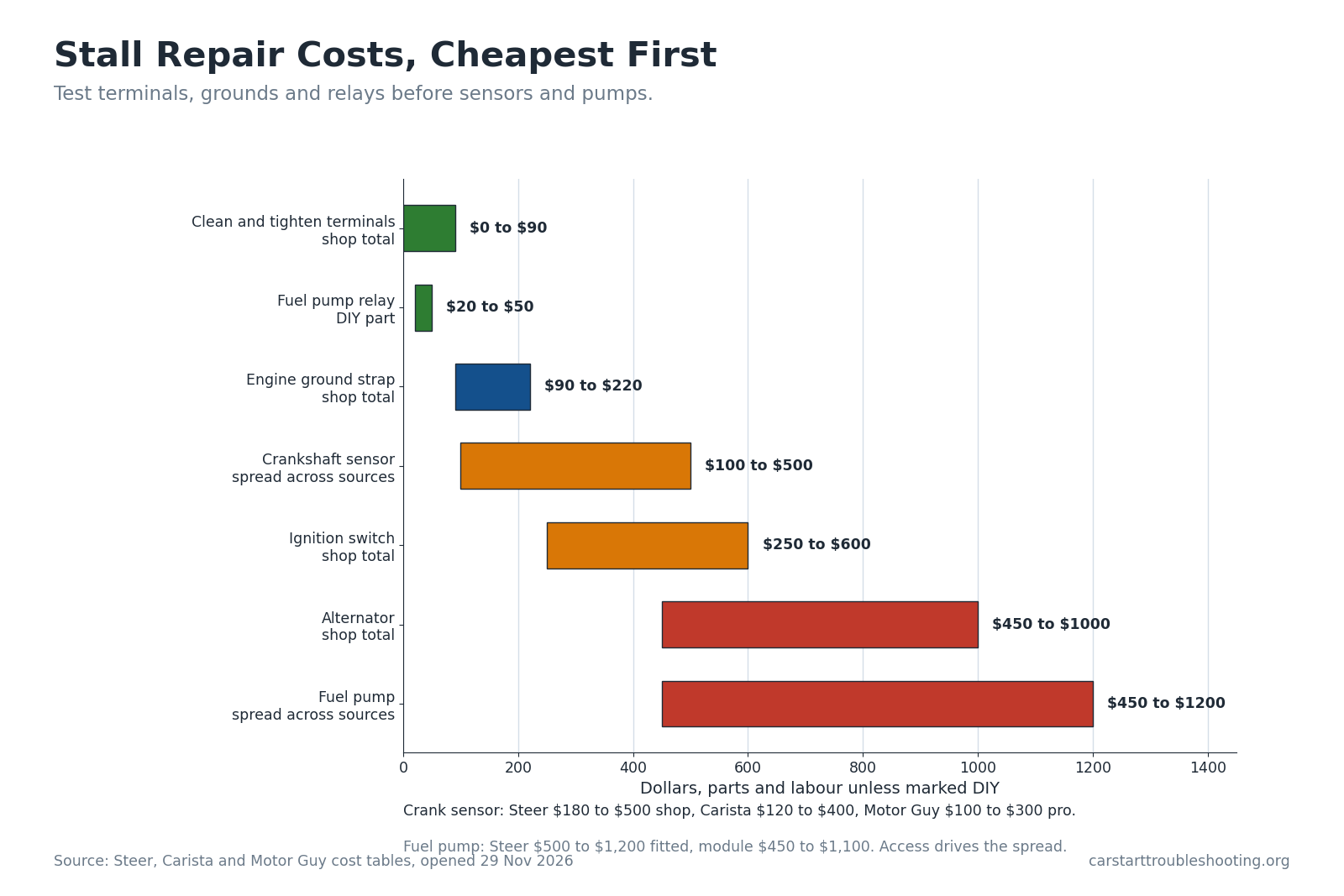
Costs only help in the right order, because terminals and grounds come before sensors and relays come before pumps. Opened sources disagree on several totals, so this section prints the spread and budgets with the wider end until diagnosis narrows the fault. Steer lists parts and shop totals side by side. Terminal cleaning runs $0 to $25 in parts and $0 to $90 at a shop, while a ground strap runs $15 to $50 in parts and $90 to $220 fitted. A battery runs $130 to $300 in parts and $180 to $400 fitted in the same table. An ignition switch runs $60 to $250 in parts and $250 to $600 fitted in that table, while an alternator runs $180 to $450 in parts and $450 to $1,000 fitted.
Crank sensor totals spread wider, because Steer lists $30 to $150 in parts and $180 to $500 at a shop, while Carista lists $120 to $400 total with parts at $20 to $150. Carista also warns that totals can exceed $600 where the sensor sits behind the flywheel or transmission, and Motor Guy lists $100 to $300 for professional replacement with $35 to $100 for do it yourself work. Access explains most of that spread, since a front mounted sensor swaps fast while a buried sensor eats labour.
Fuel side totals spread too, because Steer lists an in tank fuel pump at $180 to $600 in parts and $500 to $1,200 fitted, while the Steer hot stall guide lists a fuel pump module at $450 to $1,100. A tank vent valve or vent filter runs $120 to $350 in that guide, a coolant temperature sensor runs $90 to $250, a camshaft sensor runs $100 to $300, and an ignition module or coil runs $150 to $500. Relay money stays small, since Motor Guy lists a bad fuel pump relay impact at $20 to $80 and replacement at $20 to $50 for do it yourself work. That gap matters, because a relay test costs minutes while a pump job costs hundreds.
Towing belongs in the budget talk, because Motor Guy puts towing at $100 to $200, and one tow beats a second stall across traffic. Diagnosis fees vary by shop, since freeze frame data, live data, pressure tests, and a road test take time. That time costs less than a wrong pump or a wrong sensor.
Questions drivers ask next
Why does my car die while driving then restart at once? An instant cut with a fast restart points at a signal or power dropout, and crank and cam sensors, chafed wiring, grounds, ignition switch contacts, and relays lead that list. Scan stored and pending codes first, watch live RPM while cranking, and inspect wiring and terminals before you buy parts.
Why does my car restart only after cooling for 20 minutes? Heat sensitive parts fit that delay, because a crank sensor with a cracked winding fails hot and recovers cool, while ignition modules and coils follow the same pattern on older cars. A fuel pump weakening hot restarts after 10 to 30 minutes in opened tables, so time the delay and match it to the table near the top of this guide.
Can a bad alternator cause a stall with a restart? A failing alternator usually fades rather than cuts, because the battery light comes first, lights dim over five minutes to half an hour, the engine dies, and cranking fails. A jump start can revive it briefly, and running voltage under load settles the question, since under about 12.8 volts running means the system fails to charge.
Will a stall always leave a code? No, because brief dropouts can store pending codes while power loss can leave no code since the computer lost power. Steer notes that a complete crank dropout can leave no code, so scan anyway, because freeze frame data and live RPM help where codes stay silent.
Is it safe to keep driving after one stall? Drive home at most, and only with care, because every cause here worsens with time and the risk sits in the next stall location. Turns across traffic, merges, and tunnels remove assist at the worst moment, so tow when the stall repeats, the dash goes dark, or the battery light led the stall.
How do I tell a fuel pump stall from a crank sensor stall? Watch the quit, because fuel faults sputter and fade under load while crank signal loss cuts like a switch. Watch the restart too, since fuel faults often need more cranking while signal dropouts can restart in seconds, and pressure data with live RPM confirms the split.
Sources
- Steer guide to cars dying while driving (opened 29 November 2026)
- Steer guide to cars running a few minutes then dying (opened 29 November 2026)
- Motor Guy guide to cars shutting off while driving then restarting (opened 29 November 2026)
- Motor Glen guide to stalls while driving then restarting (opened 29 November 2026)
- Engineer Fix guide to cars turning off and on while driving (opened 29 November 2026)
- Engineer Fix guide to intermittent fuel pump relays (opened 29 November 2026)
- Carista crankshaft position sensor symptoms and cost guide (opened 29 November 2026)
- AutoZone guide to stalling while driving (opened 29 November 2026)
Automotive Safety Notice
Lead-acid batteries produce flammable hydrogen gas and contain corrosive sulfuric acid. Always wear ANSI-rated eye protection, disconnect the negative terminal before electrical servicing, and consult an ASE-certified technician for fuel leaks or high-voltage hybrid systems.

Alexander Reed, MEng
Automotive engineer (MEng, 2021) specializing in no-start diagnostics, parasitic draw isolation, and starter-charging systems.
Verified Gravatar Profile ↗
Reader Discussion & Questions
0 Comments