
Table of Contents (10 Sections)
You added fuel. The engine cranks. It still will not fire. That pattern after a dry tank usually means air sits in the fuel lines and the pump has lost prime.
Do the restart in order. Add enough fuel first. Prime the pump with key cycles next. Crank in short bursts after that. Skipping the prime step makes most drivers crank a dry line for a full minute and flatten the battery.
No bench test stands behind this guide. Every amount, cycle count and crank limit below comes from a Ford owner manual page, a Ram diesel manual page, an AAA guide, or a named source opened for this post and listed in Sources with its read date. Where two sources disagree, this post prints both numbers.
Why a dry tank stops the next start
A modern gasoline car carries its electric fuel pump inside the tank. Fuel around the pump cools it. Fuel through the pump lubricates it. AAA states both points in its quarter tank guide.
When the tank runs dry, the pump draws air in place of fuel. Air compresses under pressure. Liquid fuel does not. The pump must push that air out and refill the lines before pressure at the injectors returns to normal.
The Ford owner manual page for running out of fuel gives the plain version. Add fuel. Switch the ignition off and on several times. Expect cranking to take a few seconds longer than normal. That longer crank comes from the refill work the pump still has to finish.
A single dry event rarely kills a healthy pump at once. Heat builds while the pump runs without fuel around it. Repeated low tank driving adds that heat again and again. AAA links that pattern to a shorter pump life and to repair bills in the hundreds of dollars.
Sediment adds a second risk. Dirt and rust particles settle near the tank floor over time. A dry pickup can stir that layer and pull it toward the filter. AAA says low fuel makes that pickup more likely. A filter that passed fuel last week can choke flow this week.
Step one: add enough fuel, then add a little more
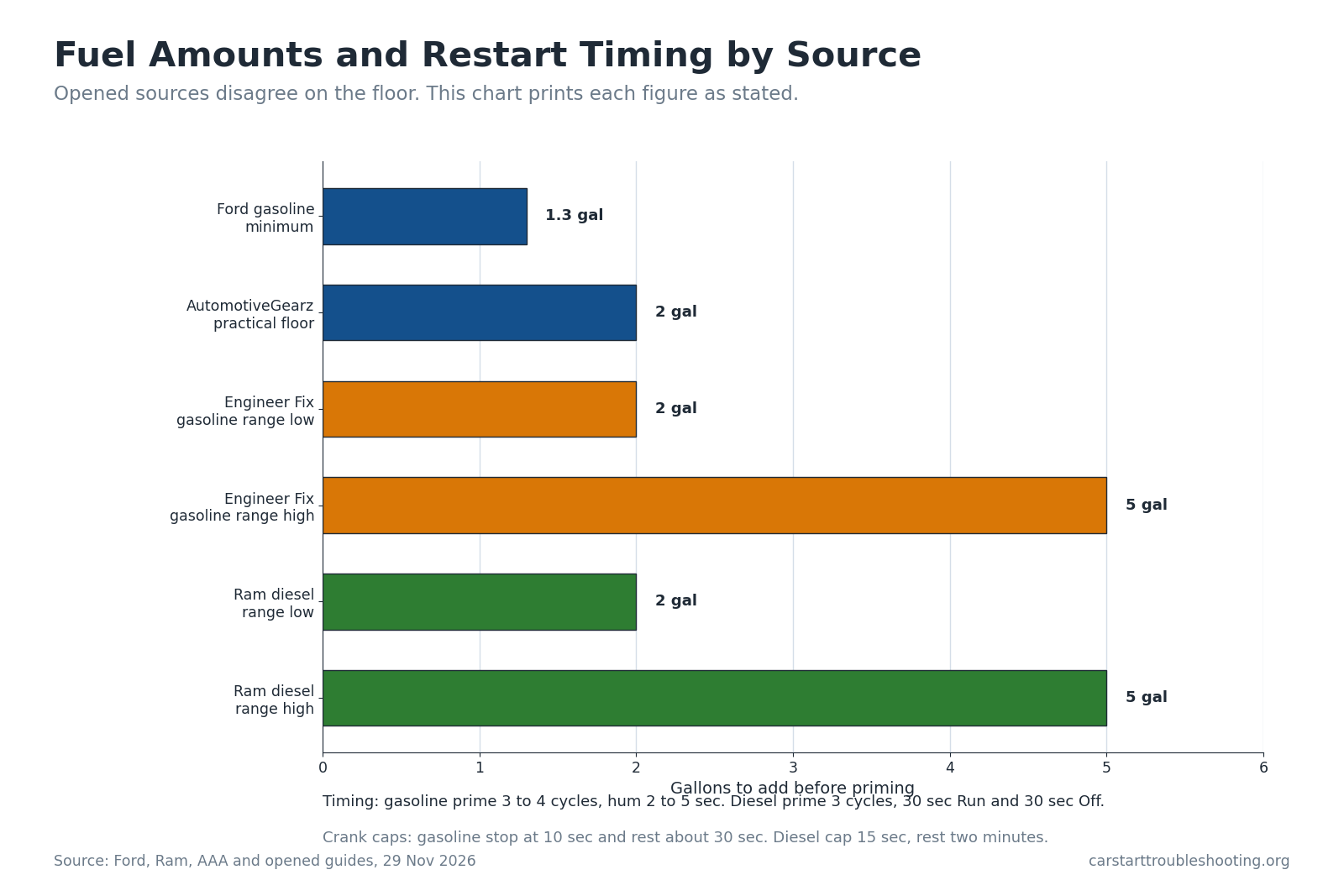
Ford sets the gasoline minimum at 1.3 gallons, or 5 litres, to restart the engine. Ford adds a slope warning. A car parked on a steep slope may need more fuel before the pickup stays covered.
Other opened guides land in the same band with slightly different floors. One gasoline guide puts the practical floor at 1 to 2 gallons and calls 2 gallons the safer minimum. A second guide says add at least 2 to 5 gallons before priming. Print those numbers side by side and the rule stays clear. One gallon from a small can often leaves the pickup half exposed on a slope or in a wide flat tank.
Use 2 gallons as your working floor for a gasoline car on level ground. Use more on a slope. Then drive straight to a station and fill the tank past one quarter. AAA uses one quarter as the daily floor for pump cooling. A half tank gives 150 to 200 miles in most cars by AAA count, and that reserve matters on a long trip.
| Source opened for this post | Fuel amount stated | Slope note |
|---|---|---|
| Ford owner manual, gasoline | Minimum 1.3 gal (5 L) | More fuel may be required on a steep slope |
| Gasoline restart guide, AutomotiveGearz | At least 1 to 2 gal, 2 gal practical minimum | No slope figure stated |
| Check engine light guide, Engineer Fix | At least 2 to 5 gal | No slope figure stated |
| Ram manual, diesel | About 2 to 5 gal (8 L to 19 L) | No slope figure stated on that page |
That table holds the honest spread. Ford gives the lowest floor. The other guides push higher. Your tank shape and parking angle decide which end of the spread you need.
Fuel can safety before you pour
Ford prints the container rules on the same page. Use an approved fuel container only. Place the container on the ground while you fill it. Keep the nozzle in contact with the container. Never fill a container inside the vehicle. Static from fuel flow can spark a fire in an ungrounded container, and Ford states that risk in plain words.
Cars with a capless filler need the funnel supplied with the car. Ford warns against aftermarket funnels on that system. A wrong funnel can damage the capless inlet and turn a fuel stop into a repair.
Step two: prime the pump before you crank
Priming means you run the electric pump in short bursts without engaging the starter. Each burst pushes liquid fuel forward and moves air toward the engine. Pressure builds in steps.
Follow this sequence on a gasoline car with a key or a push button.
- Turn the ignition to On or Run. Stop before Start. On a push button car, press the button without your foot on the brake so the dash wakes and the engine stays off.
- Listen near the rear of the car. A healthy pump gives a low hum or buzz for about 2 to 5 seconds, then stops.
- Turn the ignition fully Off. Wait a few seconds.
- Repeat the On and Off cycle 3 to 4 times. Some opened guides say 3 to 5 cycles. Ford says switch off to on several times and gives no fixed count.
- Crank the engine only after those cycles finish.
That hum check splits the job in half. A pump that hums on each cycle can build pressure once air clears. A pump that stays silent on every cycle points to a power fault, a relay fault, or a dead pump. More cranking fixes none of those three.
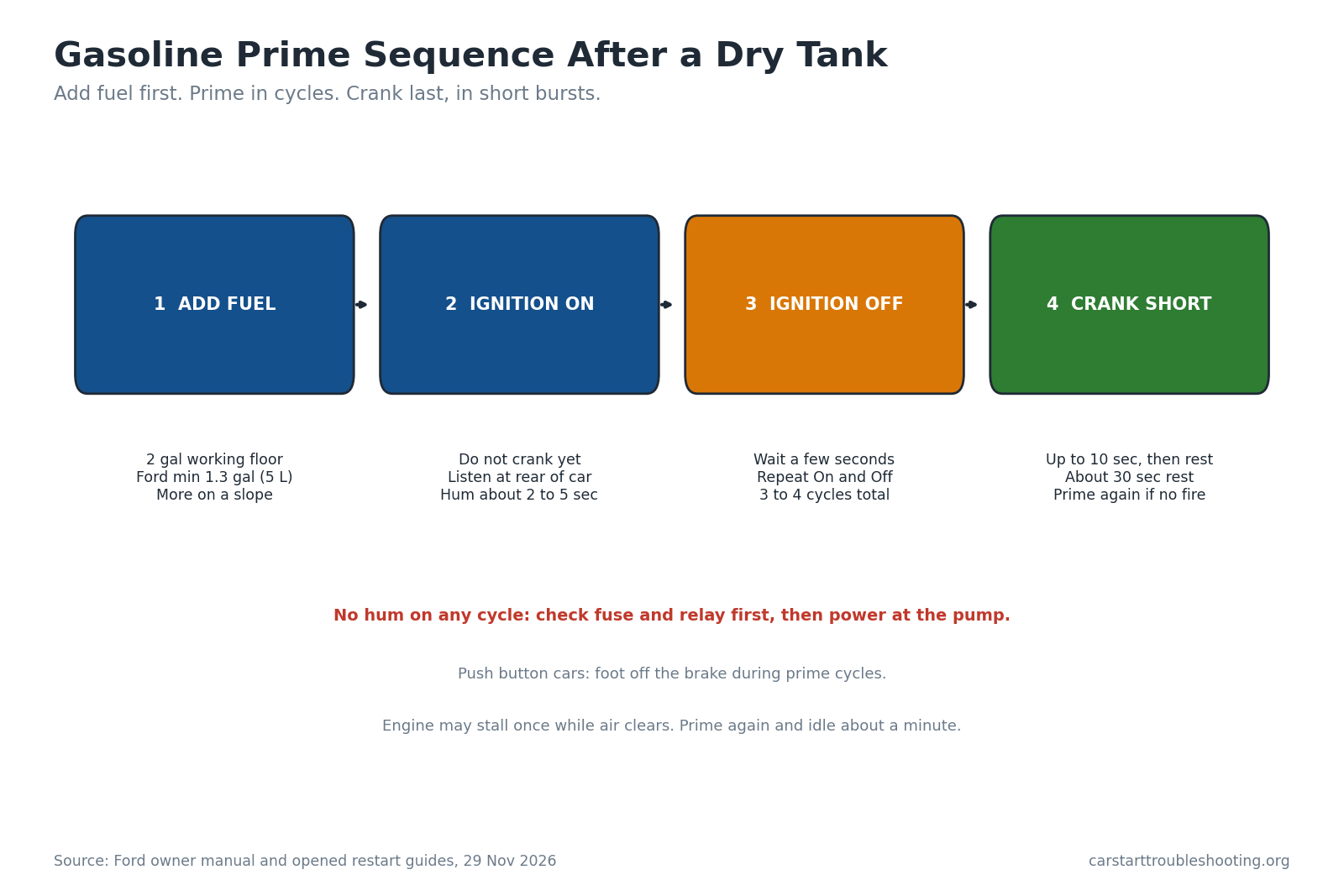
Push button cars need one extra care point. A foot on the brake turns a button press into a start attempt. Keep your foot off the brake during prime cycles. Our push button start diagnosis covers the brake switch side of that system.
Step three: crank in short bursts, then rest
Ford expects a few extra seconds of cranking on the first restart. Opened guides put the first crank at up to 10 to 15 seconds. Stop at 10 seconds if the engine shows no sign of firing. Rest the starter for about 30 seconds. Prime again, then crank again.
Long cranking carries two costs. The starter motor heats fast under load. The battery voltage drops with each long pull. A weak battery then cranks slower, and slow cranking makes a fuel fault look worse than it is. Our battery or alternator test guide gives three voltage readings that settle the battery side before you blame the pump.
The engine may catch, run rough for a few seconds, and stall once. Air pockets clearing the rail cause that stumble. Prime once more and restart. Let the engine idle for about a minute before you drive. A smooth idle tells you pressure has steadied. A rough idle that will not settle sends you to the fault split below.
Do not hold the starter for 30 seconds at a stretch. No opened source supports that habit. Every source caps the crank or adds a rest. Follow the cap.
If it still will not start: split by sound, then by codes
Work this split in order. Each branch ends in a test, and each test rules one cause in or out.
| What you find | Likely cause | Next test |
|---|---|---|
| No pump hum on any prime cycle | Pump power fault, relay fault, or dead pump | Check the fuel pump fuse and relay first, then test for power at the pump |
| Pump hums, engine cranks fast, no start | Air still in lines, clogged filter, or weak pump output | Prime 2 more cycles, then check fuel pressure with a gauge |
| Engine starts, stalls, then restarts | Last air pockets clearing, or low fuel still uncovering the pickup | Add more fuel, prime again, and watch the idle for a full minute |
| Engine runs rough under load | Filter restriction from stirred sediment, or pump output falling | Pressure test under load and a filter check |
| Cranking slows with each attempt | Battery drained by long cranks | Charge or jump the battery, then repeat the prime sequence |
A pressure gauge gives the cleanest answer on the middle rows. Our bad fuel pump symptoms guide lists the tests in order for a pump that hums but delivers weak pressure. A pump can hum and still fail under load. Sound alone never proves output.
The filter branch deserves care. Many modern cars carry the filter inside the tank module with no service interval on the outside. A shop can test pressure before and after the filter path where the design allows it. Do not open fuel lines at the roadside. Fuel under pressure sprays, and a hot engine bay adds fire risk.
Vapor lock sits lower on the list for modern injected cars. One opened guide raises it for hot days and suggests a 20 to 30 minute cool down. Treat that as a last branch after prime, pressure and filter checks. A car that failed on a mild day after a dry tank almost always has air, pressure, or filter trouble first.
The check engine light after a dry tank
Fuel starvation can log fault codes while the engine misfires on a lean mix. One opened guide names three families. P0300 covers random or multiple cylinder misfires. P0171 and P0174 cover system too lean on each bank. Low fuel pressure codes sit in the P02XX range.
Those codes often arrive with the dry event and clear after normal running returns. The same guide puts self clearing at three to five successful drive cycles for temporary codes. A drive cycle means a start, a drive under varied conditions, and a shutdown.
Read the codes before you clear anything. A code reader shows which family logged. Clear the codes only after the car runs smooth and the codes match the starvation event. A light that returns at once, rough running that stays, or power loss that stays points past the dry tank. That pattern needs pump and pressure testing at a shop.
A flashing check engine light means active severe misfire. Stop driving and arrange help. Raw fuel reaching the catalyst can overheat it. That warning stands apart from a steady light after a dry tank.
Our cranks but will not start guide orders fuel, spark and compression checks for a car that still refuses after fuel pressure checks out.
Diesel cars follow a stricter restart
Diesel fuel systems must purge air before injection works at all. AAA states that point directly and calls the purge work labor heavy and costly at times. Never run a diesel tank dry if you can avoid it.
The Ram manual page for a Cummins diesel gives exact steps. Add about 2 to 5 gallons. Complete three priming cycles before cranking. Each cycle runs the ignition at Run for about 30 seconds, then Off for at least 30 seconds. Crank after the third cycle. Let the engine idle for at least 30 seconds after it starts.
Ram caps cranking at 15 seconds per attempt. Allow two minutes between attempts. The engine may run rough until air leaves the lines. That rough spell matches the gasoline pattern with a longer prime in front of it.
Older diesel designs add a hand primer or a bleed screw at the filter housing. One opened guide describes pumping a primer bulb until it firms up, then bleeding air at the filter until fuel flows without bubbles. Your owner manual names the exact hardware on your engine. Follow that page over any general guide, this one included.
Never open a high pressure diesel fuel system with the engine running. Ram prints that warning at the top of its priming page. High pressure spray can cause grave injury.
Damage check after the restart
Drive the next few days with the dry event in mind. Watch for four signs.
- A louder whine from the tank area than you recall from before
- Sputtering or power loss on hills or hard acceleration
- Longer cranking on the first start of the day
- A check engine light that returns after you cleared starvation codes
Any one sign can have other causes. Two signs together after a dry tank raise the pump and filter on the suspect list. A pressure test settles it faster than guesswork.
One more habit protects the next pump. Refill at one quarter tank. AAA recommends that floor for daily driving and a half tank for travel. The fuel left in the tank keeps the pump covered, cool and lubricated. Prevention costs a fuel stop. A pump job costs hundreds of dollars by AAA count, plus a tow if the pump fails away from home.
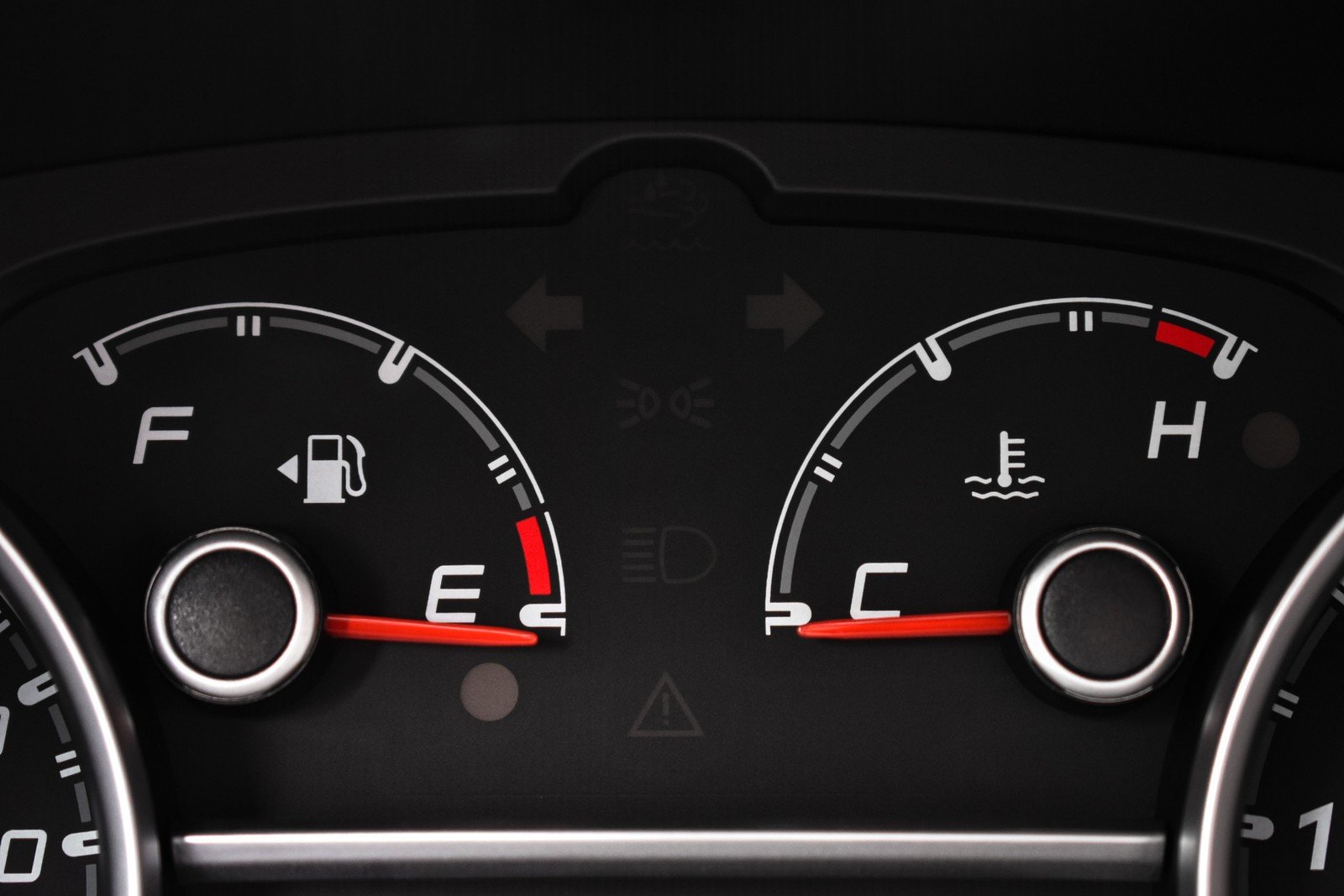
Check the gauge habit as well. A gauge that reads high at empty strands drivers who trust it. Learn your car range per tank from the trip meter for a few fills. That backup number warns you when the gauge lies.
Sources
- Ford owner manual, running out of fuel, gasoline, read 29 November 2026. Minimum 1.3 gal (5 L), slope note, switch ignition off to on several times, longer cranking, container and capless funnel rules.
- Ram manual, priming if the engine has run out of fuel, diesel, read 29 November 2026. About 2 to 5 gal (8 L to 19 L), three cycles of about 30 seconds at Run and at least 30 seconds Off, idle at least 30 seconds, crank cap 15 seconds with two minutes between attempts, high pressure warning.
- AAA Club Alliance, never let your gas tank drop below a quarter, read 29 November 2026. Pump cooling and lubrication, sediment pickup at low fuel, water in the tank, quarter tank floor, half tank 150 to 200 miles, diesel air purge warning, pump replacement in the hundreds of dollars.
- AutomotiveGearz, how to start your car after running out of gas, read 29 November 2026. At least 1 to 2 gal with 2 gal practical minimum, prime 3 to 4 cycles at 5 to 10 seconds, pump hum about 2 to 3 seconds, crank up to 10 to 15 seconds with a 30 second rest, stall once or twice while air clears, diesel hand primer and bleed steps, vapor lock cool down 20 to 30 minutes.
- Engineer Fix, ran out of gas and now my check engine light is on, read 29 November 2026. At least 2 to 5 gal, prime 3 to 5 cycles at 3 to 5 seconds, P0300 and P0171 and P0174 and P02XX code families, self clear after three to five drive cycles.
Automotive Safety Notice
Lead-acid batteries produce flammable hydrogen gas and contain corrosive sulfuric acid. Always wear ANSI-rated eye protection, disconnect the negative terminal before electrical servicing, and consult an ASE-certified technician for fuel leaks or high-voltage hybrid systems.

Alexander Reed, MEng
Automotive engineer (MEng, 2021) specializing in no-start diagnostics, parasitic draw isolation, and starter-charging systems.
Verified Gravatar Profile ↗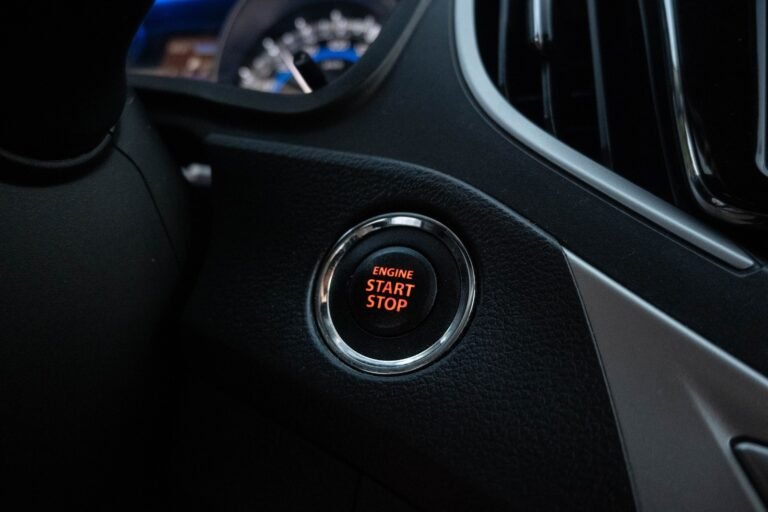


Reader Discussion & Questions
0 Comments